How Did We Get To The Speed Of Light?

Every high school physics student knows c, or the speed of light, it’s 3 x 10^8 metres per second. More advanced or more curious students will know that this is an approximation, and the figure of 299,792,458 metres per second that forms the officially accepted figure comes from a resonance of the caesium atom from which is derived a value for the second.

Galileo
Galileo Galilei, whose presence in this story should come as no surprise. Justus Sustermans, Public domain.

But for those who are really curious about measuring the speed of light the question remains: Just how did we arrive at that figure and how long have we been measuring it? The answer contains some surprises, and some exceptionally clever scientific thought and experimentation over the centuries.

The nature of light and whether it had a speed at all had been puzzling philosophers and scientists since antiquity, but the first experiments performed in an attempt to measure it were you will not be surprised to hear, performed by Galileo sometime in the early 17th century. His experiment involved his observation of assistants uncovering lanterns at known distances away, and his observations  failed to arrive at a figure.

Later that century in 1676 the first numerical estimate of the speed of light was made by the Danish astronomer Ole Rømer, who observed an apparent variation in the period of one of Jupiter’s moons depending upon whether the Earth was approaching it or moving away from it. From this he was able to estimate the time taken for light to cross the Earth’s orbit, and from there the mathematician Christiaan Huygens was able to produce a figure of 220,000,000 metres per second.

Spinning Cogs And Mirrors: Time Of Flight
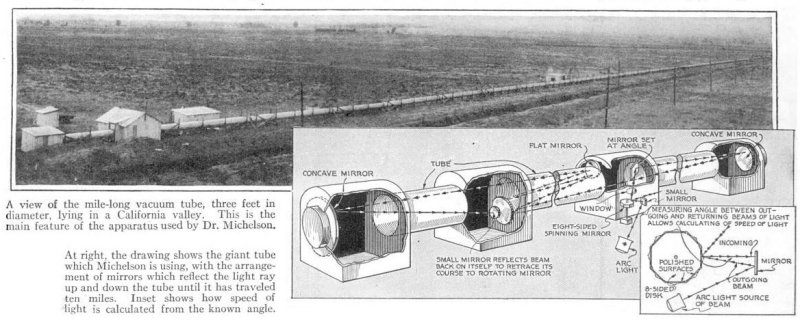
The mile-long evacuated tube used in Michelson's time-of-flight experiment. H.
The mile-long evacuated tube used in Michelson’s time-of-flight experiment. H. H. Dunn, Public domain.

The experiments with which we will perhaps be the most familiar are the so-called time of flight measurements, which take Galileo’s idea of observing the delay as light travels over a distance, and bring to it ever higher precision. This was first performed in the middle of the 19th century by the French physicist Hippolyte Fizeau, who reflected a beam of light from a mirror over several kilometres, and used a toothed wheel to chop it into pulses. The pulses could be increased in frequency by moving the wheel faster until the time taken for the light to travel the distance from wheel to mirror and back again matched the separation between teeth and the returning pulse could be observed. His calculation of 313,300,000 metres per second was successively improved upon through the work of succession of others including Léon Foucault, culminating in the series of experiments by the American physicist Albert A. Michelson in the 1920s. Michelson’s final figure stood at 299,774,000 metres per second, measured through a multi-path traversal of a mile-long evacuated tube in the California desert. In the second half of the century the techniques shifted to laser interferometry, and in the quest to define the SI units in terms of constants, eventually to the definition mentioned in the first paragraph.

The most fascinating part of the story probably encapsulates the essence of scientific discovery, namely that while to arrive at something takes the work of many scientists building on the work of each other, it can then often be rendered into a form that can be understood by a student who hasn’t had to pass through all that effort. We could replicate Fizeau and Michelson’s experiments with a pulse generator, laser diode, and oscilloscope, which while of little scientific value nearly a century after Michelson’s evacuated tube, is still immensely cool. Has anyone out there given it a try?

Header image: Tommology, CC BY-SA 4.0.
The Light Guide Hiding In Your Extrusion

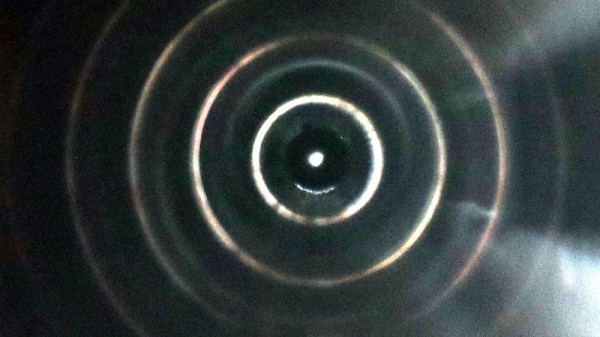
There should be a line of jokes that start “A physicist and an engineer walk into a bar…”. In my case I’m an engineer and my housemate is a physicist, so random conversations sometimes take interesting turns. Take the other day for example, as one does when talking she picked up a piece of aluminium extrusion that was sitting on our coffee table and turned it over in her hands. It has a hole down its centre and it’s natural to peer down it, at which point her attention was caught by the appearance of a series of concentric rings of light. Our conversation turned to the mechanism which might be causing this, and along the way took us into cameras, waveguides, and optical fibres.

The light reaching us after traveling along a straight narrow tube should at a cursory glance be traveling in a straight line, and indeed when I point the extrusion out of my window and look down it I can see a small segment of the tree in the distance I’ve pointed it at. It didn’t take us long to conclude that the concentric rings were successive reflections of the light coming into the end hole from off-centre angles.

In effect, the extrusion is a pinhole camera in which the image is projected onto the inside of a cylinder stretching away from the pinhole rather than onto a flat piece of film, and we were seeing the successive reflections of the resulting distorted image as they bounced to and fro down the tube towards us. It’s likely the imperfect mirror formed by the aluminium wall allowed us to see each image, as light was being diffused in our direction. Adding a piece of tape with a small pinhole at the end accentuated this effect, with the circles becoming much more sharply defined as the projected image became less blurry. Continue reading “The Light Guide Hiding In Your Extrusion”

A Variable Capacitor For Not A Lot

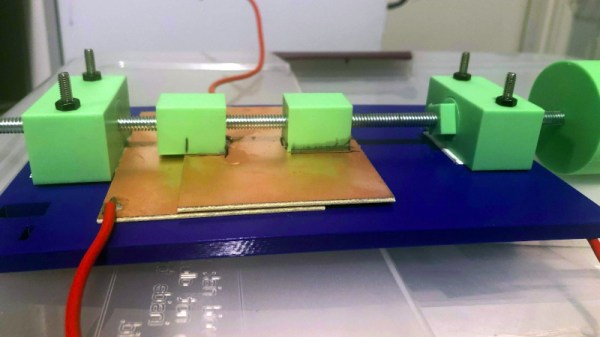
There’s one component which used to be ubiquitous in every experimenter’s junk box, but nowadays unless you happen to be a radio amateur the chances are you may not have seen one in a long time, if ever. We’re talking of course about the air-dielectric variable capacitor, the tuning element for millions of radio receivers back in the day but now long ago replaced by much flimsier polymer-dielectric parts. There’s still a need for variable capacitors though, in particular a high-voltage variant for use in magnetic loop antennas. It’s something that [Ben] had a need for, which he solved with a clever combination of PCB material and 3D printing.

While the variable capacitors of yore invariably used intersecting vanes on a rotor, this one has two large parallel plates that intersect as one is moved over the other with a lead screw. It’s cheap and effective, and best of all, the files to make it can be downloaded from Thingiverse. He claims a 34pF-164pF capacitance range, which, looking at the size of the plates we find to be believable (and which is a useful range for most HF applications). We like this solution, and believe it makes more sense than being scalped for an older example at a radio rally.

This isn’t the first variable capacitor we’ve shown you, though some previous examples have been more conventional.

Are Apple Trying To Patent The Home Computer 45 Years Too Late?

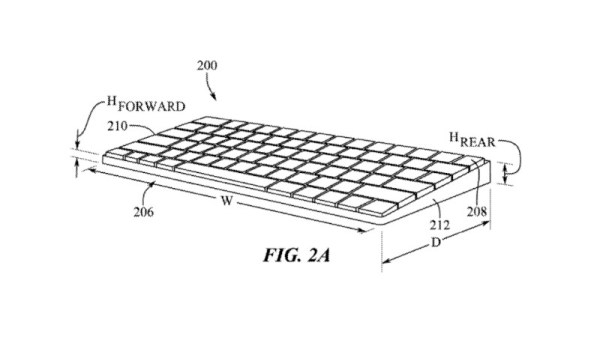
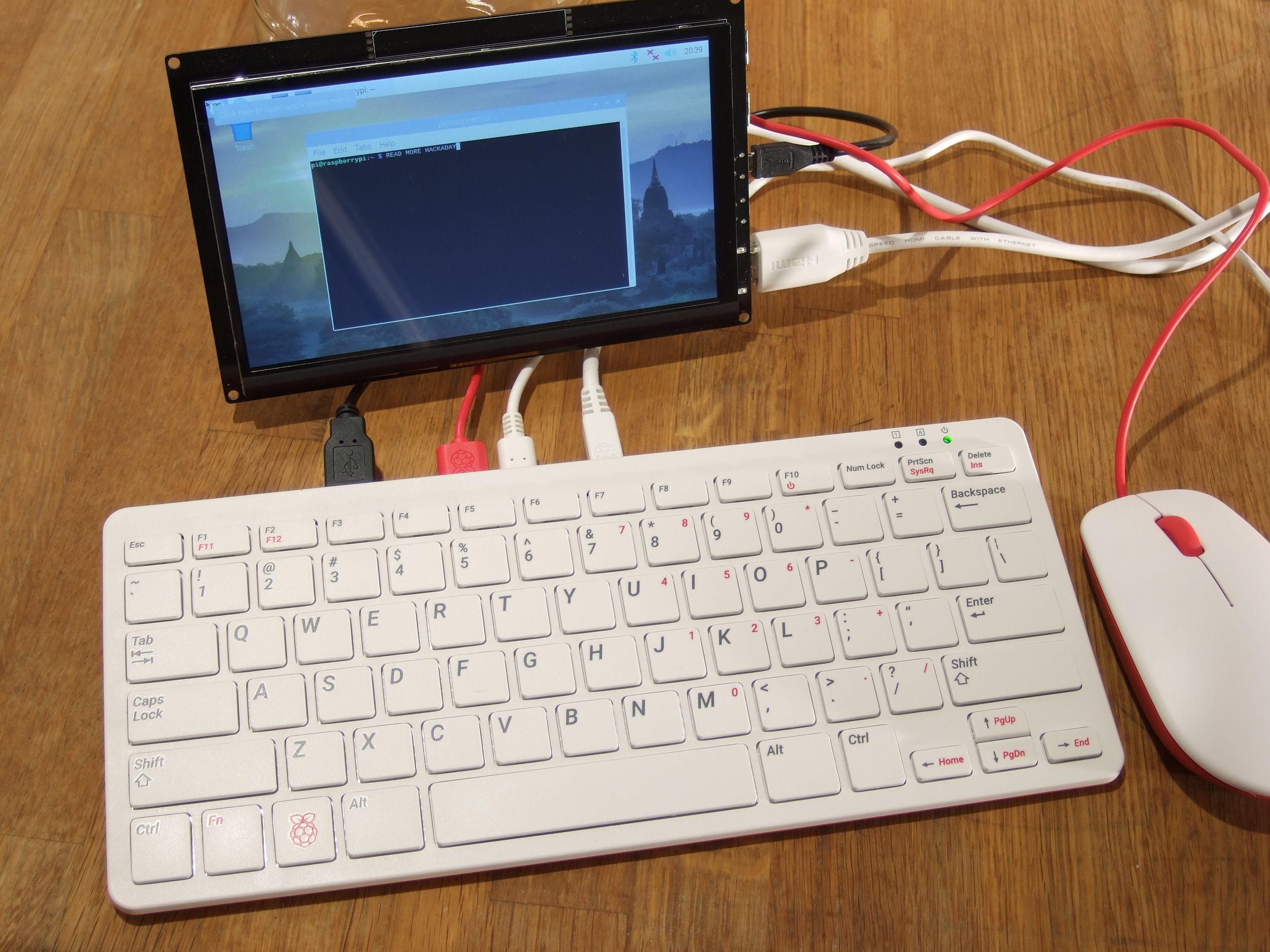
In our recent piece marking the 10th anniversary of the Raspberry Pi, we praised their all-in-one Raspberry Pi 400 computer for having so far succeeded in attracting no competing products. It seems that assessment might be premature, because it emerges that Apple have filed a patent application for “A computer in an input device” that looks very much like the Pi 400. In fact we’d go further than that, it looks very much like any of a number of classic home computers from back in the day, to the extent that we’re left wondering what exactly Apple think is novel enough to patent.

A Raspberry Pi 400 all-in-one keyboard console computer
Looks pretty similar to us.

Reading the patent it appears to be a transparent catch-all for all-in-one computers, with the possible exception of “A singular input/output port“, meaning that the only port on the device would be a single USB-C port that could take power, communicate with peripherals, and drive the display. Either way, this seems an extremely weak claim of novelty, if only because we think that a few of the more recent Android phones with keyboards might constitute prior art.

We’re sure that Apple’s lawyers will have their arguments at the ready, but we can’t help wondering whether they’ve fallen for the old joke about Apple fanboys claiming the company invented something when in fact they’ve finally adopted it years after the competition.

Thinking back to the glory days of 8-bit computers for a moment, we’re curious which was the first to sport a form factor little larger than its keyboard. Apple’s own Apple ][ wouldn’t count because the bulk of the machine is behind the keyboard, but for example machines such as Commodore’s VIC-20 or Sinclair’s ZX Spectrum could be said to be all-in-one keyboard computers. Can anyone provide an all-in-one model that predates those two?

You can read our Raspberry Pi 400 review if the all-in-one interests you.

Via Extreme Tech.


The Battlefield That’s 5 KHz Wide

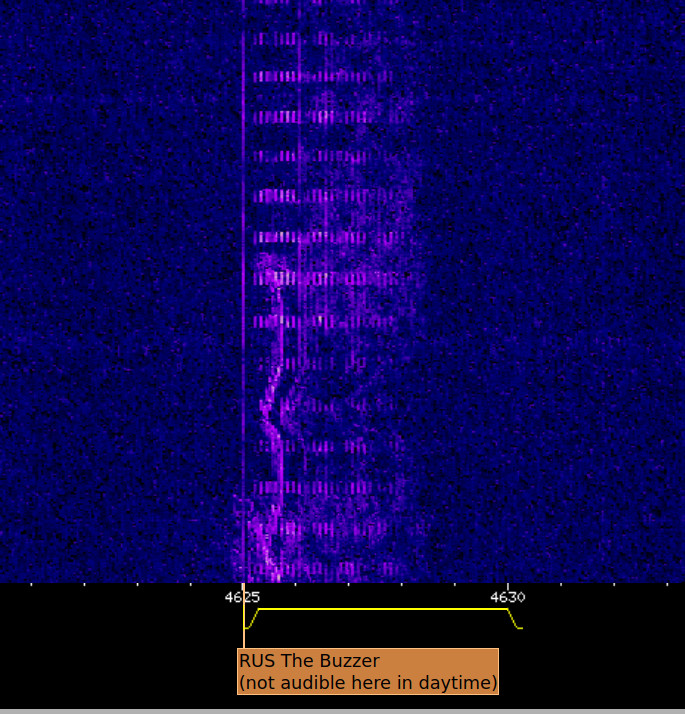
The airwaves are full of news from the battle in Ukraine, with TV and radio journalists providing coverage at all hours. But for those with a bit of patience there’s something else from the conflict that can be found with a radio receiver, the battle over 5 kHz of spectrum starting at 4625 kHz. This has for many years been the location on the dial for “the Buzzer“, a Russian military transmitter whose nickname describes its monotonous on/off buzzing transmission perfectly. As the current Ukrainian situation has taken shape it has become a minor battleground, and the Buzzer now shares its frequency with a variety of other stations broadcasting music, spectrograms, and other radio junk intended to disrupt it.

A spectrogram showing the wavy line of an air raid siren
The air raid siren produces a particularly distinctive spectrogram.

For the curious this can be watched unfolding on a spectrogram or through headphones by anyone within range who has an HF receiver, or for everyone else, with a WebSDR. In Western Europe it’s best listened to in hours of darkness, we suggest you consult the webSDR.org list to see which has the best signal. We’ve heard it on receivers in Poland, Russia, and the ever-reliable uTwente WebSDR in the Netherlands. Over the time we’ve been monitoring it we’ve heard overlaying speech, and music varying from the Soviet and American anthems through dance music and K-pop to 1960s British rock and of course Boney M’s Rasputin, with a few slightly macabre choices such as Final Countdown and an air raid siren. We’ve even heard TV intros from the Benny Hill Show, the A-Team and Mission Impossible, so whoever is doing this has a wide taste.

Alongside the music at about 4628kHz meanwhile we’ve watched a series of spectrogram messages scroll past in Ukrainian, Russian, and English, ranging from “Stop war” to lewd suggestions about the Russian President. It’s fair to say that none of these transmissions have obscured the Buzzer, but they have had the effect of significantly increasing the noise on the channel.

To have a listen yourself, point a receiver within range at the appropriate time of day towards 4625 kHz and select USB demodulation and a 5 kHz bandwidth. Meanwhile, for some background on the Cold War HF relics, have a read about numbers stations.

The Antonov An-225 Seems To Have Been Destroyed After All

Something that probably unites most Hackaday readers is a love of machines, particularly unique or interesting ones. In the world of aircraft for example, we’ve run several stories about those which push the edges of the size envelope, be they the Hughes Hercules troop carrier, the Scaled Composites Stratolifter space launcher, or the Antonov An-225 Mriya cargo plane. This last machine has been in the news for all the wrong reasons over the last few days, with reports emerging that it may have been destroyed in the fighting around its base at Hostomel near Kyiv. There has been some uncertainty around this news as it has alternately been claimed to have been destroyed or to have miraculously survived, but now a set of photographs have emerged showing what appears to be the An-225 burning in its damaged hangar.

The An-225 is a unique aircraft not only in the sense that there is no other model quite like it, but also because it was manufactured for the special purpose of being the transport carrier of the Soviet Union’s Buran space shuttle, and thus only one airframe was completed. Its characteristic twin tail served to avoid the turbulence that would have resulted from a Buran mounted on top of its enormous fuselage, and the six engine configuration required to move such a behemoth was in part the clue to identifying it in the photograph. Those readers who were lucky enough to see it take off or land in person will attest to its impressive physical presence, while the rest of us remain sad to have missed that chance.

It seems crass to talk about the destruction of an aircraft when compared to the scale of the unfolding tragedy in Ukraine, but we think perhaps our British and French readers who grew up with Concorde in the sky will understand the power of such a machine as a source of pride. We hope that the Antonov company will return to the design of huge cargo aircraft in peacetime, and Ukranians can again have pride in a monster aircraft that the rest of us will drive for miles just to watch taking off or landing.

The issue of which aircraft is the world’s largest can be a complex one, as we’ve explored in the past.

Header image: Vasiliy Koba, CC BY-SA 4.0.

Where Do You Want To Go Today? Perhaps To A Linux With A Familiar Interface?

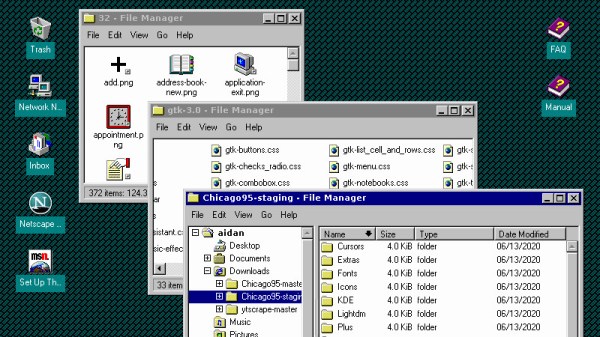
Sometimes we cover works of extreme technological merit here at Hackaday, other times we cover interesting projects that while they might not lie at the bleeding edge are interesting enough that they deserve a wider audience. Sometimes though, we bring you something in this field simply because it amuses us and we think it will you too. Such is the case with [Bryan Lunduke]’s look at making a Linux desktop look like Windows 95. And lest you think that it might be yet another skin to make Windows users transition to Linux a bit easier, the aim and result is to make it look exactly like Microsoft’s mid-90s desktop.

Underneath it all is the relatively familiar xUbuntu distribution, with a deliciously troll-worthy project called Chicago95 atop it. This takes some existing Windows 95 theme and icon projects, and adds GTK themes, an MS-DOS shell theme, the ability to install those cheesy ’90s Plus! themes, and a Microsoft Office 95 theme for LibreOffice. It really does deliver an experience very close to the Redmond original.

So, what’s the point here in 2022? In the first instance it’s an excellent opportunity to troll open-source enthusiast friends with a crusty laptop seemingly running ’95 and showing YouTube videos on Netscape Navigator 3. But beyond the jokes there is a serious use for it. There may be many criticisms that can be leveled at Windows 95, but it’s safe to say that its GUI was a significant success whose echoes can be found in many desktops here in 2022. There are a huge number of people in the world who are completely at home in a Windows 95 environment who might struggle with a Linux desktop, and this gives them a way to be immediately productive.  Would you give your grandmother a Linux box with this desktop?