The Internet – On A Casio Calculator!

Over the years we’ve become used to seeing some impressive hacks of high-end calculator software and hardware, most often associated with the Z80-based models from Texas Instruments. But of course, TI are far from the only player in this arena. It’s nice for a change to see a Casio receiving some attention. The Casio fx series of graphical calculators can now communicate with the world, thanks to the work of [Manawyrm] in porting a TCP/IP stack to them.

As can be seen in the video below, lurking in the calculator’s menu system is an IRC client, there is also a terminal application and a webserver which you can even visit online (Please be aware that it’s only a calculator though, so an onslaught of Hackaday readers clicking the link may bring it down). The Casio doesn’t have a network interface of its own, so instead, it speaks SLIP over the serial port. In this endeavor, it uses a UART driver sourced from [TobleMiner].

It’s always good to see a neglected platform get some love, and also to note that this is an unusual outing for an SH4 CPU outside its most familiar home in the Sega Dreamcast. It’s a surprise then to read that the SH4 in a calculator of all products, is a custom version that lacks an FPU. This deficiency doesn’t mean it can’t be overclocked though, as this very old Hackaday article describes.

Continue reading “The Internet – On A Casio Calculator!”

Just What Have We Become?

The world of open source software is one that often sees disputes between developers, some of which spawn lifelong schisms between devotees of different forks, and others mere storms in a teacup that are settled over a few beers. There are a couple of stories of late though that seem to show the worst in the online world, and which all of us should take a moment to think about.

Many of you may have heard two weeks ago of the passing of [near], the software developer and game translator whose bsnes emulator for the Super Nintendo was the go-to platform for retro Nintendo enthusiasts intent on the pursuit of the closest possible match to the original without possessing real Nintendo hardware. The details of their passing are particularly distressing, in that they committed suicide after numerous attacks over several years from users of Kiwi Farms, a website notorious for the worst kinds of trolling.

Hot on the heels of that distressing story comes news that [Cookie Engineer] is stepping down as maintainer of the project that’s now called Tenacity, a fork of the popular but now-controversial Audacity audio editor. They are doing so after being targeted by users of 4chan, the most well-known of online trolling websites, following an ill-advised Simpsons joke in a naming poll for the software. [Cookie Engineer] alleges that the harassers knocked on doors and windows where they live and a real-world knife attack followed.

Nobody deserves to be hounded to death, to suffer the sort of sustained harassment that [near] encountered, or to be confronted with knife-wielding strangers merely because they have stuck their head above the parapet as an open-source developer. There are no excuses to be made, no justifications for this.

All of us who read Hackaday are likely to be regular users of open-source software, many of us will have used bsnes and may yet use Tenacity, but we probably rarely stop for a moment to think of the real people behind them. Countless hours from innumerable highly-skilled people are what makes the open-source world tick, and aside from the immeasurable sadness of suicide or the horror of a knife attack there can only be harm done to open source software as a whole if to be a prominent developer or maintainer is to expose yourself to this.

The Internet will always have raucous communities at its margins and that’s something which still contributes to its unique culture, but when it jumps off the webpage and into damaging real people then perhaps it has become a monster. As a community we can do so much better, and we shouldn’t be prepared to accept anybody who thinks otherwise among our ranks.

We’d like to remind our readers that help exists for those who have reached the point of considering suicide, and that should you suffer from mental health problems you are not alone in this. Everybody, take care of yourselves, and keep an eye out for each other.

End Of An Era: NTSC Finally Goes Dark In America

A significant event in the history of technology happened yesterday, and it passed so quietly that we almost missed it. The last few remaining NTSC transmitters in the USA finally came off air, marking the end of over seven decades of continuous 525-line American analogue TV broadcasts. We’ve previously reported on the output of these channels, largely the so-called “FrankenFM” stations left over after the 2009 digital switchover whose sound carrier lay at the bottom of the FM dial as radio stations, and noted their impending demise. We’ve even reported on some of the intricacies of the NTSC system, but we’ve never taken a look at what will replace these last few FrankenFM stations.

If you are an American you may have heard of ATSC 3.0, perhaps by its marketing name of NextGen TV. Just like the DVB-T2 standard found in other parts of the world, it’s an upgrade to digital TV standards to allow for more recent video compression technologies and higher definition broadcasts. It has an interesting backwards compatibility feature absent in previous ATSC versions; there is the option of narrowing the digital bandwidth from 6 MHz to 5.5 MHz, and transmitting an analogue FM subcarrier where the old NTSC sound carrier on the same channel would have sat. Thus the FrankenFM stations have the option of upgrading to ATSC 3.0 and transmitting a digital channel package alongside their existing FM radio station. It’s reported that this switchover is happening, with one example given in the Twitter thread linked above.

The inexorable march of technology has thus given better quality TV alongside the retention of the FrankenFMs. We have to admit to being sorry to see the passing of analogue TV, it was an intricate and fascinating system that provided a testbed for plenty of experimentation back in the day. Perhaps as we see it slip over the horizon it’s worth pondering whether its digital replacement will also become an anachronism in an age of on-demand streaming TV, after all it shouldn’t have escaped most people’s attention that in 2021 the good TV content no longer comes to your screen via an antenna socket. Meanwhile we’ll keep our CRTs running, just in case we ever want to relive a 1980s night in with a VHS tape of Back To The Future.

Header image: Mysid, Public domain.

As Chinese Wheels Touch Martian Soil And Indian Astronauts Walk Towards The Launch Pad, Can We Hope For Another Space Race?

If you were born in the 1960s or early 1970s, the chances are that somewhere in your childhood ambitions lay a desire to be an astronaut or cosmonaut. Once Yuri Gagarin had circled the Earth and Neil Armstrong had walked upon the Moon, millions of kids imagined that they too would one day climb into a space capsule and join that elite band of intrepid explorers. Anything seems possible when you are a five-year-old, but of course the reality remains that only the very fewest of us ever made it to space.

Did You Once Dream Of The Stars?

The Soviet cosmonaut Yuri Gagarin in Finland in 1961. Arto Jousi, Public domain.

The picture may be a little different for the youth of a few decades later though, did kids in the ’90s dream of the stars? Probably not. So what changed as Shuttle and Mir crews were passing overhead?

The answer is that the Space Race between the USA and Soviet Union which had dominated extra-terrestrial exploration from the 1950s to the ’70s had by then cooled down, and impressive though the building of the International Space Station was, it lacked the ability to electrify the public in the way that Sputnik, Vostok, or Apollo had. It was immensely cool to people like us, but the general public were distracted by other things and their political leaders were no longer ready to approve money-no-object budgets. We’d done space, and aside from the occasional bright spot in the form of space telescopes or rovers trundling across Mars, that was it. The hit TV comedy series The Big Bang Theory even had a storyline that found comedy in one of its characters serving on a mission to the ISS and being completely ignored on his return.

A few years ago a Chinese friend at my then-hackerspace was genuinely surprised that I knew the name of Yang Liwei, the Shenzhou 5 astronaut and the first person launched by his country into space. He’s a national hero in China but not so much on the rainy edge of Europe, where the Chinese space programme for all its progress at the time about a decade after Yang’s mission had yet to make a splash beyond a few space watchers and enthusiasts in hackerspaces. But this might be beginning to change.

Continue reading “As Chinese Wheels Touch Martian Soil And Indian Astronauts Walk Towards The Launch Pad, Can We Hope For Another Space Race?”

The First New Vacuum Tube Computer Design For Well Over Half A Century

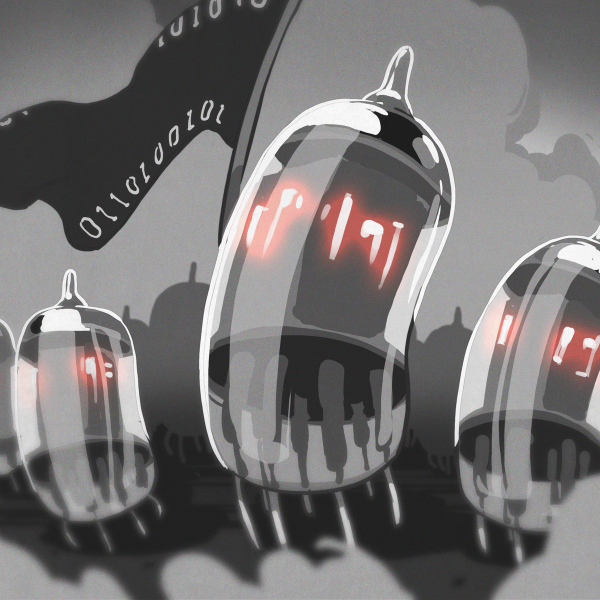
In a few museums around the world, there lies the special experience of seeing some of the earliest computers. These room-filling monsters have multiple racks of vacuum tubes that are kept working by the dedication and care of their volunteer maintainers. A visit to the primordial vacuum tube computer, Colossus at Bletchley Park, UK, led [Mike] on the path towards designing an entirely new one. He thinks it’s the first to see the light of day in over five decades. ENA, the Electron tube New Automatic Computer, is the result.

It uses 550 Soviet 6N3P double triodes, and its 8-bit Von Neumann architecture is constructed from the tubes wired up as 5-input NOR gates. ROM is a diode matrix, and RAM comes courtesy of reed relays. The whole thing is assembled as eleven PCBs on a wall-mounted frame, with a console that holds the piece de resistance, a display made from an array of LEDs. A Pong game is in development, meanwhile the machine makes an impressive room heater.

If you’d like to see some more vacuum tube computational goodness, we saw Colossus at the National Museum of Computing, back in 1996.

Digital Audio For Microcontrollers Doesn’t Come Much Simpler Than A WART

Adding an audio channel to your microcontroller project can mean a pile of extra components and a ton of processing power, as a compressed stream must be retrieved and sent to a dedicated DAC. Or if you are [rdpoor], it can mean hooking up a low-pass filter to the UART that’s present on even the simplest of devices, and constructing a serial data stream that mimics PWM audio.

Sound on your microcontroller, it’s this simple!

WART is a Python script that converts a WAV file into a C formatted byte array that can be baked into your microcontroller code, and for which playback is as simple as streaming it to the UART. The example uses a Teensy and a transistor to drive a small speaker, we’re guessing that better quality might come with using a dedicated low-pass filter rather than relying on the speaker itself, but at least audio doesn’t come any simpler.

The code can be found in a GitHub repository and there’s a few recordings of the output in the files section Hackaday.io page, one is embedded below. It’s better than we might have expected given that the quality won’t be the best at the PWM data rate of even the fastest UART. But even if you won’t be incorporating it into your music system any time soon we can see it being a useful addition for such things as small warning sounds. Meanwhile if persuading serially driven speakers to talk is of interest, there’s always the venerable PC speaker.

Continue reading “Digital Audio For Microcontrollers Doesn’t Come Much Simpler Than A WART”

But Does It Run TOOM?

id Software’s iconic 1993 first-person shooter game Doom was the game to play on your 486 (or fast 386) and was for many their first introduction to immersive 3D environments in gaming. Its eventual release as open-source gave it a new life, and now it’s a rite of passage for newly-reverse-engineered devices: Will it run Doom?

One type of platform that never ran Doom though was the classic arcade cabinet with its portrait-aligned screen. This is something [Matt Phillips] has addressed with Toom, a PC Doom port that — finally — runs on a portrait screen.

To enter the world of a UAC space marine in glorious portrait mode, simply take an installation of Doom 1.9 for DOS, and copy the Toom files from the GitHub repository over the top of it. The minimum spec is a 486 so period hardware will be fine, all you’ll need is a monitor that can be tipped on its side.

Doom consumed far too many hours for gamers of a certain age, and while it may look quaint to modern eyes it can’t be overstated what a giant step it was compared to what had gone before. If any of you install Toom and give it a go, prepare to see its monsters when you close your eyes.

We’ve shown you Doom on all sorts of devices over the years, perhaps the most intriguing is a no-software version in FPGA hardware.