Flying Sausage Rescues Pooch, Drone Pilots Save The Day

When we write about drone stories from the United Kingdom, they often have a slightly depressing air to them as we relate tales of unverified air proximity reports closing airports or bungled official investigations that would make the Keystone Kops look like competent professionals.

But here’s a drone story from this rainswept isle sure to put a smile on the face of multirotor enthusiasts worldwide, as Denmead Drone Search And Rescue, an organisation who locate missing pets using drones, enticed lost dog Millie from a soon-to-be-engulfed tidal mudflat by the simple expedient of dangling a sausage from a drone for the mutt to follow (Facebook).

Lest you believe that Hackaday have lost their marbles and this isn’t worthy of our normal high standards, let us remind you that this is not our first flying sausage story. Behind the cute-puppy and flying meat product jokes though, there’s a serious side. Drones have received such a bad press over recent years that a good news story concerning them is rare indeed, and this one has garnered significant coverage in the general media. Maybe it’s too late to reverse some of the reputational damage from the Gatwick fiasco, but at this point any such coverage is good news.

For anyone wondering what lies behind this, let us take you back to Christmas 2018.

Unpicking The Hype Around Web 3, What’s The Tech?

The buzzword of the moment in the frothier portions of the technology press is inescapable: “Web 3”. This is a collective word for a new generation of decentralised online applications using blockchain technologies, and it follows on from a similar excitement in the mid-2000s surrounding so-called “Web 2” websites that broke away from the static pages of the early Internet.

It’s very evident reading up on Web 3, that there is a huge quantity of hype involved in talking about this Next Big Thing. If this were April 1st it would be tempting to pen a lengthy piece sending up the coverage, but here in January that just won’t do. Instead it’s time to peer under the hype and attempt to discern what Web 3 really is from a technology standpoint. Sure, a Web 3 application uses blockchain technology, often reported breathlessly as “the Blockchain” as though there were only one, but how? What is the real technology beneath it all?

Where Did All This Web 3 Stuff Come From Anyway?

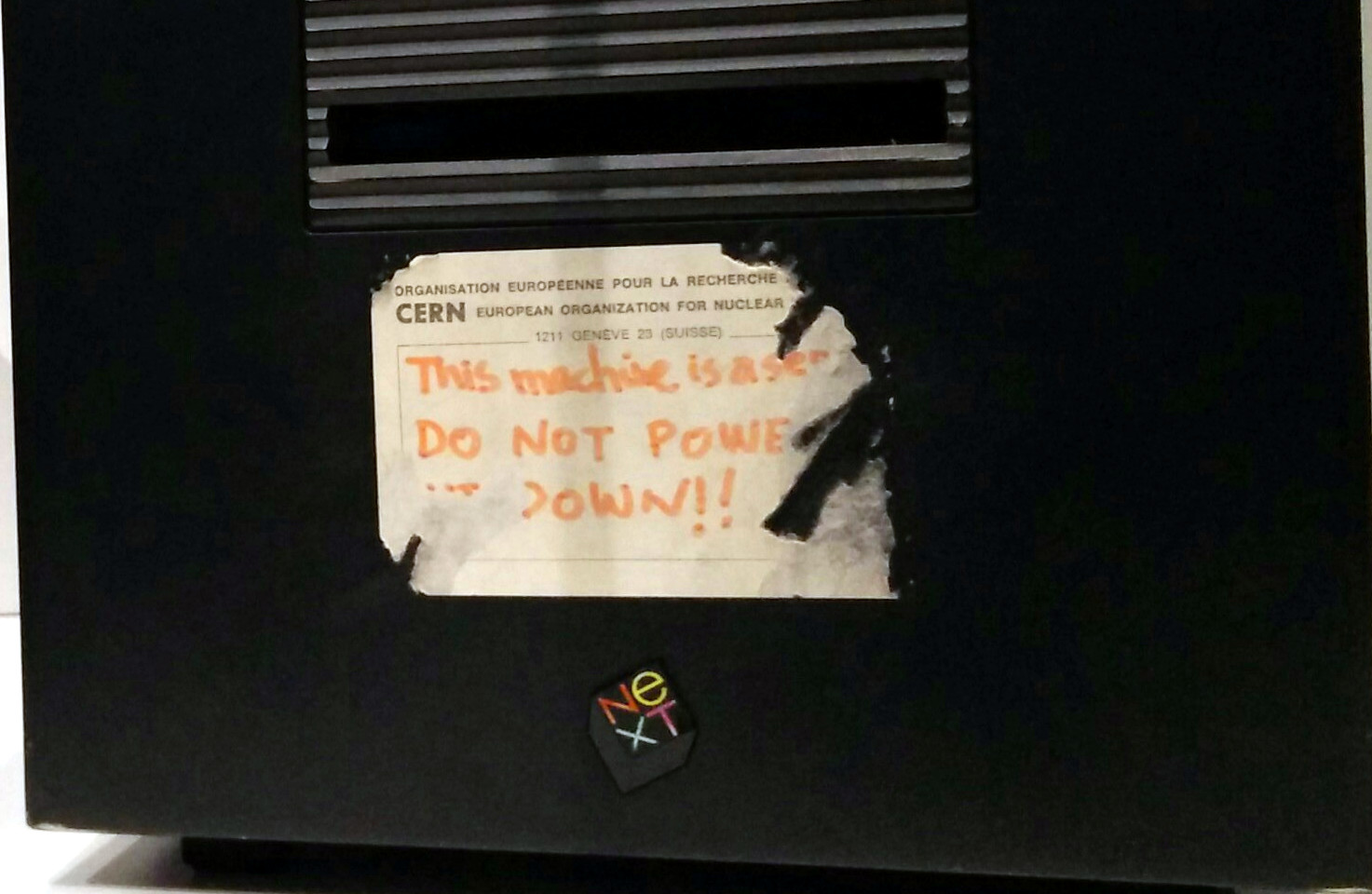
"This machine is a server. DO NOT POWER IT DOWN!!" Tim Berners-Lee's famous sticker on the front of his NeXTcube, the first web server.
“This machine is a server. DO NOT POWER IT DOWN!!” Tim Berners-Lee’s famous sticker on the front of his NeXTcube, the first web server. Binary Koala CC BY-SA 2.0.

In its earliest days, the web could be found only in academia, from Tim Berners-Lee at CERN, and then from others such as the National Center For Supercomputing Applications at the University of Illinois. In the mid-1990s the vast majority of web sites were served by the NCSA’s HTTPD server software, which served as the basis for the later hugely popular Apache project. Sites from this era were later dubbed Web 1.0, and operated as static HTML pages which could be refreshed only by reloading a page.

The millennium brought us Web 2.0. This is generally taken to refer to a much slicker generation of sites that made use of user-generated content. Behind every such generational shift lies a fresh technology, and if it was the HTTP server for Web 1.0, it was the use of Javascript in the browser to refresh page content on the fly for Web 2.0. This was dubbed AJAX, for Asynchronous Javascript And XML, and though the data transfer is now much more likely to be JSON than XML it remains the way that today’s web sites blur the line between a web page and an app. Continue reading “Unpicking The Hype Around Web 3, What’s The Tech?”

When A Single Bit Was Enough, Into The Sound Of The ZX Spectrum

It’s normal for a computer in 2022 to come with a fully-featured sound card containing a complete synthesizer as well as high-quality PCM sound recording and playback. It’s referred to as a sound card after the way the hardware first appeared in the world of PCs, but in fact it’s now considered so essential as to be a built-in part of most mainboards. There was a time when computers boasted considerably less impressive sound hardware, and among the chorus of SIDs and AY chips of the perhaps the least well-featured was the original Sinclair ZX Spectrum. Its one-bit sound, a single line on an I/O port, is the subject of a thorough investigation from [Forgotten Computer]. It’s a long video which we’ve placed below the break, but for those with an interest in 8-bit music it should make a for a fascinating watch.

For Sir Clive Sinclair the 1-bit audio must have been welcome as it removed the need for an expensive sound chip and kept the Spectrum to its low price point, but on the face of it there was little more it could do than create simple beeps using Sinclair BASIC’s built-in BEEP command. The video gives us an in-depth look at how interleaving and PWM could be used to create much more complex sounds such as the illusion of multiple voices and even sampled sounds. In particular his technique of comparing the audio output with its corresponding pin on the Sinclair ULA shows the effect of the machine’s simple low-pass filter, though the music was often so close to the edge of what the interface could do that aliasing sounds are often very obvious.

As he demonstrates the various ingenious techniques that game and demo developers used to extract performance from such limited hardware that could even try to compete with the more sophisticated machines even at the same time as their code was running whatever was on the screen, it’s difficult not to come away with immense respect for their skills. If you’ve ever experimented with computer audio then you should try hardware this simple for yourself.

Continue reading “When A Single Bit Was Enough, Into The Sound Of The ZX Spectrum”

3D Printed Magnetic Switches Promise Truly Custom Keyboards

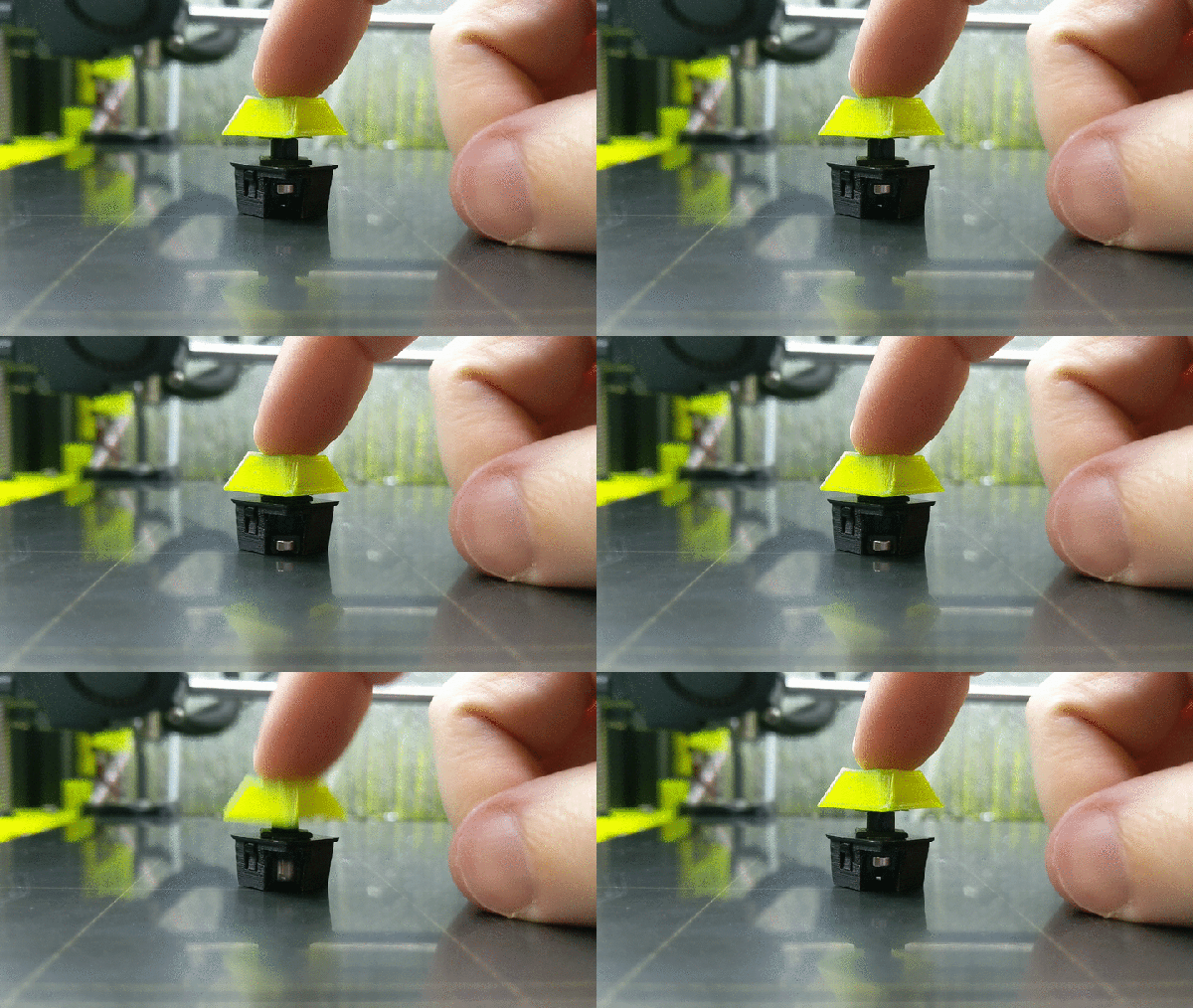
While most people are happy to type away at whatever keyboard their machine came with, for the keyboard enthusiast, there’s no stone to be left unturned in the quest for the perfect key switch mechanism. Enter [Riskable], with an innovative design for a 3D printed mechanism that delivers near-infinite adjustment without the use of springs or metallic contacts.

The switching itself is performed by a Hall effect sensor, the specifics of which are detailed in a second repository. The primary project simply represents the printed components and magnets which make up the switch mechanism. Each switch uses three 4 x 2 mm magnets, a static one mounted on the switch housing and two on the switch’s moving slider. One is mounted below the static magnet oriented to attract it, while the other is above and repels it.

With this arrangement the lower magnet provides the required tactility, while the upper one’s repulsive force replaces the spring used in a traditional mechanism. [Riskable] calls it the magnetic separation contactless key switch, but we think “revolutionary” has a nicer ring to it.

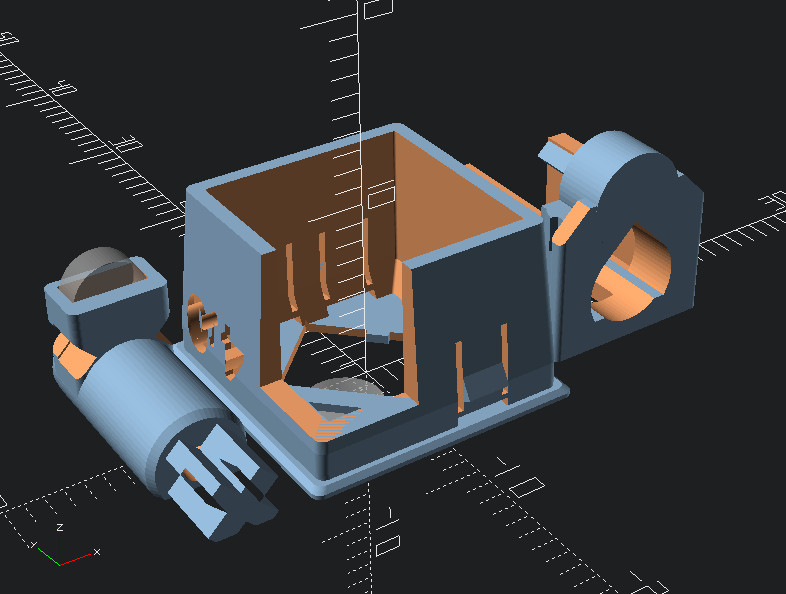
The part which makes this extra-special is that it’s a fully parametric OpenSCAD model in which the separation of the magnets is customisable, so the builder has full control of both the tactility and return force of the keys. There’s a video review we’ve posted below that demonstrates this with a test keypad showing a range of tactility settings.

We have a resident keyboard expert here at Hackaday in the shape of our colleague [Kristina Panos], whose Keebin’ With Kristina series has introduced us to all that is interesting in the world of textual input. She plans on taking a keyboard made of these clever switches on a test drive, once she’s extruded the prerequisite number of little fiddly bits.

Continue reading “3D Printed Magnetic Switches Promise Truly Custom Keyboards”

A Dodgy Dial Gets A Teardown And Some Oil

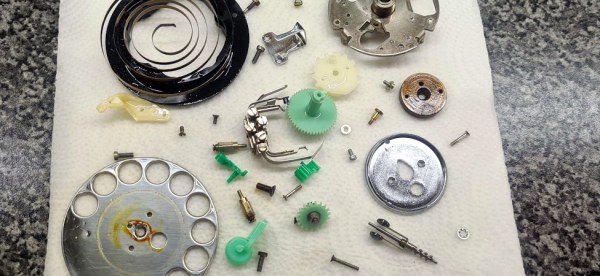
The pulse-dial telephone and its associated mechanical exchange represents the pinnacle of late-19th and early-20th century electromechanical technology, but its vestiges have disappeared from view with astonishing rapidity. [Matthew Harrold] is a telecoms enthusiast who’s been kind enough to share with us the teardown and refurbishment of that most signature of pulse-dial components, a telephone dial. In this case it’s on a rather unusual instrument, a British GPO outdoor phone that would have been seen in all kinds of industrial and safety installations back in the day and can probably still be found in the wild today if you know where to look.

The teardown soon identifies a dial that runs very slowly and is sorely in need of a clean. There follows a detailed part-by-part dismantling of the dial mechanism, followed by a careful clean, polish, and reassembly. He notes that a previous owner had used grease to lubricate it, probably the reason for its slow operation.

The result is a smoothly running dial and a refurbished phone that would probably last another half-century or more before needing more maintenance. It’s enough to make others who’ve experimented with pulse dial phones very envious.

Four Wheel Steering, Always The Option, Never The Defining Feature

A couple of weeks ago when it emerged that a new Tesla might have a four-wheel steering capability, our colleague Dan Maloney mused aloud as to how useful a four-wheel steering system might be, and indeed whether or not one might be necessary at all. This is hardly the first time four-wheel steering has appeared as the Next Big Thing on the roads. It’s time to take a look at the subject and ask whether it’s an idea with a future, or set to go the way of runflat tyres as one of those evergreen innovations that never quite catches on.

What’s your dream vehicle? If you’re like me, you have more than one. There in my lottery-winner’s garage, alongside the trail bikes and the mobile hackerspace, the dictator-size Mercedes and the Golf Mk1, will be a vehicle that by coincidence has four-wheel steering. The JCB Fastrac is a tractor that can travel across almost any terrain at full speed, and though I have no practical use for one and will never own one, I have lusted after one of these machines for over three decades. Their four-wheel steering system is definitely unusual, but that makes it the perfect vehicle with which to demonstrate four-wheel steering. Continue reading “Four Wheel Steering, Always The Option, Never The Defining Feature”

Work The World On A 555

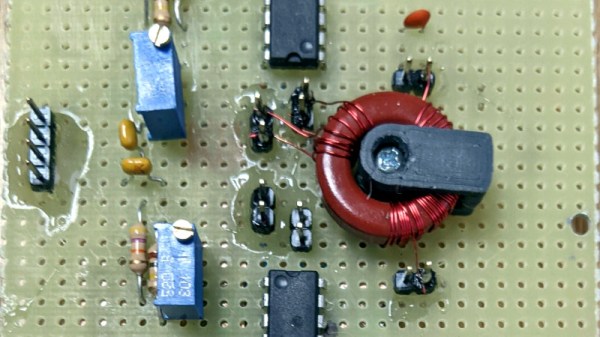
Over the years the humble 555 timer has been used in so many unexpected places, but there’s a project from [Frank Latos] which we think may be a first. On a piece of stripboard sit a pair of 555s, and instead of the usual passives there are a set of LC circuits. This is no timer, instead it’s a CW (Morse) transmitter for the 80 metre amateur radio band.

One 555 is configured as a feedback oscillator through a toroidal transformer with a tuned circuit to set the frequency of oscillation. The other takes an inverted input from the oscillator to produce complimentary push-pull outputs from both 555s, which are fed to another transformer that in turn feeds a low-pass filter and thus the antenna.

Free-running squarewave oscillators of this type are not unusual for the lower HF bands, but we think this is the first 555 design we’ve seen. As shown it doesn’t produce much in the way of RF power, but remembering half-decent motor drivers using a 556 dual timer we think that selection of one of the more powerful 555 variants might deliver some more punch. We commend his creativity though, and hope he can get that all-important entry in the log to prove it works.

If you’re curious about low-power radio operation, it’s something we’ve explored before.