When Does Car Hacking Become “Tampering”? The British Government Seeks Guidance

When a government decides to take a look at your particular field of experimentation, it’s never necessarily a cause for rejoicing, as British motor vehicle enthusiasts are finding out through a UK Government consultation. Titled “Future of transport regulatory review: modernising vehicle standards“, the document explains that it is part of the process of re-adopting under UK law areas which have previously been governed by the European Union. Of particular interest is the section “Tackling tampering”, which promises a new set of offences for “tampering with a system, part or component of a vehicle intended or adapted to be used on a road“.

They go into detail as to the nature of the offences, which seem to relate to the production of devices designed to negate the safety or environmental features of the car. They’re at pains to say that they have no wish to target the legitimate car modification world, for example in motorsport or restoration, but it’s easy to see how a car hacker might inadvertently fall foul of any new rules. It’s worried the enthusiasts enough that a petition has been launched on the UK parliamentary petition site, making the point that the existing yearly MOT roadworthiness test should fulfill the function of taking any illegal vehicles off the road.

We’re always wary when governments wander into our purview, and given where this is being written it’s fair to say that British governments have had their fair share of ill-considered laws in their time. But before we call doom upon the future of car hacking for Brits, it’s worth remarking that they don’t always make a mess in this arena. The rules for the Individual Vehicle Approval test for putting a home-built car on the road are far from a bureaucratic nightmare for example, instead being a relatively sensible primer in building a safe motor vehicle.

So we’d suggest not to panic just yet, but perhaps any British readers might like to respond appropriately to the consultation and the petition in the interests of nudging them in the right direction.

Thanks [Adam Quantrill] for the tip.
The Seductive Pull Of An Obsolete Home Movie Format

It’s dangerous for a hardware hacker to go into a second-hand store. I was looking for a bed frame for my new apartment, but of course I spent an age browsing all the other rubbish treasures on offer. I have a rough rule of thumb: if it’s not under a tenner and fits in one hand, then it has to be exceptional for me to buy it, so I passed up on a nice Grundig reel-to-reel from the 1960s and instead came away with a folding Palm Pilot keyboard and a Fuji 8mm home movie camera after I’d arranged delivery for the bed. On those two I’d spent little more than a fiver, so I’m good. The keyboard is a serial device that’s a project for a rainy day, but the camera is something else. I’ve been keeping an eye out for one to use for a Raspberry Pi camera conversion, and this one seemed ideal. But once I examined it more closely, I was drawn into an unexpected train of research that shed some light on what must of been real objects of desire for my parents generation.

A Thrift Store Find Opens A Whole New Field

One f the surprises comes in just how small this thing is.
One of the surprises comes in just how small this thing is.

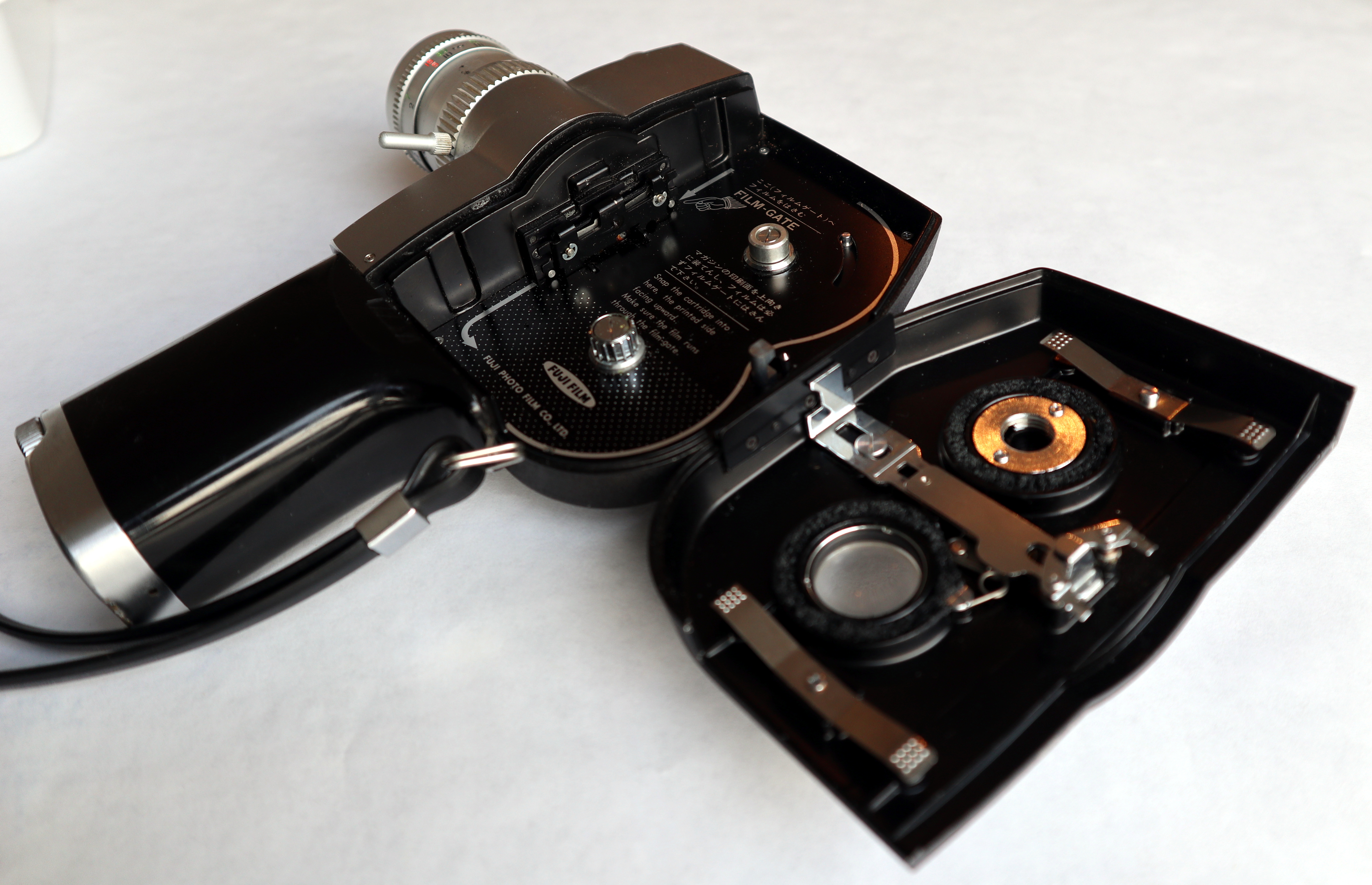
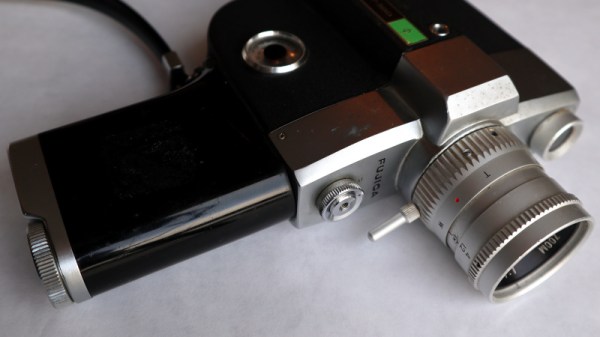
The Fuji P300 from 1972 is typical among consumer movie cameras of the day. It takes the form of a film magazine with a zoom lens assembly on its front, a reflex viewfinder on its side, and a handle with a shutter trigger button on it protruding vertically below the magazine and also housing the batteries.

Surprisingly it still has a mercury cell that would have powered its light meter; a minor annoyance to dispose of this correctly. Sometimes these devices had clockwork motors, but this one has an electric motor. It also has a light sensor that is coupled to some kind of electromechanical aperture. It would have been an expensive camera when it was new, probably as much of a purchase as an SLR or a decent mirrorless camera here in 2021.

The surprise came when I opened it up, for it looked like no other 8mm camera I had seen. I’m familiar wit the two reels of a Standard 8 or the boxy cassette of Super 8, but this one used something different. That film magazine is made to fit a compact twin-reel cartridge whose film fits in a metal film gate. This is a Single 8 camera, Fuji’s entry in the all-in-one 8 mm film market, and a format I never knew existed. To explain my unexpected discovery it was necessary to delve into the world of home movie formats in the decade before videotape arrived and drove them out. Continue reading “The Seductive Pull Of An Obsolete Home Movie Format”

You Can Always Use An ATtiny Instead Of A 555

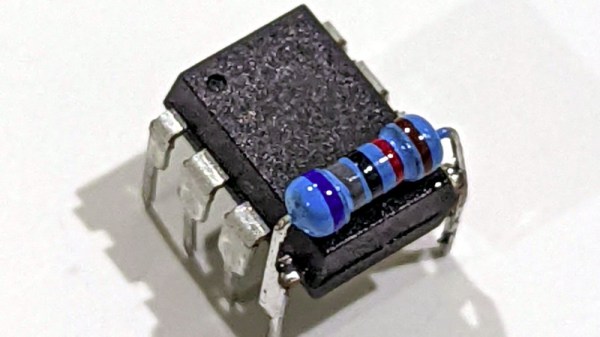
It’s a constant of writing for Hackaday, that whenever a project appears using a 555 timer, someone will say “You could have used a microcontroller to do that!”. It’s something that [Shranav Palakurthi] has approached with the ATTiny555, a project that emulates an entire 555 by making clever use of the humble and ubiquitous microcontroller chip. We’ve all been guilty of it at some time, but now at last the ATTiny85 enthusiasts have conclusive proof that their favourite piece of cheap silicon can prove its mettle.

The full details of the ingenious 555 replacement can be found in its GitHub repository, and for those willing to take the plunge it’s as simple as adding a resistor and updating the firmware. It’s not the perfect 555 replacement with its imperfect analogue performance and swapped reset and ground pins, but it does however bring the advantage of a lower supply voltage.

You can see the device in action in the YouTube video below the break, but meanwhile rejoice that finally there’s a way to replace all those unnecessary 555s with your favourite inexpensive 8-pin chip!

While we’re on the subject of the 555, don’t forget we’re running our 555 contest again.

Continue reading “You Can Always Use An ATtiny Instead Of A 555”

What Really Goes Wrong With Your Tablet

We’ve all seen our share of consumer electronic devices that need repair. It’s inevitable that, however well-cared-for it will be, there’s always the unforseen that brings its life to an end. Many of us will be using devices we’ve repaired ourselves, because often other people’s useless broken electronics can be our free stuff when we know how to fix them and they don’t. This is the arena the Restart Project operate in, as through their Restart Parties they provide repair services to save unnecessary landfill. Over nearly a decade in operation they’ve fixed a huge number of faulty items, and now they’re releasing some data and have analysed common fault modes and barriers to repair for some categories.

We’re restricted to tablets, printers, and batteries, and while many of the problems  are the wear-and-tear such as tablet screens, power supplies, charging connectors, and paper feeds that most of us would expect, it’s the barriers to repair which the Restart Project are keen to draw attention to. Products that are near-impossible to open without damage, parts such as batteries which are difficult to remove, and unavailability of spares. It’s to become part of their campaigning for legal repairability standards across Europe.

Aside from their own analysis, the full data is all available for download should you have any extra insights. We’ve made our position on this matter very clear indeed.

Oh Deere, Is That Right To Repair Resolution Troubling You?

Over the years a constant in stories covering the right to repair has come from an unexpected direction, the farming community. Their John Deer tractors, a stalwart of North American agriculture, have become difficult to repair due to their parts using DRM restricting their use to authorised Deere agents. We’ve covered farmers using dubious software tools to do the job themselves, we’ve seen more than one legal challenge, and it’s reported that the price of a used Deere has suffered as farmers abandon their allegiance to newer green and yellow machines. Now comes news of a new front in the battle, as a socially responsible investment company has the tractor giant scrambling to block their shareholder motion on the matter.

Deere have not been slow in their fight-back against the threat of right-to-repair legislation and their becoming its unwilling poster-child, with CTO Jahmy Hindman going on record stating that 98% of repairs to Deere machinery can be done by the farmer themself (PDF, page 5) without need for a Deere agent. The question posed by supporters of the shareholder action is that given the substantial risk to investors of attracting a right-to-repair backlash, why would they run such a risk for the only 2% of repairs that remain? We’d be interested to know how Deere arrived at that figure, because given the relatively trivial nature of some of the examples we’ve seen it sounds far-fetched.

It’s beyond a doubt that Deere makes high-quality agricultural machinery that many farmers, including at least one Hackaday scribe, have used to raise a whole heap of crops. The kind of generational brand loyalty they have among their customers simply can’t be bought by clever marketing, it’s been built up over a century and a half. As spectators to its willful unpicking through this misguided use of their repair operation we hope that something like this shareholder move has the desired effect of bringing it to a close. After all, it won’t simply be of benefit to those who wish to repair their tractor, it might just rescue their now-damaged brand before it’s too late.

Curious about previous coverage on this ongoing story? This article from last year will give context.

Header image: Nheyob / CC BY-SA 4.0

Pit Your Wits Against British Spooks

The festive season is upon us, and for Brits of a technical bent that means it’s time for the GCHQ Christmas Challenge. Sent out annually as part of the Christmas card from the UK’s intelligence centre, this is a chance for would-be spooks to pit their wits against some of the nation’s cleverest cryptologists whose work you’ll never have heard of.

This year the puzzle is aimed at those with a secondary school education, in the hope of fostering an interest in maths and science in younger people. It’s a series of puzzles of ascending difficulty, but don’t be lulled into a false sense of security by the earlier ones being easy, to complete the set will still require some brain power.

We’re guessing that as in previous years, this puzzle will garner a significant quantity of entries. It’s a successful public relations exercise from the agency which like all such organisations has felt its fair share of controversy in its time. There may thus be readers who regard it with some suspicion, but it’s fair to say it’s not the only such popular exercise from a govenment agency. If meanwhile you fancy a bit of GCHQ history, we caught their Science Museum exhibition back in 2019.

An NFC Antenna Ring With A Chip As Its Jewel

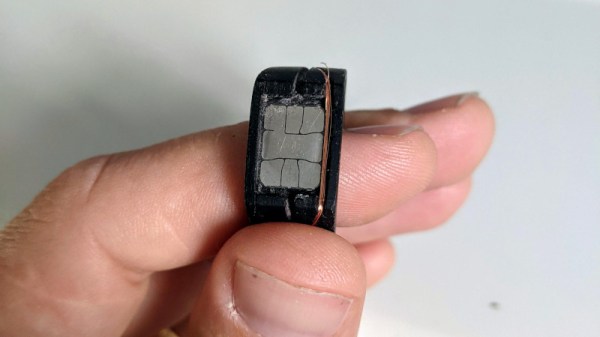
Contactless payment by means of NFC-enabled bank cards has made our everyday transactions far more convenient over the last decade, but there still remains the tedious task of finding the card and waving it over the reader. Maybe embedded chips are a step too far for many of us, but how about a bank card in a wearable such as a ring? [Jonathan Limén] shows us how, by taking the NFC chip module from a bank card and mounting it on a ring with a wire coil antenna embedded within it.

The chip in a bank card comes mounted on a small thin PCB with contacts on one side and a coil on the other that serves as its antenna. It’s not sensitive enough to work reliably with most card readers, so the card incorporates a separate printed circuit layer that forms a large-sized tuned circuit which couples to the chip antenna. After taking us through the removal of the chip from the card with some acetone, he proceeds to create a replacement for the card antenna by winding a wire coil round the ring. This becomes a trial-and-error process, but in the end, the result is a working NFC payment ring.

We quite like this idea, but would be tempted to both take away some of the trial and error with a vector network analyzer, and run a couple of turns of the wire as a closer coupling coil for the chip. This is a subject we’ve looked at before here at Hackaday, and we wouldn’t mind having another go at it.