A Phased-Array Ultrasonic 3D Scanner From Scratch

Who wouldn’t want an autonomous drone to deliver cans of fizzy drink fresh from the fridge? [Alex Toussaint] did, and in thinking how such a machine might work he embarked on a path that eventually led him to create a fully functional ultrasonic 3D scanner. In writing it up he’s produced a straightforward description of how the system works, which should also be of interest to anyone curious about phased array radar. He starts with an easy-to-understand explanation of the principle behind phased array beam forming, and there follows his journey into electronics as he uses this ambitious project to learn the art from scratch. That he succeeded is testament to his ability as well as his sheer tenacity.

He finally arrived at a grid of 100 ultrasonic emitters controlled from an Arduino through a series of shift register boards. Using this he can steer his ultrasonic beam horizontally as well as vertically, and receive echoes from objects in three-dimensional space. The ornamental bird example he uses for his scanning tests doesn’t quite emerge in startling clarity, but it is still clear that an object of its size and rough shape is visible enough for the drone in his original idea to detect it. If you would like to experiment with the same techniques and array then all the resources can be found in a GitHub repository, meanwhile we’re still impressed with the progress from relative electronics novice to this. We hope the ideas within it will be developed further.

We’ve seen ultrasonic arrays before, but mainly used in levitation experiments.

Using Ikea Guts To Add Sonos Compatibility To A Vintage Speaker

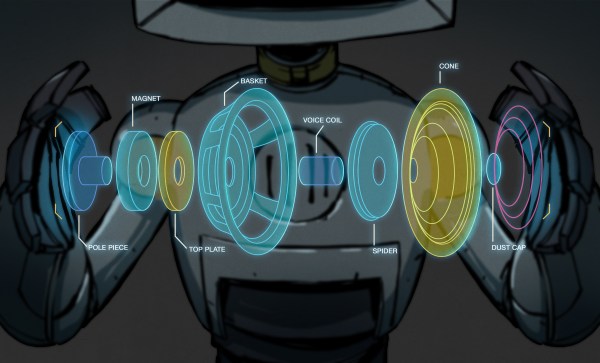
We’re in a fortunate position when it comes to audio gear, because advances in amplifier and signal processing technology have delivered us budget devices that produce a sound that’s excellent in comparison to those of a few years ago. That said, a decent quality device is good whichever decade it was manufactured in, and a speaker from the 1960s can be coaxed into life and sound excellent with a modern amplifier. It’s something [Sebastius] has explored, as he picked up an attractive-looking set of Swedish speakers from the 1960s. Wanting to bring them into the 21st century, he’s upgraded them for Sonos compatibility by hacking in the guts of an IKEA Symfonisk bookshelf speaker.

The speakers themselves looked good enough, but on closer examination they proved to bear the scars of many decades. After testing new wiring and drivers they still had a good sound to them. Their passive crossover meant that hooking them up to a single amplifier is as straightforward as it was decades ago, but a Symfonisk has an active crossover and two amplifiers. Fortunately there’s a neat hack by which those two amplifiers can be combined as one, and this is what he’s done with the resulting Symfonisk electronic package mounted on the reverse of the speaker.

The fate of the original speaker’s broken mid-range and tweeter drivers was a common enough one back in the day as speakers were ill-matched to amplifiers. Too small an amp would need turning up in volume to get a good sound resulting in distortion that would burn out the top end drivers, while too much power would result in the bass drivers being overloaded and failing. It’s unclear whether the drivers in a vintage speaker would be well-matched to an amplifier such as the Symfonisk, but we’re guessing they are safe while run at sensible volumes. Perhaps of more interest is whatever on-board DSP a Symfonisk contains, because while vintage speakers were designed for as flat a response as possible, modern compact speakers use DSP to equalise the frequency and phase responses of otherwise not-very-good-sounding enclosures. If the Symfonisk does this then those adjustments will appear as distortion in the sound of a different cabinet, but the question remains whether that distortion will be significant enough to be detectable by ear.

If the Symfonisk catches your attention, we’ve covered a teardown of it in the past.

Simple Encryption You Can Do On Paper

It’s a concern for Europeans as it is for people elsewhere in the world: there have been suggestions among governments to either outlaw, curtail, or backdoor strong end-to-end encryption. There are many arguments against ruining encryption, but the strongest among them is that encryption can be simple enough to implement that a high-school student can understand its operation, and almost any coder can write something that does it in some form, so to ban it will have no effect on restricting its use among anyone who wants it badly enough to put in the effort to roll their own.

With that in mind, we’re going to have a look at the most basic ciphers, the kind you could put together yourself on paper if you need to.

Continue reading “Simple Encryption You Can Do On Paper”

Apple AirTag Spills Its Secrets

The Apple AirTag is a $29 Bluetooth beacon that sticks onto your stuff and helps you locate it when lost. It’s more than just a beeper though, the idea is that it can be silently spotted by any iDevice — almost like a crowd-sourced mesh network — and its owner alerted of its position wherever they are in the world.

There are so many questions about its privacy implications despite Apple’s reassurances, so naturally it has been of great interest to those who research such things. First among those working on it to gain control of its nRF52832 microcontroller is [Stacksmashing], who used a glitching technique whereby the chip’s internal power supply is interrupted with precise timing, to bypass the internally enabled protection of its debug port. The firmware has been dumped, and of course a tag has been repurposed for the far more worthwhile application of Rickrolling Bluetooth snoopers.

The idea of a global network of every iDevice helping reunite owners with their lost possessions is on the face of it a very interesting one, and Apple are at great pains on the AirTag product page to reassure customers about the system’s security. On one hand this work opens up the AirTag as a slightly expensive way to get an nRF microcontroller for other applications, but the real value will come as the firmware is analysed to see how at the tag itself works.

[Stacksmashing] has appeared on these pages many times before, often in the context of Nintendo hardware. Just one piece of work is the guide to opening up a Nintendo Game and Watch.

Building An Oxygen Concentrator: It Isn’t Rocket Science

Back at the start of the pandemic, a variety of hacker designs for life-saving machinery may have pushed the boundaries of patient safety. There are good reasons that a ventilator must pass extensive safety  testing and certification before it can be attached to a patient, because were it to in some way fail, the patient would die. A year later, we have many much safer and more realistic ways to use our skills as part of the effort.

Probably one of the most ambitious projects comes from a coalition of Indian hackerspaces who are adapting a proven oxygen concentrator for local manufacture. Among them is Hackaday’s own [Anool Mahidharia], who hosts a Maker’s Asylum video (embedded below) explaining how the oxygen concentrator works and how they can be made safely.

The team have proven their ability in manufacturing over the past year, here showing off the M19 motorised air purifying respirator.

An oxygen concentrator is both surprisingly simple and imbued with a touch of magic. At its center are two columns of zeolite, a highly porous aluminosilicate mineral that performs the task of a molecular sieve. When air is pumped into the column, the zeolite traps nitrogen, leaving the oxygen-enriched remnant to be supplied onwards. There are two such columns to allow each to be on an alternate cycle of enrichment or purging to remove the accumulated nitrogen.

The point of the video is to show that such a device can be constructed from readily available parts and with common tools; as the title says it isn’t rocket science. Concentrators produced by the hackerspace coalition won’t save the world on their own, but as a part of the combined effort they can provide a useful and reliable source of oxygen that will make a significant difference in a country whose oxygen distribution network is under severe strain.

We previously covered the Indian oxygen concentrator effort when they launched the project. Their website can be found on the Maker’s Asylum website, and their crowdfunding campaign can be found on the Indian crowdfunding platform, Ketto. They have already proved their ability to coordinate large-scale manufacturing with their previous PPE and respirator projects, so please consider supporting them if you can. Meanwhile, we can’t help a twinge of space envy, from the fleeting glimpse of Maker’s Asylum in the video.

Continue reading “Building An Oxygen Concentrator: It Isn’t Rocket Science”

Ello Is A Tiny Computer With A C — Interpreter?

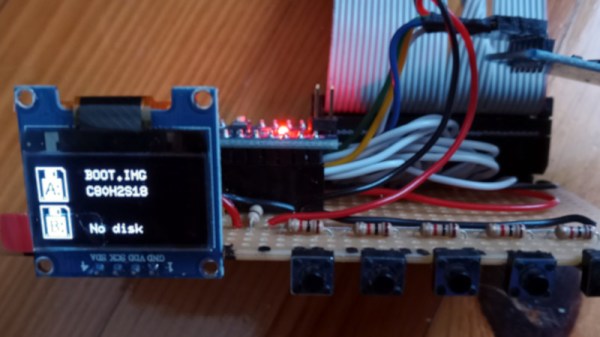
When we talk about a retrocomputer, it’s our normal practice to start with the hardware. But with [KnivD]’s ELLO 1A while the hardware is interesting enough it’s not the stand-out feature. We are all used to microcomputers with a BASIC interpreter, but how many have we seen with a C interpreter? The way C works simply doesn’t lend itself to anything but a compiler and linker, so even with a pared-down version of the language it still represents a significant feat to create a working interpreter.

The hardware centres around a PIC32MX, and has onboard SD card, VGA, sound, and a PS/2 keyboard port. The PCB is a clever design allowing construction with either through-hole or surface-mount components to allow maximum accessibility for less advanced solderers. Full information can be found on the project’s website, but sadly for those wanting an easy life only the PCB is as yet available for purchase.

We’re privileged to see a huge array of retrocomputing projects here at Hackaday, but while they’re all impressive pieces of work it’s rare for one to produce something truly unexpected. This C interpreter certainly isn’t something we’ve seen before, so we’re intrigued to see what projects develop around it.

Polyphony On A Tiny Scale

Older readers may remember the Stylophone, a small battery powered electric organ using conductive PCB pads and a stylus to create notes. The simple multivibrators in those instruments made them monophonic, but here in 2021 we can do better than that! [Sjm4306] has gone the extra mile with a PCB organ, by making a capacitive-touch instrument that boasts four-note polyphony.

At its heart is an ATmega328p whose software sports four tone generators that each emerge on a different pin. These are summed using a set of 100 Ω resistors and fed to a tiny speaker. Power comes from a CR2032 lithium cell, and he notes that a higher voltage delivers more volume.

The full story is detailed in the video below the break, along with a bit of four-note polyphonic action. We’re guessing that this instrument would sound sensational when hooked up to a reverb unit.

Continue reading “Polyphony On A Tiny Scale”