British Licence Plate Camera Fooled By Clothing

It’s a story that has caused consternation and mirth in equal measure amongst Brits, that the owners of a car in Surrey received a fine for driving in a bus lane miles away in Bath, when in fact the camera had been confused by the text on a sweater worn by a pedestrian. It seems the word “knitter” had been interpreted by the reader as “KN19 TER”, which as Brits will tell you follows the standard format for modern UK licence plate.

It gives us all a chance to have a good old laugh at the expense of the UK traffic authorities, but it raises some worthwhile points about the fallacy of relying on automatic cameras to dish out fines without human intervention. Except for the very oldest of cars, the British number plate follows an extremely distinctive high-contrast format of large black letters on a reflective white or yellow background, and since 2001 they have all had to use the same slightly authoritarian-named MANDATORY typeface. They are hardly the most challenging prospect for a number plate recognition system, but even when it makes mistakes the fact that ambiguous results aren’t subjected to a human checking stage before a fine is sent out seems rather chilling.

It also raise the prospect of yet more number-plate-related mischief, aside from SQL injection jokes and adversarial fashion, we can only imagine the havoc that could be caused were a protest group to launch a denial of service attack with activists sporting fake MANDATORY licence plates.

Header image, based on the work of ZElsb, CC BY-SA 4.0.
Know Audio: It All Depends On The DAC

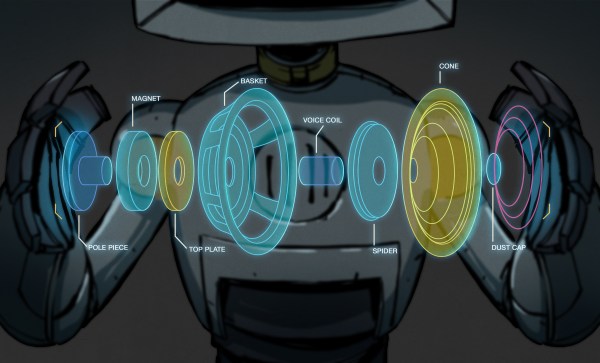
Our trip through the world of audio technology has taken us step-by step from your ears into a typical home Hi-Fi system. We’ve seen the speakers and the amplifier, now it’s time to take a look at what feeds that amplifier.

Here, we encounter the first digital component in our journey outwards from the ear, the Digital to Analogue Converter, or DAC. This circuit, which you’ll find as an integrated circuit, takes the digital information and turns it into the analogue voltage required by the amplifier.

There are many standards for digital audio, but in this context that used by the CD is most common. CDs sample audio at 44.1 kHz 16 bit, which is to say they express the level as a 16-bit number 44100 times per second for each of the stereo channels. There’s an electrical standard called i2s for communicating this data, consisting of a serial data line, a clock line, and an LRclock line that indicates whether the current data is for the left or the right channel. We covered i2s in detail back in 2019, and should you peer into almost any consumer digital audio product you’ll find it somewhere. Continue reading “Know Audio: It All Depends On The DAC”

The PinePhone Pro Is Here. But It’s Still Probably Not The Year Of Open-Source Linux On The Smartphone

A trope in open source commentary over the last decades has been the phrase “Is this the year of Linux on the desktop?”, as though the open source OS will finally break through and challenge Windows. In fact the process has been one of stealth rather than explosive growth, as the likes of ChromeOS with its Linux underpinnings become the go-to choice for an inexpensive consumer laptop. In the phone arena the same has happened with Android, as most users have no idea that a Linux foundation lies beneath their Samsung Galaxy or Google Pixel.

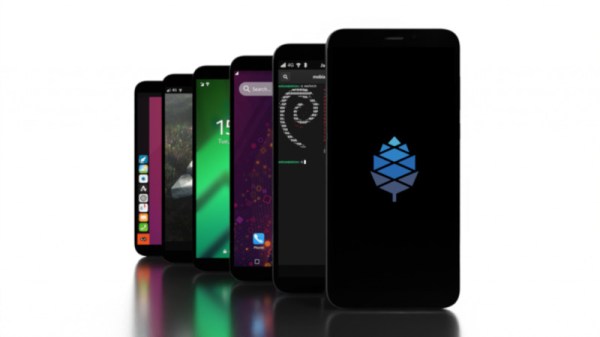
Fully open-source via Android on the phone has been very slow to arrive, but could that be changed by the arrival of Pine64’s PinePhone Pro? The new device will be available alongside their existing PinePhone, and will continue the dream of a fully open-source mobile phone with its increased-specification hardware.

As much as the specs of one black slab versus another matter, at its heart is a 1.5 GHz Rockchip RK3399S hexa-core SoC alongside 4 GB of dual-channel LPDDR4 RAM. This compares well to the original PinePhone’s quad-Core Allwinner A64 at 1.152 GHz and 3 GB LPDDR3 RAM, so it’s clear that there is plenty of capability in this phone.

Any phone whether open-source or not will however live or die on the quality of its software and support, so for this model to be a real success outside the realm of extreme open-source devotees we think that Pine64 will need to be prepared to up their game when it comes to what happens after hardware delivery. It’s fair to say that some of their previous products have been a little lacklustre in this department, with hardware bugs remaining unfixed. Their approach of relying on the community of users to deliver software support has not so far returned a stable experience for users of the original PinePhone. We understand that their intention is to provide a developer’s phone, but developers need to place phonecalls and take pictures too.

We’ve seen some PinePhone owners commenting to this effect, and though we’re fans of Pine64 and like what they are trying to do, we have to admit that those users have a point. If they were prepared to put some effort into software development to the extent of providing an official OS image with let’s say Plasma Mobile, a working phone app, a working web browser, and responsive phone features such as instant on and off, even at the expense of charging more for the phone itself, we think that they’ll be on to a winner. Otherwise they’ll remain as the really cool open-source phone that only your kernel-wizard friends own, and even then they use a Google Pixel as their everyday phone. Please Pine64, prove us wrong!

Last month our colleague Brian Cockfield took us on a tour of his PinePhone.

Arduino Nano Floppy Emulator For When Your Disk Is Not Accessible

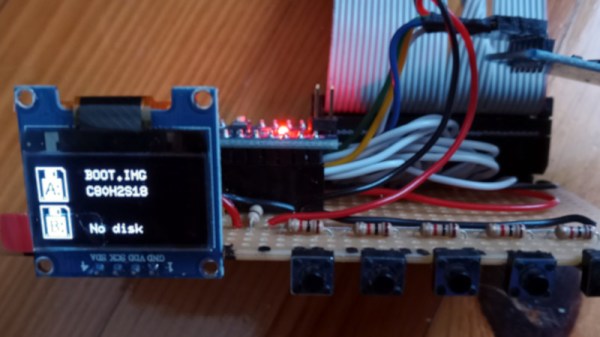
Among the plethora of obsolete removable media there are some which are lamented, but it can be difficult to find those who regret the passing of the floppy disk. These flexible magnetic disks in hard plastic covers were a staple of computing until some time in the early 2000s, and their drives could be found by the crateload in any spares box. But what about today, when there’s a need for a real floppy drive and none is to be found? Enter [Acemi Elektronikci], with an Arduino Nano based floppy emulator, that plugs into the floppy port of a PC old enough to have one, and allows the easy use of virtual floppy disks.

Aside from the Nano it has an SD card and associated level shifter, and an SSD1306 i2c screen. Most of the Arduino’s lines drive the floppy interface, so the five-button control comes to a single ADC pin via a resistor ladder. He freely admits that it’s not a perfect cycle-exact emulator of original hardware and there may be machines or even operating systems that complain when faced with it, but for all that it is a useful tool. One of the machines that may have issues is the Amiga, but fortunately there’s a fix for that with a Raspberry Pi.

A Redesigned ZX Spectrum Desktop Computer That Works Surprisingly Well

Retrocomputer enthusiasts will quite often be found pondering the great what ifs of their hobby. What if Commodore had had a half-way decent marketing division is a popular one, but the notoriously penny-pinching ways of Sinclair Research are also a plentiful source. What if Sinclair had won the competition for a computer in UK schools, not only the first time around when Acorn’s BBC Micro scooped the prize, but also what if they’d entered the fray once more in 1983 when there was another chance? [10p6] investigates this possibility, and comes up with a Spectrum desktop computer that you can see in the video below the break.

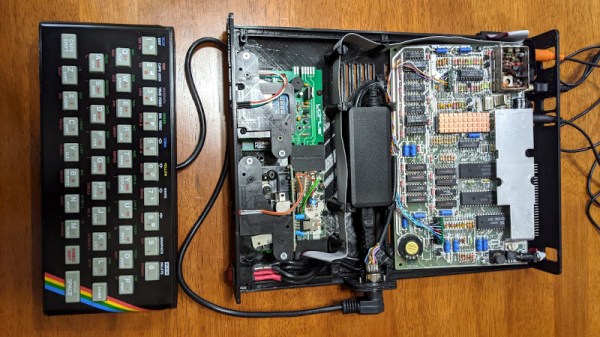
The first two-thirds of the video is devoted to renders which, while pretty to look at, offer nothing of substance. In the later part though we see a build, putting a Spectrum 48k board, Interface 1, and two Microdrives in a slimline case along with a power supply. Meanwhile a ZX rubber keyboard is mounted stand-alone on the end of a cable. It’s a computer that we know would have been an object of desire for many kids back in the day, and we agree with the video that it could have been integrated onto one board without the need for a separate Interface 1. We feel it’s inevitable though that Sinclair’s cost-cutting would have caused something to go astray and there would certainly have been only one Microdrive, even though we like that separate keyboard a lot.

They claim that the STLs will be available from a Facebook group, however unless you happen to have a set of Microdrives and an Interface 1 to go with your Spectrum that you’re prepared to butcher for the project we’re guessing that the chief interest lies in watching it unfold and that some of the ideas might translate to other platforms. Meanwhile if you’re interested in the Microdrive, we did a teardown on them last year.

Continue reading “A Redesigned ZX Spectrum Desktop Computer That Works Surprisingly Well”

The Simplest Way To Spot 2.4GHz RF

When the cool kids are showing off their SDRs it’s easy to forget that a radio receiver can be very simple indeed. The crystal set is one of the earliest forms of radio receiver, a tuned circuit and a diode that would pick up those AM broadcast stations no problem. But lest you imagine that these receivers can only pick up those low frequencies, here’s Hackaday alum [Ted Yapo] with a handy 2.4GHz receiver that picks up strong WiFi and microwave oven leakage.

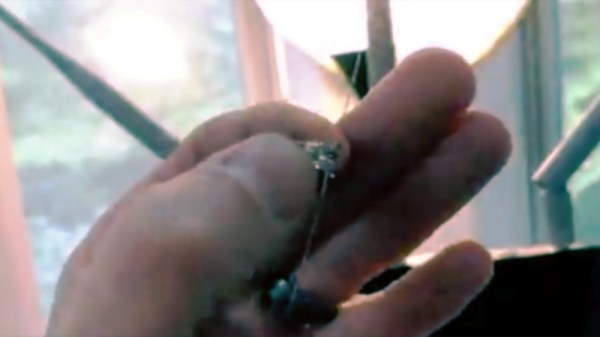
It’s about as simple as it gets, an LED with a UHF diode in reverse across it. The clever part lies in the wire leads, which are cut to resonate as a dipole at 2.4 GHz. The resulting RF voltage is rectified by the UHF diode, leaving enough DC for the LED to flash. If you are wondering why the LED alone couldn’t do the job as a rectifier you would of course be on to something, however its much worse high frequency performance would make it not up to the job at this frequency.

The glory days of analogue broadcasting may now be in the past, but it’s still possible to have fun with a more conventional crystal radio. If you are adventurous, you can even make one that works for the FM, band too.

The Pi 400 As A PC Peripheral

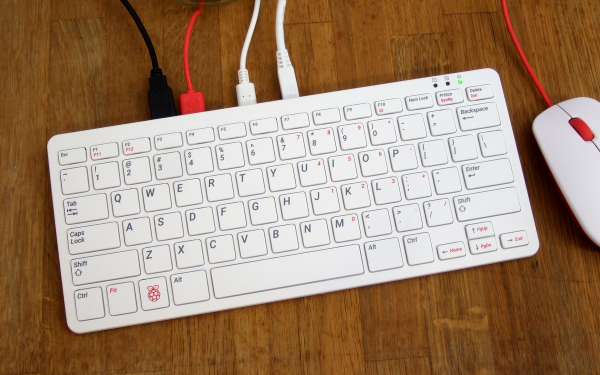
The Raspberry Pi 400 all-in-one computer is a neat little unit that is powerful enough to take on most humdrum computing tasks while doing an excellent job of freeing up valuable desktop space. But what about those moments when both the Pi and a PC are needed on the same desktop? How can the Pi and the bulky PC keyboard share the same space?

[Gadgetoid] may have the answer, with a clever bit of software that presents the Pi’s mouse and keyboard as peripherals on its USB-C power port. If your PC has a high-power USB socket that can run the Pi then it can use the small computer’s input devices just as well as the Pi itself can. It’s fair to say that the Pi 400’s keyboard is not it’s strongest point, but we can see some utility in the idea.

Running it is simply a case of running an executable from the Pi. Control can be wrested back to Raspberry Pi OS with a simple keystroke. Perhaps it’s not the ultimate desktop experience, but if you’re a die-hard Pi-head there’s plenty of appeal.

Within a few weeks, it’s a year since the launch of the Pi 400. We’ve not seen as many of them as the other Pi models, but you might find our original review to be of interest.

Thanks [Itay] for the tip.