Printed Focus Control For Pro Style Cinematography

When you watch a movie and see those perfect focus switches or zooms, the chances are you’re not seeing the result of the cameraman or focus operator manually moving the lens controls. Instead, they will have been planned and programmed in advance and executed by a motor. If you take a close look at many lenses you’ll see a ring that’s more than just extra knurling, it’s a gear wheel for this purpose. Want to experiment with this technique without buying professional grade accessories? [l0u0k0e] has you covered with a 3D printable focus zoom motor accessory.

The motor behind it all is a geared stepper motor, and there are a set of printed parts to complete the model. It’s recommended to use PETG, and nylon for the gears, but it would work in PLA with a shorter life. It’s designed to work with the standard 15 mm tube you’ll find on many camera rigs, and while you can write your own Arduino sketches to control it if you wish, we’re given instructions for hooking it up to existing focus drivers. The model is on Printables, should you wish to try.

This is by no means the first focus puller we’ve seen, in fact you can even use LEGO.

A Network Status Panel The Way It Should Be

Sometimes a project forms itself around a component rather than an idea, and thus it was that [Maximilien] found himself building a data rate monitor for the connection between two data centers. Some MD0657C2-R LED dot matrix displays for not a lot needed a project.

The displays are mounted in groups of four on small PCBs, driven by a MAX6952, which are then controlled by a Pi Pico. There are several display panels in the project, each of which is a pained and laser-etched acrylic sheet with a pair of the LED boards mounted behind it. These in turn go on the front of a wooden enclosure, with a set of LED ring lights behind to illuminate the etched parts of the panels. Each display panel has its own Pico, daisy chained together and driven by a Pico W that supplies network connectivity.

As you might expect, this isn’t the first status panel we’ve brought you over the years.

In Film, What’s Old May Still Be New Again

We recently published an affectionate look at a Polaroid Land camera, whose peel-apart instant film is long out of production except for a very few single exposure packs form a boutique manufacturer. All that was left was a discussion of modifying it for conventional roll film, or perhaps hacking a modern back-to-front Polaroid sheet into it.

Never say never though, because along come the Chinese company Light Lens Lab with a short announcement at the end of a post talking about grain structures and anti-halation layer materials for their black and white film.

Lastly, with our future development plan, we are currently developing and researching instant peel-apart film, with plans on producing and making available black and white peel-apart film by 2025 in various format. We aim to have an update on our packaging and test shot for the next development/research progress installment. We are also researching, developing and producing colour reversal films that consist of a dye-incorporating development process, commonly known as K-14, for 135 and 120 formats in 2026.

So there you go, no sooner has Hackaday declared a format unavailable, than it shows every sign of reappearing. At this point we’d like to take the opportunity to report that McDonalds Szechuan Chicken McNugget sauce will never ever be available again. Continue reading “In Film, What’s Old May Still Be New Again”

A Steady Vacuum For The Fastest Cassette Tape Drive Ever

If you think of a 1960s mainframe computer, it’s likely that your mental image includes alongside the cabinets with the blinkenlights, a row of reel-to-reel tape drives. These refrigerator-sized units had a superficial resemblance to an audio tape deck, but with the tape hanging down in a loop either side of the head assembly. This loop was held by a vacuum to allow faster random access speeds at the head, and this fascinates [Thorbjörn Jemander]. He’s trying to create a cassette tape drive that can load 64 kilobytes in ten seconds, so he’s starting by replicating the vacuum columns of old.

The video below is the first of a series on this project, and aside from explaining the tape drive’s operation, it’s really an in-depth exploration of centrifugal fan design. He discovers that it’s speed rather than special impeller design that matters, and in particular a closed impeller delivers the required vacuum. We like his home-made manometer in particular.

What he comes up with is a 3D printed contraption with a big 12 volt motor on the back, and a slot for a cassette on the front. It achieves the right pressure, and pulls the tape neatly down into a pair of loops. We’d be curious to know whether a faster motor such as you might find in a drone would deliver more for less drama, but we can see the genesis of a fascinating project here. Definitely a series to watch.

Meanwhile, if your interest extends to those early machine rooms, have a wallow in the past.

Continue reading “A Steady Vacuum For The Fastest Cassette Tape Drive Ever”

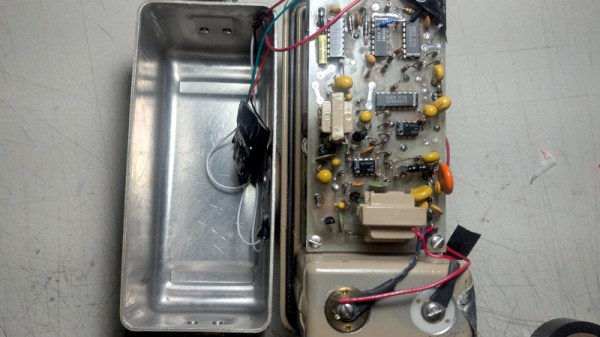
A Vintage ‘Scope Comes Back To Life

We’re suckers for a vintage electronic teardown here at Hackaday, and thus it’s pleasing to see [Thomas Scherrer OZ2CPU] with a 1962 AEG oscilloscope on his bench. It’s definitely seen better days, and is a single-trace 10 MHz unit of the type you might have seen in a typical general purpose electronics lab back in the day.

Pulling the cover off, and as expected there’s a row of tubes each side of the centrally mounted CRT. No printed circuits in sight, and no transistors either, though the rectifiers are selenium parts. After a clean-up it’s time to look at the tubes, and they show the metallic deposits characteristic of long operation. We’re more used to that from older televisions than test equipment,

Gently bringing the power up it looks promising, but there’s a purple glow from one of the PCL82 triode-pentodes. Replacing that and a double-triode results in a ‘scope that surprisingly, is working. It was evidently a high quality device in the first place, with components capable of lasting for over six decades.

We’ve seen more from his bench involving tubes, including this device using a magic-eye tube as the heavy lifter.

Continue reading “A Vintage ‘Scope Comes Back To Life”

What Use Is An Original Raspberry Pi?

Almost uniquely among consumer grade computer manufacturers, the Raspberry Pi folks still support their earliest boards. We’re guessing that’s in part due to the much more recent Pi Zero using the same 32-bit system-on-chip, but it’s still impressive that a 13-year-old single board computer still has manufacturer OS support. With so many of these early boards out there, is there much you can do with them in 2025? [Jeff Geerling] gives it a try.

His test Pi is unusual in itself, the 2013 blue special edition that RS gave away in a social media promotion. Sadly we didn’t win one back in the day and neither did he, so he picked it up in an online auction. We’re treated to some very slow desktop exploration, but it’s clear that this is not where the strengths of a Pi 1 lie. It was reckoned at the time to be roughly equivalent to a Pentium II or Pentium III in PC terms, so that shouldn’t be a surprise. Instead he concludes that it’s better as a headless machine, though he notes how projects are starting to abandon 32 bit builds. The full video is below the break.

We asked the same question not so long ago, and the Hackaday Pi 1 now quietly analyses news content on its two-watt power budget. It’s still a useful little Linux box for your script-based projects even if it will never win any speed prizes.

Continue reading “What Use Is An Original Raspberry Pi?”

2025 Pet Hacks Contest: Weigh Your Dog The Easy Way

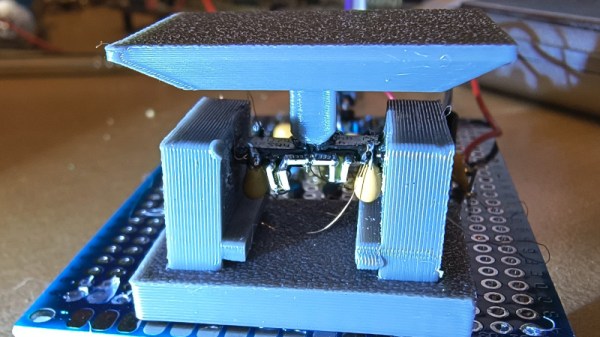
If you need to weigh your pet, you’ll soon find that getting an animal to stand on a weighing machine to order is very difficult indeed. If the critter in question is a cat or a small dog you can weigh yourself both holding them and not holding them, and compute the difference. But in the case of a full size Bernese mountain dog, the hound is simply too big for that. Lateral thinking is required, and that’s how [Saren Tasciyan] came up with the idea of making a dog bed that’s also a weighing machine. When the mutt settles down, the weight can be read with ease. The bed itself is a relatively straightforward wooden frame, with load cells placed above rubber feet. The load cells in turn talk to an ESP8266 which has an LCD display to deliver the verdict. Dog weighed, without the drama.

This project is of course part of the Hackaday 2025 Pet Hacks contest, an arena in which any of the cool hacks you’ve made to enhance you and your pet’s life together can have an airing. Meanwhile this isn’t the first time this particular pooch has had a starring role; he’s sported a rather fetching barrel in a previous post.