A Few Of My Favorite Things: Amateur Radio

Hackaday has among its staff a significant number of writers who also hold amateur radio licenses. We’re hardware folks at heart, so we like our radios homebrew, and we’re never happier than when we’re working at high frequencies.

Amateur radio is a multi-faceted hobby, there’s just so much that’s incredibly interesting about it. It’s a shame then that as a community we sometimes get bogged down with negativity when debating the minutia. So today let’s talk about a few of my favourite things about the hobby of amateur radio. I hope that you’ll find them interesting and entertaining, and in turn share your own favorite things in the comments below.

Continue reading “A Few Of My Favorite Things: Amateur Radio”

The Sony ScopeMan, Possibly The Best Product They Never Made

From the perspective of a later decade it’s sometimes quaint and amusing to look back at the technological objects of desire from times past. In the 1980s for example a handheld television was the pinnacle of achievement, in a decade during which the Walkman had edged out the transistor radio as the pocket gadget of choice it seemed that visual entertainment would surely follow. Multiple manufacturers joined the range of pocket TVs on offer, and Sony’s take on the format used a flattened CRT with an angled phosphor screen viewed from behind through its glass envelope. [Niklas Fauth] took one of these Sony Watchman devices and replaced its TV circuit board with one that turned it into a vector display. The Sony Scopeman was born!

The schematic is deceptively simple, with an ESP32 receiving audio via Bluetooth and driving the deflection coils through a pair of op-amps and a set of driver transistors. These circuits are tricky to get right though, and in this he acknowledged his inspiration. Meanwhile the software has two selectable functions: a fairly traditional X-Y vector ‘scope display and a Lorenz attractor algorithm. And of course, it can also display a vector version of our Wrencher logo.

We like the Scopeman, in fact we like it a lot. There may be some discomfort for the retro tech purist in that it relies on butchering a vintage Watchman for its operation, but we’d temper that with the observation that the demise of analogue broadcast TV has rendered a Watchman useless, and also with the prospect that a dead one could be used for a conversion project.

[Niklas] has had more than one project appear on these pages, a memorable example being his PCB Tesla coil.

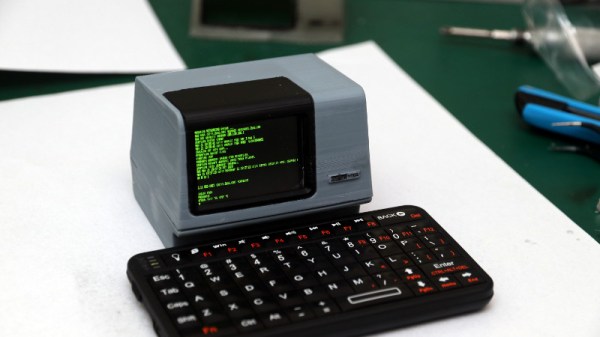
A Miniature VT102 Running A Miniature PDP11

We spend a lot of time looking at retrocomputing in the form of gaming and home computers, but it’s true to say that minicomputers are less common than hardware projects. Perhaps it’s the size, cost, or even relative rarity of the original machines, but DEC minicomputers are a bit unusual around here. [Sprite_TM] hasn’t bought us a PDP11 or a VT102 terminal, but he’s done the next best thing in the form of a miniature working VT102 that also conceals a PDE11 emulator. It runs Tetris, which was originally developed on a Russian clone of the PDP11 architecture, and the 2.1BSD operating system.

Powering it all is an ESP32 module, and the PDP11 emulator is the well-known SIMH software. Porting this to the slightly limited environment of the microcontroller required a few compromises, namely the network stack and the configuration interface. In a particularly clever move [Sprite_TM] enabled BSD networking by writing an ESP32 layer that takes network packets via SIMD directly from BSD. It includes its own DHCP client and wireless network configuration tool, allowing an ancient UNIX-derived operating system from the 1970s to connect to the 21st century Internet through an emulator with its network code stripped out.

The case is a masterwork in OpenSCAD, a complete VT102 unit in miniature with a tiny LCD screen that when printed on a resin printer is a remarkable facsimile of the real thing. It doesn’t have a keyboard counterpart, but even with a miniature Bluetooth ‘board it still looks pretty impressive. In the video below the break he boots it into 2.1BSD, and importantly since it is a server operating system, logs into it from his laptop and plays a game of Zork.

[Sprite_TM] has brought us so many impressive projects over the years using the ESP32 and other parts. Maybe you have a favorite, but for us it’s the PocketSprite Game Boy-like tiny handheld console.

Continue reading “A Miniature VT102 Running A Miniature PDP11”

AT Keyboard Becomes Child’s Speaking Toy

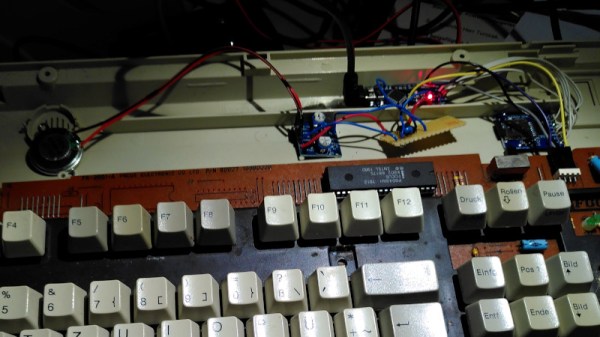
Just as cats find sitting on a keyboard to be irresistible, so do children find pressing their keys. After throwing some ideas around with other parents, [Peter] came up with the idea of transforming an old AT  keyboard into a learning toy by making each key press “speak” its corresponding letter.

The donor keyboard is a nondescript late-80s AT compatible PC. Before readers imagine that a sought-after mechanical ‘board is being defiled, these were manufactured in their millions back then with exactly the same lackluster actions as modern cheap input devices. This one had plenty of space inside for an Arduino Nano that emulates an AT keyboard host and plays WAV file samples from an SD card to one of its PWM outputs. An op-amp low pass filter cleans up the noise from this rudimentary DAC, and feeds a little speaker through an audio amplifier. The keyboard supports both male and female voices, as well as a piano.

Hours of juvenile fun will no doubt result, but we can’t help wondering whether this could become the bane of a parent’s life in the manner of so many other noise-producing toys. Meanwhile, [Peter]’s work has graced these pages in the past, most recently with an automatic cooker hood.

A Surefire Way To Make Masks

By now, the wearing of a facemask to protect ourselves from pandemic infection is for many of us a daily fact of life. Perhaps that means a cheap disposable mask, but there’s no reason that has to be the case. It’s easy to make more durable masks that can be washed and re-used time and time again, and our Hackaday colleague [Kristina Panos] has shared her pattern and workflow to help you do it.

Her pattern isn’t a complex cut-out but a simple rectangle, and the trick of sewing them together and flipping them inside out makes for a very tidy result. With three pleats pressed in and the elastic sewn up the result is a mask that’s neat, attractive, effective, and cheap, which is a win in our book.

It’s worth repeating her important point that these are not for use in medical environments, instead they’re the standard street-wear aerosol catchers we’re all used to. This isn’t the first time we’ve looked at masks here at Hackaday, or indeed though [Kristana]’s are by far the tidier neither is it first time one of us has made a mask. We looked at them in depth last year in our surviving the pandemic as a hacker series.

A 136 Euro Pulse Jet For Some No-Firework Lockdown Fun

With the aim of reducing virus transmission due to gatherings during the pandemic, the Dutch government have banned fireworks. The people of the Netherlands like their noisy things so we’re told that the ban has been widely flouted, but [Build Comics] are a law-abiding group of workshop tool heroes. For their lockdown noise, they created an entirely-legal pulsejet. The interesting part is that it was made entirely using fairly basic tools on a minimalist budget, with TIG and MIG eschewed in favour of a mundane stick welder.

The form of the pulse jet will probably be familiar as it has been taken from other published designs. A long tube is bent back upon itself with a combustion chamber placed in one of its arms such that the jet forms a resonant chamber that produces continuous pulses of exhaust gas. This one is made from stainless steel tube, and the exhaustive documentation should be worth a look for anyone tempted to make their own. Welding thin sheet with a stick welder requires quite a bit of skill, and in a few places they manage to burn a hole or two. One requires a patch, but the time-honoured technique of running a bead around the edge manages to successfully close another.

Their first attempt to fire it up using a leaf blower with a 3D-printed adapter fails, but following the construction of a more resilient part and a more efficient gas injector the engine starts. It’s then taken out on a farm for some serious noise without too many angry neighbours, as you can see in the video below the break.

The hero tools of Build Comics have appeared here before, most recently with an analogue meter clock.

Continue reading “A 136 Euro Pulse Jet For Some No-Firework Lockdown Fun”

RISC-V Comes To The BeagleBoard Ecosystem With Upcoming Beagle V SBC

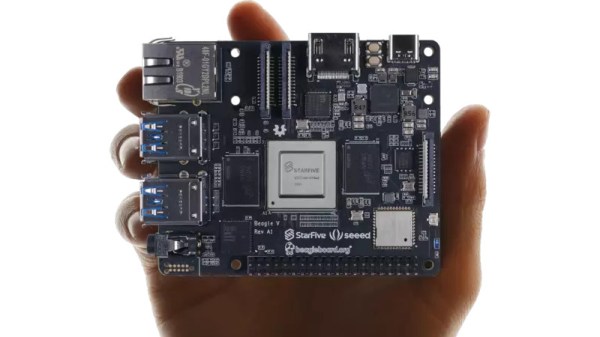
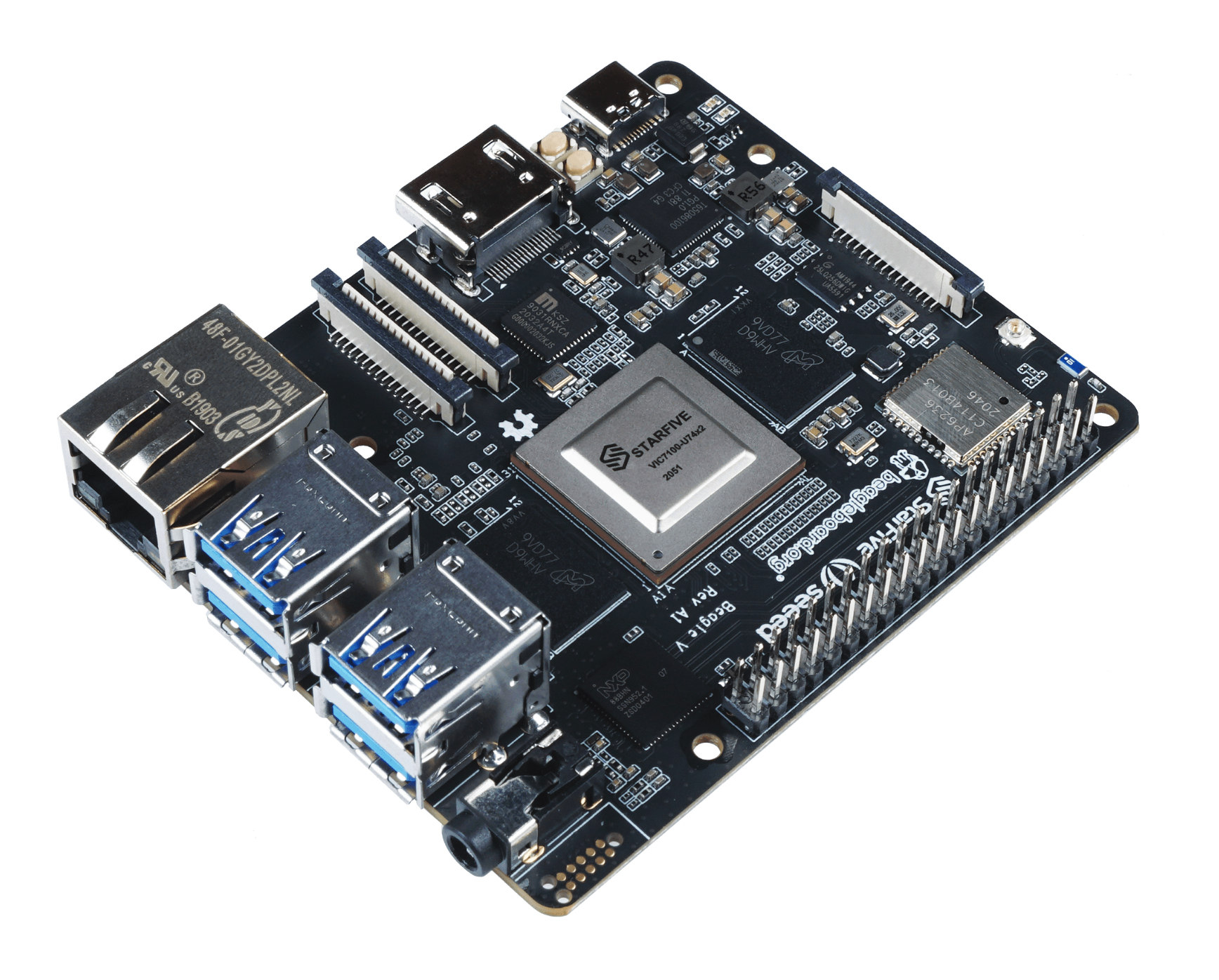
The Beagle V, a RISC-V-based single board computer from a collaboration between BeagleBoard and Seeed Studios aims to be “The First Affordable RISC-V Computer Designed to Run Linux”. RISC-V is the open-source processor architecture that everyone is interested in because it bypasses proprietary silicon of manufacturers such as Intel or AMD, allowing companies to roll their own silicon processors without licensing fees for the core.

BeagleBoard has long been one of the major players in the Single-Board Computer arena so far dominated by the Raspberry Pi. The board, slightly larger than the company’s previous offerings, features a StarFive dual-core 64-bit RISC-V processor running at a 1.0 GHz clock speed. The spec sheet on their GitHub repo indicates 4 and 8 GB RAM options, built-in WiFi and Bluetooth, and hardware video support for decoding, two camera connectors, one DSI connector for an external display, as well as a full-sized HDMI port. Gigabit Ethernet, four USB-3 ports, an audio jack, and USB-C as the power supply are packed onto the edges of the board. GPIO is routed to a 2×20 pin header.

Seeed Studio pegs the cost of the board at $149 for the 8 GB RAM version, although currently you must apply and be selected to purchase a board in this early stage. It’s unclear if the price will remain unchanged after this first run; the product page notes a coupon code is necessary and the Seeed Studios article indicates this is an introductory price. However, the same article also lists the 4 GB RAM variant at $119. The BeagleBoard page shows a timeline of April 2021 for a “pilot run for community”.

It’s exciting to see RISC-V continue to make inroads. This is a powerful board based around the core, and if successful it will help further prove the viability of open source processing cores in increasingly mainstream products.