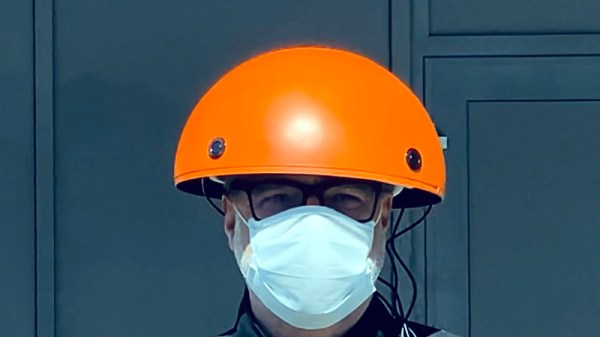
Those of you with an eye to classic cinema will remember 1985’s Back To The Future, and particularly its scientist character Dr. Emmett Brown. When the protagonist Marty McFly finds himself in 1955, on his first meeting with they younger Dr. Brown the latter is wearing an experimental helmet designed to read thoughts. It doesn’t work, but it’s an aesthetic we’re reminded of in [Håkan Lidbo]’s Corona Hat, a social distancing tool that incorporates distance sensors into a piece of headgear.
The device is simple enough, half of a globe fitted with a set of car reversing sensors and the battery from an autonomous vacuum cleaner. It’s sprayed a bright orange, and worn on the head as he walks around town in the video below the break. It beeps any time something or somebody gets too close, and as far as we can see it’s effective in what it does. We are not so sure about the look though, to us as well as Emmett Brown it’s a little too reminiscent of the character Sheev in the 2005 Dukes of Hazzard movie who wore an armadillo’s armour as a hat. Perhaps more conventional headgear as a basis might gain it a few fewer askance looks.
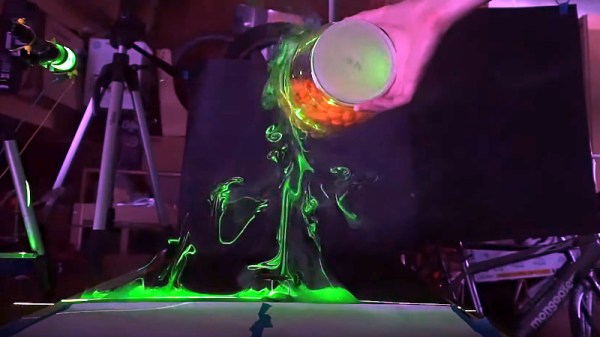
For some of us the smell of rosin soldering flux vaporizing from the tip of an iron as a project takes shape is as evocative as the scent of a rose on a summer’s day. We’ve certainly breathed enough of it over the years, as it invariably goes from the piece of work directly into the face of the person doing the soldering. This is something that has evidently troubled [AlphaPhoenix], who has gone to extravagant lengths to research the problem using planar laser illumination and a home-made (and possibly hazardous) smoke generator.
He starts with a variety of hypotheses with everything from a human-heat-driven air vortex to the Coandă effect, but draws a blank with each one as he models them using cardboard cut-outs and boxes as well as himself. Finally he has the light bulb moment and discovers that the key to the mystery lies in his arms coming across the bench to hold both iron and solder. They close off an area of lower-pressure dead space which draws the air current containing the smoke towards it, and straight into his face. It’s something that can be combated with a small fan or perhaps a fume extractor, as despite some video trickery we have yet to master soldering iron telekinesis.
When it comes to YouTube videos, there’s little we like more than some good quality workshop action, watching someone in command of their tools craft a machine from raw materials with an amazing result. It’s something [Workshop From Scratch] delivers with his homemade mini dumper, in which he makes a small dump-truck from scratch with a result that looks as though he’d bought it factory-made from his agricultural supplier.
At its heart is a substantial chassis made from welded together double box section tube, to which he’s bolted a second-hand hydraulic transmission of the type you would find on larger walk-behind groundskeeping machinery. At the back is a front steering axle from a mobility scooter, that pivots on a bearing and wheel hub from a Ford Mondeo to ensure stability on rough ground. There is a platform for the operator to stand on as the little Honda 4-stroke engine moves it around. The bucket is plasma cut and welded, and it’s safe to say that his welding ability exceeds ours.
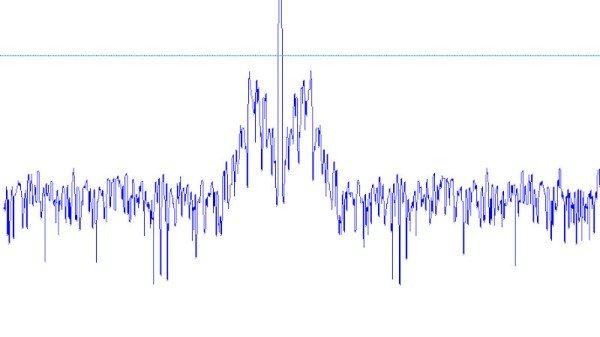
We are used to seeing shots from TV news helicopters every day, they are part of the backdrop to life in the 21st century. But so often we hear them overlaid with studio commentary, so it’s interesting to hear that their raw audio contains telemetry. It caught the attention of [proto17], who took some audio pulled from a news helicopter video and subjected it to a thorough investigation to retrieve the data.
The write-up is at a very in-depth level, and while there’s an admission that some of the steps could have been performed more easily with ready-made tools, its point is to go through all steps at a low level. So the action largely takes place in GNU Radio, in which we see the process of identifying the signal and shifting it downwards in frequency before deducing its baud rate to retrieve its contents. The story’s not over though, because we then delve into some ASCII tricks to identify the packet frames, before finally retrieving the data itself. It still doesn’t tell you what the data contains, but it’s a fascinating process getting there nonetheless.
So after a false start due to bad weather, the first crewed launch of a SpaceX Crew Dragon capsule with two astronauts on board has gone ahead. After playing catch-up with the ISS for around 27 hours they’re now safely aboard. At times it seems that space launches have become everyday occurrences, but they are still heroes who have risked their lives in the furtherment of mankind’s exploration of space. Their achievement, and that of all the scientists, engineers, and other staff who stand behind them, is immense.
I watched the drama unfold via the live video feed. Having heaved a huge sigh of relief once they were safely in orbit, the feed cut to the studio, and then moved on to interview the NASA administrator Jim Bridenstine. He was naturally elated at a successful launch, and enthused about the agency’s achievement. You can watch the full interview embedded below, but what caught my attention was his parting sentence:
And if this can inspire a young child to become the next Elon Musk, or the next Jeff Bezos, or the next Sir Richard Branson, then that’s what this is all about
I was slightly shocked and saddened to hear this from the NASA administrator, because to my mind the careers of Musk, Bezos, or Branson should not be the ones first brought to mind by a space launch. This isn’t a comment on those three in themselves; although they have many critics it is undeniable that they have each through their respective space companies brought much to the world of space flight. Instead it’s a comment on what a NASA administrator should be trying to inspire in kids.
Ask yourself how many billionaire masters-of-the-universe it takes for a successful space race compared to the number of scientists, engineers, mathematicians, technicians, physicists, et al. From the anecdote of the NASA administrator it takes about three, but if he is to make good on his goal of returning to the Moon in 2024 and then eventually taking humanity to Mars it will take a generation packed full of those other roles. To understand that we’ll have to take a trip back to the Apollo era, and how that generation of kids were inspired by the spacecraft on their screens.
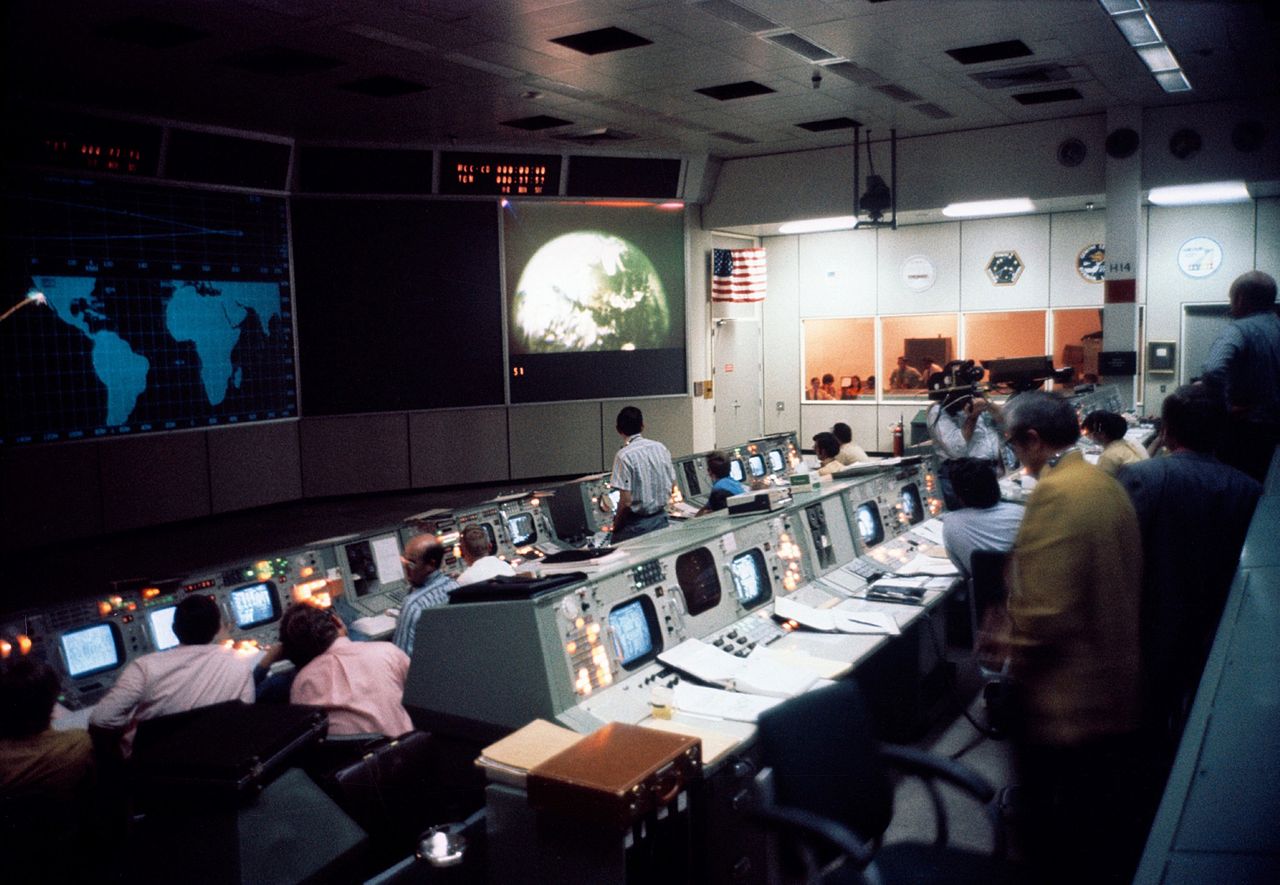
Inspiration from probably the coolest room in the world at the time, the Apollo mission control in Houston. NASA on The Commons / No restrictions
Fifty years ago, we were very much on the brink of becoming a spacefaring planet. American astronauts were taking their first steps on the Moon, and Soviet cosmonauts were occupying real space stations that would soon be capable of housing them for months at a time. Planetary probes were returning colour TV pictures from other worlds, and it was certain that in the immediate aftermath of the Apollo programme we’d be sending astronauts and probably cosmonauts too further afield. A Mars base in the 1980s perhaps, and following our fictional Star Trek heroes further afield thereafter.
We now know it didn’t quite work out that way, but a whole generation of tech-inclined kids grew up wanting nothing more than to be involved in space flight. The vast majority of us never made it, but with that inspiration we took our soldering irons and 8-bit home computers and ran with them. Those NASA folks were the coolest of role-models, and no doubt their Soviet equivalents were too for kids on the other side of the Iron Curtain.
With the best will in the world, the chances of any kid becoming the next Jeff Bezos is about as high as that of their becoming the next Neil Armstrong. Compared to the number of kids in the world, the number of billionaires and the number of astronauts both pale into statistical insignificance. But the chances of a kid becoming an engineer or a scientist is much higher, and in those careers their chances of having some of their work be involved with the space effort becomes not entirely unlikely.
I understand what the NASA administrator was trying to say, but can’t shake the feeling that if those are the people he rolls out to inspire kids watching a space launch, he’s missed an opportunity. Those are the names we all recognize, but shouldn’t we also elevate the people making the scientific breakthroughs so their names are equally recognized? Like Margaret Hamilton, Gene Kranz, and Sergei Korolev and many others before them, we should be making names like Tom Mueller and Margarita Marinova prominent examples of where a career in the sciences can take you. But to be honest, the real problem is we just don’t hear much about all the people doing this fascinating engineering and that’s a sad state of affairs.
Looks like it’s time for Hackaday to pursue a biography series based on the many great minds who are the ones delivering on the promise and vision of today’s (and tomorrow’s) space race. Get us started by talking about your favorite behind the scenes science folks in the comments below.
Many of us will possess digital oscilloscopes which offer at an affordable price an array of features once unimaginable on the analogue CRT ‘scopes of yesteryear. But those old analogue beasts were fine pieces of equipment when they were made and remain so today. So how can they find a place in the digital age?
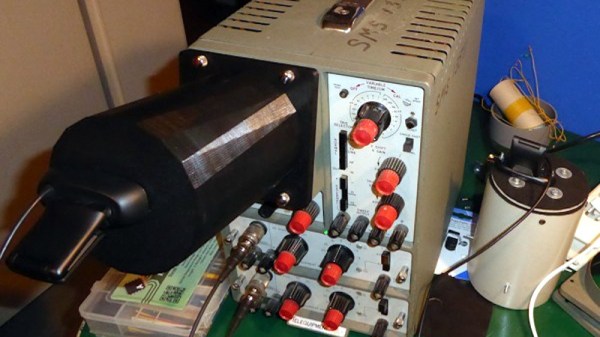
Perhaps [Joseph Eoff] has the answer, because he’s fitted his trusty Telequipment D43 with a camera in a 3D-printed attachment, paired with a piece of cross-platform Python/Qt custom software using OpenCV to identify, digitize, and quantify the traces. The software allows viewing the either the digitized trace or the real trace, and derives measurements of voltage and frequency from them. One limitation is that despite the ‘scope being a dual-trace model, the software only has a single set of cursors to measure one trace at a time. All the code can be had from the GitHub repository, should you wish to experiment with it or extend it.
It’s worth thinking for a minute at what price point a remotely decent digital ‘scope starts, then considering the ease with which surprisingly good older analogue instruments can be found on the second-hand market for not a lot. An approach such as this one makes them an even more attractive proposition.
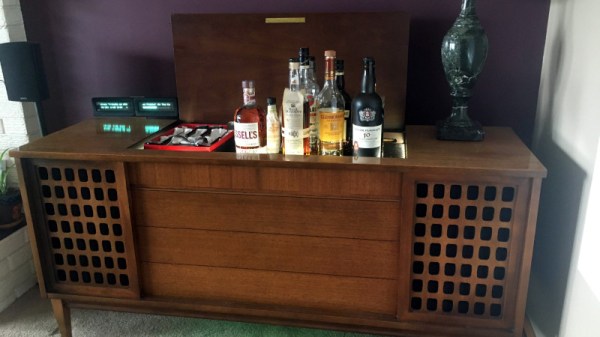
There was a time when consumer electronics were statement items, designed to resemble quality furniture that would be shown off as a centerpiece of the home. Televisions in ornate wooden cabinets, or stereos looking for all the world like sideboards. [Zethus] had just such a huge record player and radio combo in a sideboard, and having little use for the cream of 1950s home entertainment technology, he rebuilt it as a concealed liquor cabinet with electronic controls and a much more modern stereo that forms part of a Logitech Media Server multi-room system.
After removing the tube-based radio chassis and Garrard jockey-wheel turntable it was time to gut their supporting woodwork and install the platform derived from a standing desk. With suitably impressive lighting and a pair of VFD displays for the music choice, there is the inevitable Raspberry Pi running the show. Control is achieved by a set of hidden capacitive buttons, and there’s a Web interface to allow both music and magical appearance of alcohol from the comfort of a smartphone. The whole can be seen in the video below the break.
Whenever a piece of vintage electronics is gutted in this way there will always be people who find it disquieting, but the truth is that these all-in-one stereos were made in huge quantities during the mid-century period and do not have a significant value. This one may have lost its original electronics, but it lives on safe from the dump that has claimed so many of its brethren. Happily this isn’t the first one we’ve seen saved with a Pi.