The Key To This City Opens A Real Lock

There are few more satisfying moments than the first time you pick a lock. No matter that it’s a dollar-store padlock that you opened with a pick from a $10 eBay kit, the magic of something that should be secure clicking open in the palm of your hand is hard to beat. Pin tumbler locks are surprisingly simple devices, and to demonstrate this [Farmcraft 101] has produced one at 10x scale to demonstrate their operation on the bench.

The video is a delightful exercise in wood-shop voyerism, as we see him construct the various parts of the lock using his lathe and other workshop tools. A key of the size usually reserved for Freedom Of The City is made, but this one really does slide into the keyway and operate those pins. At the back is a latch mechanism, and the result is a fully-functional model that anyone should be able to use to figure out how the lock works.

Thelock itself isn’t the whole story though, because given the date he’s used it as the basis for a cracking April Fool in which he sends up the [Lock Picking Lawyer] and proceeds to demonstrate the glaring insecurities in his creation. Both videos are there for your enjoyment, below the break. And if you can’t wait to have a go at a lock or two, don’t forget you can always make your own tools using paperclips.

[Ed note: streetcleaner bristles. Thank me later.]

Continue reading “The Key To This City Opens A Real Lock”

Iceland Is Doing Its COVID-19 Proximity Tracing The Open Source Way

As governments around the world grapple with the problem of tracing those who have had contact with a person known to have been infected with the COVID-19 virus, attention has turned to the idea of mobile apps that can divulge who a person has been near so that they can be alerted of potential infections. This has a huge potential for abuse by regimes with little care for personal privacy, and has been a significant concern for those working in that field. An interesting compromise has been struck by Iceland, who have produced an app for their populace that stores the information on the device and only uploads it with the user’s consent once they have received a diagnosis. We can all take a look, because to ensure transparency they have released it as open source.

On signing up for the scheme a central server stores the details of each user as well as their phone number. When the epidemiologists have a need to trace a person’s contacts they send a notification, and the person can consent to their upload. This is a fine effort to retain user privacy, with depending on your viewpoint the flaw or the advantage being that the user can not have their data slurped without their knowledge. Iceland is a country with a relatively small population, so we can imagine that with enough consent there could be effective tracing.

We installed the Android version on the Hackaday phone to have a look, but unfortunately it seems to need to be in Iceland to be of use enough to explore. We would be interested to hear from our Icelandic readers, to hear their views. Meanwhile readers can juxtapose the Icelandic app with another proposal for a more anonymised version.

Decentralized Privacy-Preserving Proximity Tracing

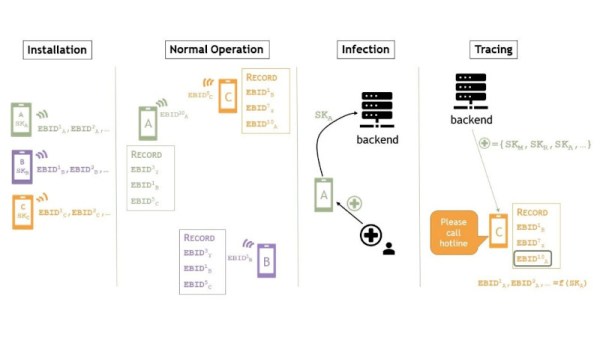
As we continue through the pandemic, whether we are on lockdown or still at work, there is a chance for all of us that we could still pick up the virus from a stray contact. Mapping these infections and tracing those in proximity to patients can present a major problem to infection control authorities, and there have been a variety of proposals for smartphone apps designed to track users’ contacts via the Bluetooth identities their phones encounter. This is a particular concern to privacy advocates, because there is a chance that some governments could use this as an excuse to bring in intrusive personal surveillance by this means. A group of academics from institutions across Europe have come together with a proposal for a decentralised proximity tracing system that allows identification of infection risk without compromising the privacy of those using it.

Where a privacy-intrusive system might use a back-end database tracking all users and recording their locations and interactions, this one uses anonymised tokens stored at the local level rather than at the central server. When a user is infected this is entered at app level rather than at server level, and the centralised part of the system merely distributes the anonymised tokens to the clients. The computation of whether contact has been made with an infected person is thus made on the client, meaning that the operator has no opportunity to collect surveillance data. After the pandemic has passed the system will evaporate as people stop using it, rather than remaining in place harvesting details from installed apps. They are certainly not the first academics to wrestle with this thorny issue, but they seem to have ventured further into the mechanics of it all.

As with all new systems, it’s probably good to subject it to significant scrutiny before deploying it live. Have a read. What do you think?

We are all watching our authorities as they race to respond to the pandemic in an effective manner, and we hope that should they opt for an app that it does an effective job and they resist the temptation to make it too intrusive. Our best course of action meanwhile as the general public is to fully observe all advised public health measures such as self-isolation or the wearing of appropriate personal protective equipment.

Adding RGB To A CRT

There was a time when all TVs came with only an antenna socket on their backs, and bringing any form of video input to them meant dicing with live-chassis power supplies. Then sets with switch-mode supplies made delving into a CRT TV much safer, and we could bodge in composite video and even RGB sockets by tapping into their circuitry. For Europeans the arrival of the SCART socket gave us ready-made connectivity, but in the rest of the world there was still a need to break out the soldering iron for an RGB input. [Jacques Gagnon] is in Canada, and has treated us to a bit of old-school TV input hacking as he put an RGB socket on his JVC CRT set.

Earlier hacks had inventive incursions into discrete analogue circuitry, but on later sets such as this one the trick was to take advantage of the on-screen-display features. The signal processing chip would usually have an RGB input with a blanking input to turn of the picture during the OSD chip’s output. These could be readily hijacked to provide an RGB input, and this is the course taken here. We see a VGA socket on the rear panel going to a resistor network on a piece of protoboard stuck in a vacant space on the PCB, from which a set of lines then go to the signal processing chip. The result is a CRT gaming monitor for retro consoles, of the highest quality.

For those of us who cut our teeth on CRT TVs it’s always good to see a bit of TV hacking. It’s a mod we’ve seen before, too.

Help Save The National Videogame Museum

The National Videogame Museum in Sheffield, UK, houses a unique collection celebrating all decades of video games and their culture, and as the lockdown has brought with it a crisis threatening its very existence, has launched a crowdfunding campaign with a video we’ve placed below the break. As a relatively young organisation, they have yet to build up the financial buffer that a more established one would have. It’s important that this and other heritage sites live to open again another day, so we’d urge you to take a look.

On their website they’re providing a page of activities for the bored youngster in your life, but to whet your appetite should you wish to visit them in the future they also have a selection of pages about the rest of their exhibition.

One of the sad features of living through  a pandemic comes in knowing that some of the businesses and organisations we hold dear might not make it through the crisis. We’ve put in a few orders to smaller suppliers over the last week or two to shove a bit of extra business their way, and no doubt you have too. What is not so easy however, is when the threatened organisation is a visitor attraction; we can’t make the trip during a lockdown. The NVM is unlikely to be the only such attraction facing the pinch, so we’d urge you to look out for those that are close to you as well.

Continue reading “Help Save The National Videogame Museum”

Download A Bit Of Sinclair History

If you are a devotee of the Sinclair series of 8-bit home computers then a piece of news from the Centre For Computing History in Cambridge may be of interest to you, they’ve released a copy of the ROM from their ZX Spectrum prototype. This machine surfaced last year as part of a donation form the company originally contracted to write the Spectrum ROM and has been given pride of place int heir exhibition ever since. They’ve been doing some very careful work on it, and while The Register reports they can’t yet make the board boot, they have extracted the code for study. In the video below the break, we see it running on the Speccy emulator on an older Windows PC.

The ROM comes with an invitation to the ZX Spectrum community to analyze it against the stock version, in the hope of revealing ossified fragments of code such as that for the Microdrive storage peripheral which never made it into the stock Spectrum. But should you simply want to try your favorite games with the earliest possible version of the ROM, you can do that too.

We covered the machine’s emergence last year, meanwhile, if you haven’t been to the Centre for Computing History yet, we suggest you take a look at our review from a few years ago.

Continue reading “Download A Bit Of Sinclair History”

Turn Off Those Batteries With Their Protection Chip

It should be a feature of every device powered by a lithium-ion battery, that it has a protection chip on board that automatically disconnects it should it go out of its safe voltage range. A chip most often used for this purpose in single-cell applications is the Fortune Semiconductor DW01, and [Oliver] shares a tip for using this chip to power down the battery. The DW01 has a CS, or current sense pin, which if taken high momentarily will put the chip into an off state until the battery is disconnected.

Looking at the DW01 datasheet we can see that this would work, but we can’t help having a few questions. The CS pin is a safety sensor pin, providing over current, short circuit, and reverse polarity detection. It’s the kind of pin one might mess with only when one is absolutely certain it’s not likely to trigger a dangerous fault condition, so a bit of care should be required. However, we can see that leaving its resistor in place and supplying it a momentary logic level through another resistor should work. We’d be interested in the views of any readers with more experience in the world of lithium battery protection on this hack.

Meanwhile, a good read for any reader should be our look last year at lithium-ion safety.