AI Makes Hyperbolic Brain Hats A Reality

It isn’t often that the world of Hackaday intersects with the world of crafting, which is perhaps a shame because many of the skills and techniques of the two have significant overlap. Crochet for instance has rarely featured here, but that is about to change with [Janelle Shane]’s HAT3000 neural network trained to produce crochet hat patterns.

Taking the GPT-2 neural network trained on Internet text  and further training it with a stack of crochet hat patterns, she was able to generate AI-designed hats which her friends on the Ravelry yarn forum set to crochet into real hats. It’s a follow-up to a previous knitting-based project, and instead of producing the hats you might expect it goes into flights of fancy. Some are visibly hat-like while others turn into avant-garde creations that defy any attempt to match them to real heads. A whole genre of hyperbolic progressions of crochet rows produce hats with organic folds that begin to resemble brains, and tax both the stamina of the person doing the crochet and their supply of yarn.

Perhaps most amusingly the neural network retains the ability to produce text, but when it does so it now inevitably steers the subject back to crochet hats. A Harry Potter sentence spawns a passage of something she aptly describes as “terrible crochet-themed erotica“, and such is the influence of the crochet patterns that this purple prose can even include enough crochet instructions to make them crochetable. It would be fascinating to see whether a similar model trained with G-code from Thingiverse would produce printable designs, what would an AI make with Benchy for example?

We’ve been entertained by [Janelle]’s AI work before, both naming tomato varieties, and creating pie recipes.

Thanks [Laura] for the tip.
Stack Those Boards For An Extra-Special Backlit LED Effect

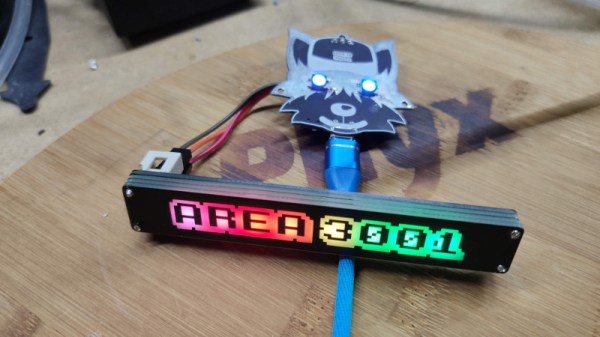
By now most of us should be used to backlit LEDs, in which a bare board with no copper or soldermask as an LED mounted on its reverse side to shine through as if with a diffuser. [Wim Van Gool] has created such an LED display with a twist, instead of reverse mounted LEDs his Shitty Add-On for Area3001 hackerspace in Leuven, Belgium has a set of WS2812 addressable LEDs shining upwards through a void in a stack of PCBs to the diffuser. The effect is of something that looks about the size and shape of a Kit-Kat finger with a glowing hackerspace logo on the front, and it breaks away from the SAO norm.

Full details are on the GitHub repository for the project, in which we find both large and small takes on the same idea. It appears that there is no onboard processor and that the WS2812s are driven from the host badge, but that doesn’t take away from the ingenuity of the design.

The through-PCB diffuser seems to be the badge must-have of the moment, we’ve seen quite a few such as the recent Numberwang badge. That’s the exciting thing about badge design though, one always knows that there will be a new twist along in the next crop of badges, to keep everything fresh.

A Conference Badge Breathes Life Into A Rotary Phone

We have covered the astonishing diversity of conference badges to a great extent over the years, and we are always pleased and surprised at the creativity and ingenuity that goes into their creation. But the saddest thing about so many badges is that after the event they go into the drawer and are never touched again, such a missed opportunity!

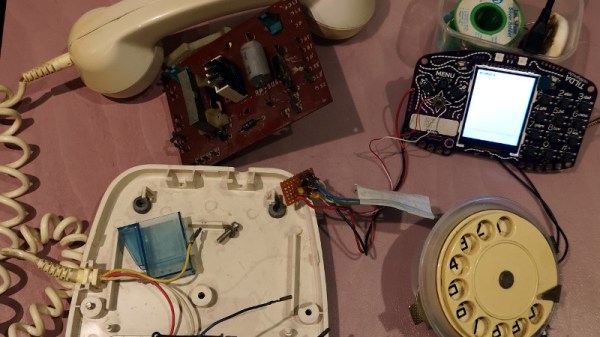
It’s a trend that [Dan] has reversed though, with his rotary dial phone brought to life with an EMF Tilda MkIV. This was the badge from last year’s EMF Camp 2018, and its defining feature was a built-in GSM mobile phone. We didn’t give it a full review at the time because it has problems with the GSM part at the event and it would have been unfair to display what was an amazing badge in a negative light, but once we got it home it was straightforward enough to put a commercial SIM in the slot and use the public networks with it.

[Dan]’s phone is an Eastern European model that came to him through his grandfather. Inside it’s a relatively conventional design, into which he’s patched a couple of the Tilda’s I/O lines from the dial through a debounce circuit. But simply selecting a couple of lines wasn’t enough, as most of those on its expansion port come via a port expander. He needed inputs that could generate an interrupt, so he hijacked a couple from the on-board joystick. He’s included Python code which you can see in action in the video below. It’s important to note that he’s yet to hook up the audio to the badge so this is a work in progress, but it’s an interesting project nevertheless.

Rotary phones hold a special place among hardware hackers, we’ve featured many projects including them. This isn’t the first GSM rotary phone we’ve brought you, and don’t forget they can also talk via Bluetooth.

Continue reading “A Conference Badge Breathes Life Into A Rotary Phone”

A Masterpiece, But Our Maestro Is A CNC Machine

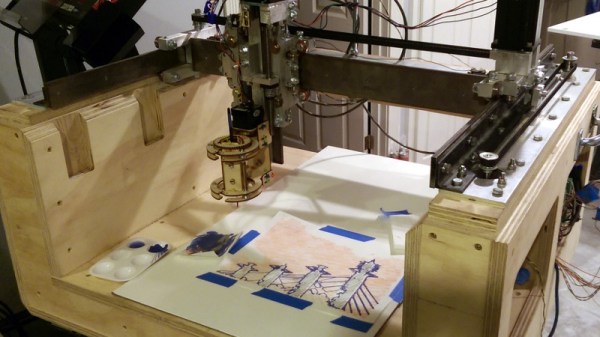
Sometimes we manage to miss projects when they first appear, only to have the joy of discovering them a while later. So it is with [John Opsahl]’s Project Convert To Paint, a CNC painting ‘bot that takes a bitmap image and paints it on canvas as a fine artist would, with a real brush, and paints.

It was first created for the 2017 robotart.org competition, and takes the form of a fairly standard CNC gantry machine. It departs from the norm in its chuck however, as it has what is described as a universal artist chuck, capable of holding a variety of artistic implements. The images are converted from bitmap to vector format, and thence to gcode with the help of a bit of custom Python code.

He’s at pains to say that simply because an image can be converted to a paintable format does not mean that it will produce a good picture. But some of the results are rather impressive, delivering anything from a pointilist effect to a broader brush stroke. We can see that with a bit of experience in the processing it would be possible to create a veritable gallery of masterpieces.

We may have missed this one the first time, but we did catch another drawbot from the same competition.

Hands-On: BornHack’s Light Sabre Badge

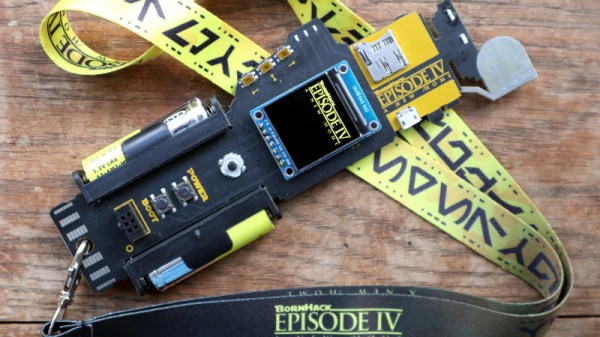
A badge modelled after the handle of a light sabre? Yes Please! This Star Wars themed hardware is the work of hardware designer Thomas Flummer for the 2019 BornHack conference held in Denmark last month. (Check out my roundup of the event if this is the first you’ve heard of it.)

It's not a badge but a light sabre! The front of the BornHack 2019 badge.
It’s not a badge but a light sabre! The front of the BornHack 2019 badge.

It fits the hand nicely, and with clever side-on placement of the two AA battery holders (a trick we first saw with the 2016 Hackday Superconference badge) it also keeps any protruding solder joints away from clothing. In the centre of the badge is the 240×240 pixel colour display that also hides the Silicon Labs Happy Gecko processor and its surrounding components. Three buttons at the edge of the board to the left of the screen are a nice fit for your thumb when holding it in your left hand — a good choice if you happen to leave your right hand behind on a visit to the Cloud City of Bespin.

Between the battery holders lies a four-way joystick, two buttons, and a 6-pin add-on connector. Above it is a micro SD card socket and a micro USB socket, and above them are an IR emitter and receiver. All of the hardware is on the front of the PCB, with no components on the reverse (other than the solder joints for the batteries). But it is there you will find a set of exposed pads for serial and I2C interfaces. Continue reading “Hands-On: BornHack’s Light Sabre Badge”

Is It A Boat? Is It A Hammock? No, It’s Both!

If you’re enjoying a Western Canadian summer, two of the best ways to do so involve a hammock, or a boat. Seeking to improve on this mighty duo with a hammock-boat combo, [Jarrett] describes his progress at Vancouver Hack Space.

The boat he chose was a one-person catamaran with an aluminium frame and what appear to be inflatable pontoons, while the hammock is one designed for a garden or patio with a steel tubular frame. A design goal was to not modify or destroy the structure of either item, so the challenge was to securely mount the two frames together. A variety of false starts involving bent steel or aluminium were tried, followed by a final success with the aluminium tubes reinforced with more tube inside them, and the hammock attached with U-bolts.

The testing took place on what appears to be a public lake, and the contraption floated well. When it had been pushed out to a landing stage our intrepid adventurer boarded the hammock —  and promptly the whole edifice tipped itself over, depositing him in the drink. Further experimentation revealed that balance was critical, and a revised position could achieve a stable boarding. He paddles off into the sunset as you can see in the video below the break, though as his friends remind him, without his beer.

Commercial hammocks are surprisingly expensive for what they are. Don’t worry though, if you find them to be beyond your budget you can always make a frame for one yourself.

Continue reading “Is It A Boat? Is It A Hammock? No, It’s Both!”

Because Conventional Laser Harps Aren’t Dangerous Enough

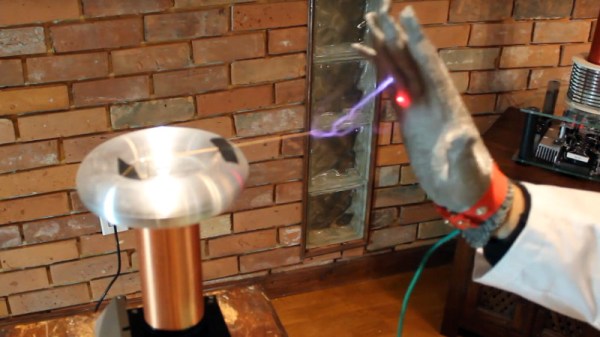
In the late 1980s, the French musician [Jean-Michel Jarre] famously toured with a laser harp. The word among teenage fans was that he had to wear special gloves to stop his hands getting burned, because 1980s teens were both impressionable and didn’t know much about lasers. In fact we’re told by a member of our community who was part of his road crew that the glove was a matter of reflectivity, so laser harps remain relatively harmless and French harpists retain their fingers. To add a bit of spice to the laser harp experience, [James Cochrane] hooked up a laser rangefinder to a Tesla coil to make an instrument with a bit more crackling energy in its performance than the [Jarre] model.

It starts with a laser tape measure modified to serve as an Arduino rangefinder, coupled to custom MIDI code to make a laser harp MIDI controller. The Tesla coil in question happens also to be a MIDI instrument, so the one can control the other with ease. The addition of an earthed chain mail glove allows it to be played in close proximity to the coil, and he rewards us with a rendition of the Star Trek theme. Tesla fun and games behind us, he then gives us a demonstration with a more conventional MIDI instrument.

We’ve had innumerable Tesla coil projects here over the years, if you’re hungry for more we suggest starting with this unusual planar PCB coil design. Meanwhile you can see the laser harp coil in the video below the break.

Continue reading “Because Conventional Laser Harps Aren’t Dangerous Enough”