A Sonoff Switch Repurposed As A Thermostat

Underfloor heating is a wonderfully luxurious touch for a bedroom and en-suite bathroom, and [Andy] had it fitted so that he could experience the joy of walking on a toasty-warm floor in the morning. Unfortunately after about a year it stopped working and the culprit proved to be its thermostat. A replacement was eye-wateringly expensive, so he produced his own using an ESP8266-powered Sonoff wireless switch.

The thermostat has a thermistor as its temperature sensor, embedded in the floor itself. This could be brought to the ESP’s solitary ADC pin, but not without a few challenges along the way. The Sonoff doesn’t expose the pin, so some very fine soldering was the first requirement. A simple voltage divider allowed the pin to be fed, but through it he made the unfortunate discovery that the ESP’s analogue input has a surprisingly low voltage range. A new divider tying it to ground solved the problem, and he was good to go.

Rather than using an off-the-shelf firmware he created his own, and with a bit of board hacking he was able to hard wire the mains cabling and use one set of Sonoff terminals as a sensor connector. The whole fit neatly inside an electrical fitting box, so he’s back once more to toasty-warm feet.

This isn’t the first ESP thermostat we’ve featured, nor will it be the last. Here’s a particularly nice build from 2017.


Hackaday Prize Mentor Session: Product Engineering With Giovanni Salinas

This year we’ve added something new and exciting to the Hackaday Prize mix. Mentor sessions link up hardware teams with experts from backgrounds useful in moving their product development forward. We’ve assembled a dream team of mentors, and today we’re excited to publish video of the first mentor session which you’ll find embedded below. It’s a great chance to hear about the engineering going into each entry, and to learn from these back and forth conversations that help move the effort forward. We encourage you to sign up for an upcoming session!

Giovanni Salinas, the Product Development Engineer at Supplyframe’s DesignLab, is the mentor for this session. He has a huge breadth of experience in product development, and in today’s installment he’s working with four different product teams.

Continue reading “Hackaday Prize Mentor Session: Product Engineering With Giovanni Salinas”

From Dirt To Space, Backyard Iron Smelting Hackerspace Style

When I went to a hacker camp in the Netherlands in February I was expecting to spend a few days in a comfortable venue with a bunch of friends, drink some beer, see a chiptune gig, and say “Ooh!” a lot at the exciting projects people brought along. I did all of those things, but I also opened the door to something unexpected. The folks from RevSpace in the Hague brought along their portable forge, and before long I found myself working a piece of hot rebar while wearing comically unsuitable clothing. One thing led to another, and I received an invite to come along and see another metalworking project of theirs: to go form ore to ornamental technology all in one weekend.

From Dirt To Space is a collaboration between Dutch hackerspaces with a simple aim: to take iron ore and process it into a component that will be launched into space. The full project is to be attempted at the German CCCamp hacker camp in August, but to test the equipment and techniques a trial run was required. Thus I found myself in a Le Shuttle car transporter train in the Channel Tunnel, headed for the Hack42 hackerspace in Arnhem where all the parties involved would convene.

Continue reading “From Dirt To Space, Backyard Iron Smelting Hackerspace Style”

A Very Modern Flying Spot Scanner

Analogue TV signals are a beautiful exercise in order and synchronisation, in that as the white dot on your old CRT TV back in the day traced its way across the glass it would have been doing so in faithful obedience to the corresponding electron beam in the camera at the studio. But a camera with a lens and light-sensitive scanning camera tube wouldn’t have been the only way of generating a picture. The flying-spot scanner drew a raster over its subject — usually celluloid film — with a white dot of light and recorded the result with a single photocell to produce a video signal. The ever resourceful [Niklas Roy] has built one using a video projector.

In this scanner the “dot” is a square of white pixels that is moved around the scene, while the sensor is a photoresistor that is read by an Arduino which passes the data to a PC. The whole is mounted in a booth that the subject positions themselves in front of, and covers their head with a cloth. It’s a slow process because the photoresistor is hardly the best sensor, in fact a portrait takes 83 seconds.

The result is hardly superlative quality, but of course this is an artwork in itself rather than a particularly good camera. It is however an impressive piece of work, and we know we’d give it a go if we had the chance.

[Niklas] is a frequent feature on these pages, having produces some pretty impressive work over the years. Some of our favourites are his container-sized music construction machine, and his tiny cardboard plotter.

Who Really Has The Largest Aircraft?

We were all glued to our screens for a moment a few weeks ago, watching the Scaled Composites Stratolaunch dual-fuselage space launch platform aircraft make its first flight. The six-engined aircraft represents an impressive technical feat by any standard, and with a wingspan of 385 ft (117 m) and payload weight of 550,000 lb (250 t), is touted as the largest ever flown.

Our own Brian Benchoff took a look at the possibility of hauling more mundane cargo as an alternative (and possibly more popular) use of its lifting capabilities. And in doing so mentioned that “by most measure that matter” this is the largest aircraft ever built. There are several contenders for the title of largest aircraft that depend upon different statistics, so which one really is the largest? Sometimes it’s not as clear as you’d think, but finding out leads us into a fascinating review of some unusual aeronautical engineering.

Continue reading “Who Really Has The Largest Aircraft?”

How Hard Can It Be To Buy A Computer In Germany And Get It Back Home To The UK?

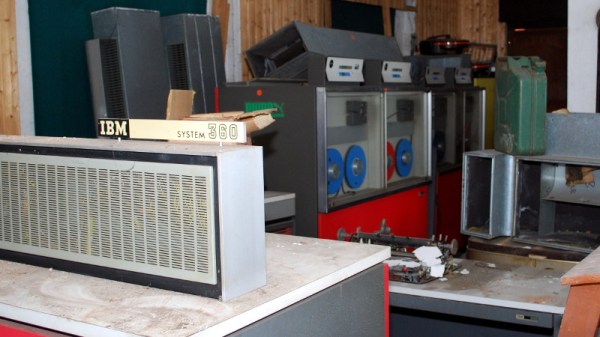
Some of the best adventures in the world of hardware hacking start in the pub. For three volunteers at the National Museum Of Computing in the UK, [Adam Bradley], [Chris Blackburn], and [Peter Vaughan], theirs started over a pint with an eBay listing for an old computer in Germany. No problem you might think, we’re well used to international parcel shipping. This computer wasn’t a crusty old Commodore 64 though, instead it was a room-sized IBM System/360 Model 20 from the 1960s, complete with the full array of peripherals and what seemed to be a lot of documentation and software media. It would need a Mercedes Sprinter, a large van, to shift it, but that seemed feasible. With a bit of frantic bidding they secured the auction, and set off for Germany to view their purchase.

Arriving at the machine’s location they found a little bit more than they had expected. In an abandoned building on a side street in Nuremburg there was an intact machine room full of the IBM computer cabinets over a false floor with all the machine cabling in place, and the only usable access was through a street door which hadn’t been opened in decades and which was obstructed by the false floor itself. To cap it all they found they’d bought not one but two System/360s, and also unexpectedly a 1970s System/370 Model 125. Clearly this was more than a job for a quick in-and-out with a Sprinter.

What followed became a lengthy saga of repeated trips, van hire, constructing ramps, and moving heavy computer parts to a hastily rented storage unit. Decabling a computer of this size is no easy task at the best of times, and these cables had spent many decades in a neglected machine room. It’s a fascinating read, and a very well-documented one with plenty of photos. The machines now sit in their storage units awaiting a return to the UK, and the trio are soliciting any help they can find to make that happen. So if you happen to own a European haulage company with spare capacity on your Germany — UK route or if you can help them in any way, donate or get in touch with them. We think this project has much more to offer, so we’ll be following their progress with interest.

These three intrepid computer hunters were brought together at The National Museum Of Computing at Bletchley, UK. If you find yourself within range it is an essential place to visit, we did so in 2016.

A Compact Strain Wave Gear Assembly

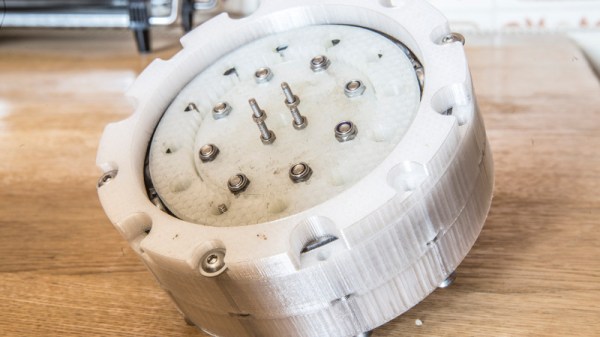
Strain wave gearing is a clever way to produce a high-efficiency, high ratio gearbox within a small space. It involves an outer fixed ring of gear teeth and an inner flexible ring of teeth which are made to mesh with the outer by means of an oval rotor distorting the ring. They aren’t cheap, so [Leo Vu] has had a go at producing some 3D-printable strain wave gearboxes that you could use in your robotic projects.

He’s created his gearbox in three ratios, 1:31, 1:21 and 1:15. It’s not the most miniature of devices at 145mm in diameter and weighing well over a kilogram, but we can still imagine plenty of exciting applications for it. We’d be curious as to how tough a 3D printed gear can be, but we’d expect you’ll be interested in it for modest-sized robots rather than Formula One cars. There’s a video featuring the gearbox which we’ve placed below the break.

This certainly isn’t the first strain wave gearset we’ve brought you, more than one 3D printed project has graced these pages. We’ve even brought you a Lego version. Continue reading “A Compact Strain Wave Gear Assembly”