Catapult Your Best Wishes With This 3D-Printable Card

It’s the season to be surrounded by greeting cards of all shapes and sizes from friends old and new. News of their families and achievements, reminders that they exist, and a pile of cards to deal with sometime in January. Wouldn’t it be great if you could send something with a little more substance, something your friends would remember, maybe even hang on to?

[Brian Brocken]’s 3D-printed Da Vinci catapult kit may not fill that niche for everyone, but we can guarantee it will be a talking point. The Da Vinci catapult design uses a pair of springs similar to an archer’s bow, to unwind a pair of ropes and thus turn the shaft upon which the catapult shaft itself is fitted. All these components are mounted in a single piece with sprues similar to an injection moulded model kit, allowing the whole to easily be posted in an envelope.

The parts are all available to print separately among the files on the Thingiverse page for those with no need to mail them. For the casual spectator he’s made a YouTube video that we’ve placed below the break, detailing the design and build process as well as showing the device in use.

Continue reading “Catapult Your Best Wishes With This 3D-Printable Card” →

Happy 50th Birthday To All You Epoch Birthers

Good morning everyone, and what a lovely start to the new year it is, because it’s your birthday! Happy birthday, it’s your 50th! What’s that you say, you aren’t 50 today? (Looks…) That’s what all these internet databases say, because you’ve spent the last decade or so putting 1970-01-01 as your birth date into every online form that doesn’t really need to know it!

It’s been a staple for a subset of our community for years, to put the UNIX epoch, January 1st 1970, into web forms as a birth date. There are even rumours that some sites now won’t accept that date as a birthday, such is the volume of false entries they have with that date. It’s worth taking a minute though to consider UNIX time, some of its history and how its storage has changed over the years.

Continue reading “Happy 50th Birthday To All You Epoch Birthers” →

PoE Powers Christmas Lights, But Opens Up So Much More

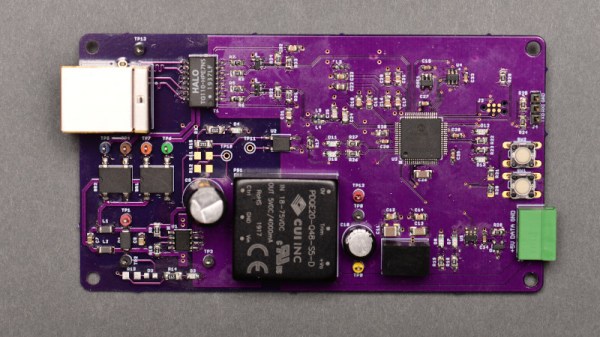
Addressable LEDs are a staple of homemade Christmas decorations in our community, as is microprocessor control of those LEDs. So at first sight [Glen Akins]’ LED decorated Christmas tree looks pretty enough, but isn’t particularly unusual. But after reading his write-up you’ll discover there’s far more to the project than meets the eye, and learn a lot about the technologies behind it that has relevance far beyond a festive light show.

The decoration is powered exclusively from power-over-Ethernet, with a PIC microcontroller translating Art-Net DMX-over-Ethernet packets into commands for the LED string. The control board is designed from the ground up and includes all the PoE circuitry, and the write-up  gives a very thorough introduction to this power source that takes the reader way beyond regarding PoE as simply another off-the-shelf black box. Along the way we see all his code, as well as learn a few interesting tidbits such as the use of a pre-programmed EEPROM containing a unique MAC address.

So if your house has CAT5 wiring and you want an extra dimension to your festive splendour, you’ve officially got a whole year to build your own version. He’s featured here before, with his buzzer to break the Caps Lock habit.

Continue reading “PoE Powers Christmas Lights, But Opens Up So Much More” →

Your TS80 – Music Player

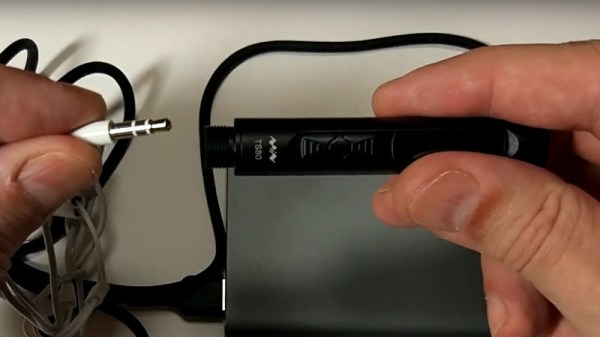
By now most readers will be familiar with the Miniware TS100 and TS80 soldering irons, compact and lightweight temperature controlled soldering tools that have set a new standard at the lower-priced end of the decent soldering iron market. We know they have an STM32 processor, a USB interface, and an OLED display, and that there have been a variety of alternative firmwares produced for them.

Take a close look at the TS80, and you’ll find the element connector is rather familiar. It’s a 3.5 mm jack plug, something we’re more used to as an audio connector. Surely audio from a soldering iron would be crazy? Not if you are [Joric], who has created a music player firmware for the little USB-C iron. It’s hardly a tour de force of musical entertainment and it won’t pull away the audiophiles from their reference DACs, but it does at least produce a recognisable We Wish You A Merry Christmas as you’ll see from the video below the break.

Since the TS100 arrived a couple of years ago we’ve seen a variety of inventive firmware for it. You may remember [Joric]’s previous triumph of a Tetris game for the iron, but our favourite is probably the TS100 oscilloscope.

Continue reading “Your TS80 – Music Player” →

At Three Grand A Tail Light, There’s An Opportunity For A Hacker

It can be amusing sometimes, to read an incredulous reaction from outside our community to something that would be bread-and-butter in most hackerspaces. Take the sorry saga of the Cadillac XLR tail light, as reported by Jalopnik. This car was a more-expensive Corvette with a bit of lard around its midriff, and could appear a tempting pick for a bit of inexpensive luxury rubber-burning were it not for the revelation that a replacement second-hand tail light for one of these roadsters can set you back as much as three grand. The trusty auto on the drive outside where this is being written cost around a tenth that sum, so what on earth is up? Is it because a Caddy carries some cachet, or is something else at play?

It appears that the problem lies in the light’s design. It’s an LED unit, with surface mount parts and a set of fragile internal PCBs that are coated in something that makes reworking them a challenge. On top of that, the unit is bonded together, and instead of being a traditional on-off tail light it’s a microprocessor-controlled device that gets its orders digitally. This is all too much for XLR owners and for the Jalopnik hacks, who castigate General Motors for woefully inadequate design and bemoan the lack of alternatives to the crazy-expensive lights, but can’t offer an alternative.

Reading about the problem from a hardware hacker perspective they are right to censure the motor manufacturer for an appalling product, but is there really nothing that can be done? Making off-the-shelf microcontroller boards light up LEDs is an elementary introduction project for our community, and having the same boards talk to a car’s computer via CAN is something of a done deal. Add in LED strips and 3D printing to create a new backing for the tail light lens, and instead of something impossibly futuristic, you’re doing nothing that couldn’t be found in hackerspaces five years ago.

So what’s to be learned from the Cadillac XLR tail light? First of all, there’s scope for an enterprising hacker to make a killing on a repair kit for owners faced with a three grand bill. Then, there’s another opportunity for us to be acquainted with the reality that the rest of the world hasn’t quite caught up with repair culture as we might imagine. And finally there’s the hope that a badly designed automotive component might just be the hook by which the issue of designed-in obsolescence moves up the agenda in the public consciousness. After all, there will be other similar stories to come, and only bad publicity is likely to produce a change in behavior.

Of course, to get it really right you need a car that’s hackable in the first place. Or better still, one designed by and for hackers.

Thanks [str-alorman] for the tip.

Cadillac XLR header image:Rudolf Stricker [CC BY-SA 3.0].

Open-Source Analytical Balance Pits Gravity Against Electromagnetism

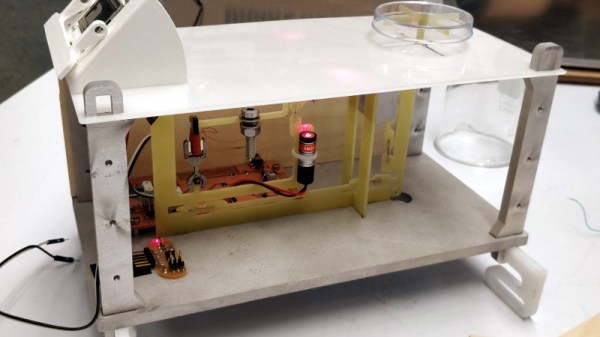
As the open-source movement has brought its influence to more and more fields, we’ve seen an astonishing variety of things once only available at significant expense become accessible to anyone with access to the tools required to create them. One such arena is that of scientific instrumentation, and though we have seen many interesting developments there has been one which has so far evaded us. An analytical balance, a very specialised weighing machine designed to measure the tiniest of masses, remains available only as a new unit costing a fortune, or as a second-hand one with uncertain history and possible contamination. Fortunately, friend of Hackaday [Zach Fredin] is on the case, and as part of one of his MIT courses he chose to create an open-source analytical balance.

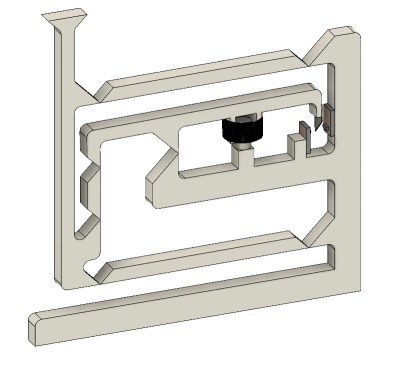
The write-up is interspersed with his course notes as he learns a series of fabrication techniques, but in addition to the milled Delrin finished model he treats us to his prototype and gives us an explanation of how these instruments work. It’s a technique that’s rather different to a traditional weighing machine: instead of measuring deformation of a spring in some way it produces a force from an electromagnet to oppose that exerted by gravity on the mass to be measured, and quantifies how much electrical energy is required to do that. The mechanism incorporates feedback through a vane and an optical sensor, which he admits he’s not yet had time to set up properly.
It’s an interesting project not least because it exposes some of the inner workings of an analytical balance, and we look forward to his completing it. If this whet your appetite for the topic it’s worth also looking at [Ben Krasnow’s] video of a balance made using a moving coil meter for an explanation of the technique.

194 LED Ball Is Free-Form Soldering On Another Level

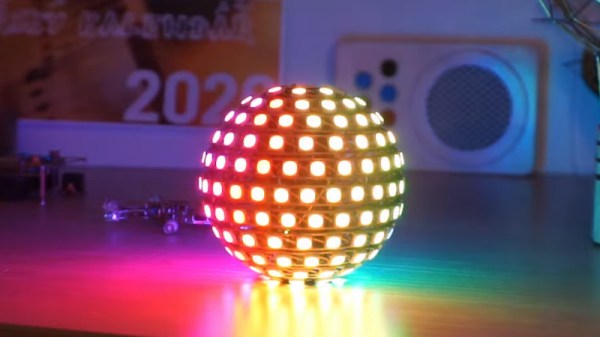
We’ve all seen plenty of impressive free-form soldering in these pages, maybe some of us have even had a go ourselves. Using nothing but bare conductors, electronic components, and solder, complex and beautiful electronic sculptures can be created. But the latest free-form project from [Jiří Praus] takes the medium to a new level, as he’s taken no less than 194 bare surface-mount addressable LEDs and formed them into a perfect sphere supported by nothing more than soldered copper wire.

This feat was achieved with the aid of a 3D printed hemispherical jig with spaces for each LED, and each half was assembled in a marathon soldering session. Some significant fault-finding was required due to a few dry joints, and an ESP32 board and Li-Po cell were fitted in between the two halves as they were joined. The result is a triumph, a Christmas bauble like no other, and one which we aren’t sure we could manage to solder so well even on a good day.

If you recognise [Jiří ]’s work, it’s probably because we’ve featured several of his creations previously. It’s always difficult to pick a favorite, but the one which caught our eye the most was his fully functional freeform Arduino Uno.

Continue reading “194 LED Ball Is Free-Form Soldering On Another Level” →