Raspberry Pi’s Power Over Ethernet Hardware Sparks False Spying Hubbub

Have you ever torn open an Ethernet jack? We’d bet the vast majority of readers — even the ones elbow-deep into the hardware world — will answer no. So we applaud the effort in this one, but the conclusion landed way off the mark.

In the last few days, a Tweet showing a Raspberry Pi with its Ethernet socket broken open suggested the little PCB inside it is a hidden bug. With more going on inside than one might expect, the conclusion of the person doing the teardown was that the Raspberry Pi foundation are spying upon us through our Ethernet traffic. That’s just not the case. But we’re still excited about what was found.

Continue reading “Raspberry Pi’s Power Over Ethernet Hardware Sparks False Spying Hubbub”

Laser-Powered Flying Machine Weighs Milligrams

We’ve become used to seeing some beautiful hand-made creations at the smaller end of the flying machine scale, tiny aircraft both fixed and rotary wing. An aircraft that weighs a few grams is entirely possible to build, such have been the incredible advances in component availability.

But how much smaller can a working aircraft be made? Given a suitable team and budget, how about into the milligrams? [Dr. Sawyer Fuller] and his team at the University of Washington have made an ornithopter which may be the lightest aircraft yet made, using a piezoelectric drive to flap flexible wings. That in itself isn’t entirely new, but whereas previous efforts had relied on a tether wire supplying electricity, the latest creation flies autonomously with its power supplied by laser to an on-board miniature solar cell that protrudes above the craft on its wires.

Frustratingly Dr. Fuller’s page on the machine is lighter on detail than we’d like, probably because they are saving the juicy stuff for a big reveal at a conference presentation. It is however an extremely interesting development from a technical perspective, as well as opening up an entirely new front in the applications for flying machines. Whatever happens, we’ll keep you posted.

You can see the craft in the video below the break, and if you’re interested lies with more conventional tiny machines take a look at the creator of a 2.9g Mustang model.

Continue reading “Laser-Powered Flying Machine Weighs Milligrams”

A Li-Ion Booster Pack, Done Right

We’re all used to battery booster packs containing a Li-ion or Li-poly cell and a little inverter circuit, they are a standard part of 21st century daily survival for those moments when smartphone battery lives don’t perform as advertised. But how many of us have considered what goes into them, and further how many of us have sought to produce the best one possible rather than a unit built at the lowest price?

It’s a course [Peter6960] has followed, producing a PCB that sits on the back of an 18650 cell holder. It follows the work of [GreatScott] in particular in its use of the TP4056 charger, MT3608 boost converter, and FS312F protection ICs. Many commercial modules omit any protection circuit, and the FS312F is of particular interest because it has a low 2.9V cut-off voltage that should lengthen the life of the cell. Files for the PCB can be found in a zip file hosted on Google Drive.

You might think that there was nothing new that could be learned about a Li-ion battery booster, but it’s always worth a look at a well-executed piece of work. We noticed he refers to Li-poly cells while using what appears to be a Li-ion 18650 cell. Most likely this is merely an oversight.

There is a lot to know about the characteristics and safety of the lithium-chemistry rechargeables, you may find [Sean Boyce]’s article on the subject to be an interesting read.

A Classy SDR Chip, Decapped

If you are a regular searcher for exotic parts among the virtual pages of semiconductor supplies catalogs, you will have probably noticed that for a given function it is most often the part bearing the Analog Devices logo that is the most interesting. It may have more functionality, perhaps it will be of a higher specification, and it will certainly have a much higher price. [Zeptobars] has decapped and analyzed an AD chip that holds all three of those honors, the AD9361 SDR transceiver.

It’s placed under a slightly inflammatory title, “when microchips are more profitable than drugs“, but does make a good job of answering why a semiconductor device at the very cutting edge of what is possible at the time of release can be so expensive. The AD9361 is an all-in-one SDR transceiver with an astonishing bandwidth, and as such was a particularly special device when it reached the market in 2013. We see some particularly fine examples of on-chip inductors and PLL circuitry that must have consumed a significant design effort to preserve both bandwidth and noise characteristics. This is an item of physical beauty at a microscopic scale as well as one of technical achievement.

The financial analysis puts Analog Devices’s gross profit at about $103 of the $275 retail purchase price of an AD9361. The biggest slice at $105 goes to the distributor, and surprisingly the R&D and manufacturing costs are not as large as you might expect. How accurate these figures are is anybody’s guess, but they are derived from an R&D figure in the published financial report, so there is some credence to be given to them.

We’ve featured [Zeptobar’s] work before more than once. A look at fake Nordic Semi parts for example or a Soviet i8080 clone have received their treatment. Always a source to watch out for!

An Oscilloscope For The Nuclear Age

Here at Hackaday, we’re suckers for vintage instruments. More than one of our staffers has a bench adorned with devices spanning many decades, and there’s nothing more we like reading about that excursions into the more interesting or unusual examples. So when a Tweet comes our way talking about a very special oscilloscope, of course we have to take a look! The Tektronix 519 from 1962 has a 1GHz bandwidth, and [Timothy Koeth] has two of them in his collection. His description may be a year or two old, but this is the kind of device for which the up-to-the-minute doesn’t matter.

A modern 1GHz oscilloscope is hardly cheap, but is substantially a higher-speed version of the run-of-the-mill ‘scope you probably have on your bench. Its 1962 equivalent comes from a time when GHz broadband amplifiers for an oscilloscope input were the stuff of science fiction. The 519 takes the novel approach of eschewing amplification or signal conditioning and taking the input directly to the CRT deflection plates. It thus has a highly unusual 125Ω input impedance, and its feed passes through a coiled coaxial delay line to give the trigger circuits time to do their job before going into the CRT and then emerging from it for termination. It thus has a fixed deflection in volts per centimeter rather than millivolts, and each instrument has the calibration of its CRT embossed upon its bezel.

The 519 would not have been a cheap instrument in 1962, and it is no accident that there are reports of many of them coming back to Tek for service with radioactive contamination from their use in Government projects. We can’t help wondering whether the Russian equivalent super-high-speed ‘scope used the same approach, though we suspect we’ll never know.

If vintage Tek is your thing, have a look at their PCB manufacture from the 1960s.

Thanks [Luke Weston] for the tip.

Biasing That Transistor: The Emitter Follower

We were musing upon the relative paucity of education with respect to the fundamentals of electronic circuitry with discrete semiconductors, so we thought we’d do something about it. So far we’ve taken a look at the basics of transistor biasing through the common emitter amplifier, then introduced a less common configuration, the common base amplifier. There is a third transistor amplifier configuration, as you might expect for a device that has three terminals: the so-called Common Collector amplifier. You might also know this configuration as the Emitter Follower. It’s called a “follower” because it tracks the input voltage, offering increased current capability and significantly lower output impedance.

The emitter follower circuit

Just as the common emitter amplifier and common base amplifier each tied those respective transistor terminals to a fixed potential and used the other two terminals as amplifier input and output, so does the common collector circuit. The base forms the input and its bias circuit is identical to that of the common emitter amplifier, but the rest of the circuit differs in that the collector is tied to the positive rail, the emitter forms the output, and there is a load resistor to ground in the emitter circuit.

As with both of the other configurations, the bias is set such that the transistor is turned on and passing a constant current that keeps it in its region of an almost linear relationship between small base current changes and larger collector current changes. With variation of the incoming signal and thus the  base current there is a corresponding change in the collector current dictated by the transistor’s gain, and thus an output voltage is generated across the emitter resistor. Unlike the common emitter amplifier this voltage increases or decreases in step with the input voltage, so the emitter follower is not an inverting amplifier.

Continue reading “Biasing That Transistor: The Emitter Follower”

Automatic I2C Address Allocation For Daisy-Chained Sensors

Many readers will be familiar with interfacing I2C peripherals. A serial line joins a string of individual I2C devices, and each of the devices has its own address on that line. In most cases when connecting a single device or multiple different ones there is no problem in ensuring that they have different addresses.

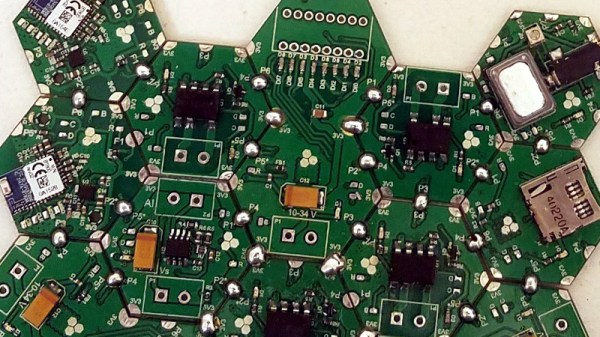
What happens though when multiple identical devices share an I2C bus? This was the problem facing [Sam Evans] at Mindtribe, and his solution is both elegant and simple. The temperature sensors he was using across multiple identical boards have three pins upon which can be set a binary address, and his challenge was to differentiate between them without the manufacturing overhead of a set of DIP switches, jumpers, or individual pull-up resistors. Through a clever combination of sense lines between the boards he was able to create a system in which the address would be set depending upon whether the board had a neighbour on one side, the other, or both. A particularly clever hack allows two side-by-side boards that have two neighbours to alternate their least significant bit, allowing four identical boards each with two sensors to be daisy-chained for a total of eight sensors with automatic address allocation.

We aren’t told what the product was in this case, however it’s irrelevant. This is a hardware hack in its purest sense, one of those which readers will take note of and remember when it is their turn to deal with a well-populated I2C bus. Of course, if this method doesn’t appeal, you can always try an LTC4316.