SHACamp 2017, A Personal Review

There are a series of stages to coming down from a festival. After the hectic rush of travel there are the several days of catching up on lost sleep and picking up the threads of your life again, then once a semblance of order has been regained there’s that few weeks of emptiness. Your life will never be the same again, it’s all so mundane.

I'm pleased to say the Hackaday and Tindie stickers were very popular.
I’m pleased to say the Hackaday and Tindie stickers were very popular.

It’s now a couple of weeks since the SHACamp 2017 hacker festival in the Netherlands was in full swing, and the write-up below has slowly taken shape over that time amid the other work of being a Hackaday scribe and editor. It’s early morning here in Southern England as I write this, so on the equivalent day while I was at SHACamp at this time I would have been carrying a large pack of stickers for distribution on the swapping table through the rising sunlight of a camp still largely asleep after the previous night’s revelry. Past our German and Dutch immediate neighbours, down the ramp from the dyke, the cardboard tent depot on my left and the food court on my right, to the information tent. Greet the bleary-eyed volunteer at the end of their graveyard shift, and spread plenty of Hackaday and Tindie stickers on the table for the masses. And then? Find a coffee, and sally forth into the field for another day among one of the most stimulating communities on Earth. My community. Your community.

The sticker table is a good place to start if you wish to get a handle on a large hacker camp. On it you will find the logos of a cross-section of the diverse organisations and groups present. There are a few commercial ones like my Jolly Wrenchers and Tindie the puppy, there are some from voluntary organisations or interest groups, but mostly they are the logos of a continent’s — even the wider world’s in some cases —  hackspaces and makerspaces. Here you see the breadth of the attendees, as the logos of spaces from thousands of miles away you’ve never encountered before mingle. This isn’t quite a global gathering, but there is a sense of global community around it.

How Do You Describe a Hacker Camp?

You shall find us by our clearly superior yet dangerous to barefoot pedestrians fused right-angled mains connector.

So before I take you through my experience of SHA, it’s best to start by describing a hacker camp in more general terms. When I’m describing a camp like SHA to the kind of people who don’t read Hackaday, I put it as similar to the music festivals they are used to but without the bands. Instead the audience provides the entertainment through the work they bring to the event or do at the event, and through a comprehensive program of talks and lectures. Oh — and this is the bit that makes their eyes open wide — every structure on site from the smallest one-man tent to the largest marquee has mains power and high-speed Internet. Sometimes people grasp what SHA is from this description, sometimes they don’t.

Different groups, be they individual hackspaces, people from a particular country, or other special interest groups, congregate in villages, collections of tents, marquees, and gazebos in which they set up whatever cool stuff they’ve brought along. My tent with its Hackaday flag was in a village composed of a mix of British hackspaces up on the dyke, which [Michael] from MK Makerspace had marked with a sign consisting of a huge BS1363A mains plug. More than one person pointed out it would have been better lying flat on the ground with pins in the air, ready to catch an unwary Monty Python foot.

Continue reading “SHACamp 2017, A Personal Review”

Remote Controlled Nerf Bomb

There was a third-party multiplayer upgrade pack for one of the Quake games back in the ’90s that included a whole slew of non-standard weapons. Among them one of the most memorable was a gravity well, that when thrown into the middle of a crowded room full of warring players would suck them into a vortex. Assuming its user had made it to safety in time, they would then be left the victor. The hyper-violent make-believe world of a first-person shooter is probably best left in a Pentium server from the ’90s, with few direct parallels in the real world. Maybe laser tag, or Nerf battles, are the closest you’ll get.

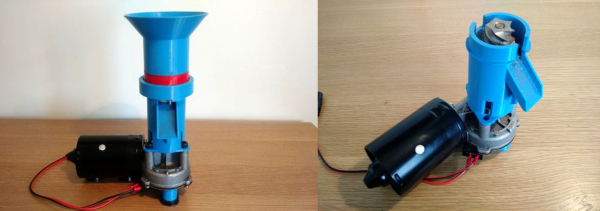
If you are a Nerf enthusiast, then you’ll appreciate [Giaco Whatever]’s CO2-powered remote-control Nerf bomb as an analogue of that Quake gravity well. It fires twelve darts at the press of a button on an infra-red remote control. The firing tubes sit in a nicely machined manifold connected via a solenoid valve to a little CO2 gas bottle. In the hectic world of a Nerf war it is slid out into the field of combat, its operator takes cover, and the other participants are showered in foam darts. There are probably kids who would sell their grandparents to own this device.

The build is detailed in the video below the break, along with a wonderfully tongue-in-cheek movie segment demonstrating it in action.

Continue reading “Remote Controlled Nerf Bomb”

So, You’ve Never Made A Spaceframe Before

It is sometimes a surprise in our community of tinkerers, builders, hackers, and makers, to find that there are other communities doing very similar things to us within their own confines, but in isolation to ours. A good example are the modified vehicle crowd. In their world there are some epic build stories and the skills and tools they take for granted would not in any way be unfamiliar to most Hackaday readers.

As part of a discussion about electric vehicles near where this is being written, someone tossed an interesting link from that quarter into the mix; a two-part treatise on building ultra-light-weight tubular frame vehicles. Or space frames, as you might know them.

You might think that making a tubular framed for a vehicle would be a straightforward enough process, but as the article explains, it contains within it a huge well of geometry and metallurgy to avoid a creation that is neither too heavy nor contains excessive weakness. Part one deals mainly with prototyping a frame, the selection of materials and joining tubes, while part two goes into more detail on fabrication. The author likes brazing which may offend the sensibilities of welding enthusiasts, but you can substitute your jointing tech of choice.

A particularly neat suggestion, one of those simple ideas that make you wish you’d thought of it yourself, is to prototype a frame in miniature with copper wire and solder to evaluate the effect of different forces upon it before you commit your final design to steel.

The articles are a few years old, but no less pertinent in the information they contain. Meanwhile if you are a spaceframe veteran, then you may have your own suggestions for the comments below. And if you’d like some tips on how not to build a spaceframe, have a look at this motorcycle.

Thank you [JHR] and [Jarkman] for the tips.

Sniff Your Local LoRa Packets

As the LoRa low-bandwidth networking technology in license-free spectrum has gained traction on the wave of IoT frenzy, LoRa networks have started to appear in all sorts of unexpected places. Sometimes they are open networks such as The Things Network, other times they are commercially available networks, and then, of course, there are entirely private LoRa installations.

If you are interested in using LoRa on a particular site, it’s an interesting exercise to find out what LoRa traffic already exists, and to that end [Joe Broxson] has put together a useful little device. Hardware wise it’s an Adafruit Cortex M0 Feather with onboard LoRa module, paired with a TFT FeatherWing for display, and software wise it scans a set of available frequencies and posts any packets it finds to the scrolling display. It also has the neat feature of logging packets in detail to an SD card for later analysis. The whole is enclosed in a 3D printed case from an Adafruit design and makes for a very attractive self-contained unit.

We’ve featured quite a few LoRa projects here, including this one with a Raspberry Pi Compute module in a remote display. Of more relevance in a LoRa testing sense though is this look at LoRa range testing.

This 6502 Computer Project Is A Work Of Art

If you were a home constructor in the 8-bit era, the chances are that if you built a microcomputer system you would have ended up with a bare printed circuit board and a terminal. If you were on a budget you might have had a piece of stripboard as well, or maybe even wire-wrap. Beautiful cases were out of reach, they came with expensive commercial computers that were not the preserve of impoverished hobbyists.

Constructing an 8-bit machine in 2017 is a much easier process, there are many more options at your disposal. There is no need to make a bare PCB when you have a 3D printer, and this is demonstrated perfectly by [Dirk Grappendorf]’s 6502 computer project. He’s built from scratch an entire 6502 system, with a text LCD display, and housed it in a case with a keyboard that would put to shame all but the most expensive commercial machines from back in the day.

But this is more than just a hobby project thrown together that just happens to have a nice case, he’s gone the extra mile to the extent that this is professional enough that it could have been a product. If you’d been offered [Dirk]’s machine in 1980 alongside the competitors from Apple and Commodore, you’d certainly have given it some consideration.

We’ve seen retrocomputers too numerous to mention on these pages over the years, so if they are your thing perhaps it’s time to draw your attention to our VCF West reports, and to our reviews of computer museums in Germany, and Cambridge or Bletchley, UK.

Thanks [Colin] for the tip.

A Digital LCD Makeover For An Analogue CRT Spectrum Analyser

[Seb Holzapfel, VK2SEB] has a rather nice spectrum analyser, a Hewlett Packard 141T. It’s an entirely analogue instrument though, so it lacks some of the sophisticated features you might expect to see on its modern counterparts.

One feature the HP does have is a vertical deflection output that in effect allows the trace to be reproduced on an oscilloscope. [Seb] has taken that and applied it to an STM32F746 Discovery board with its associated LCD touchscreen to produce an interface for the HP that includes modern features such as trace normalisation and a waterfall view. Along the way he’s had to make a voltage level converter to render the HP’s scan output into a range acceptable for the ST board.

He goes into detail on his software for the project, which he is at pains to remind us is still very much a work in progress. He notes that the HP has a range of other outputs (on those “D” sockets that include co-axial connectors) that provide information about its band and scan settings, so there is ample possibility for further customisation.

If you are interested in this project then the code is all available via GitHub, otherwise you can watch his video below the break. He’s labelled it as “Part 1”, so we look forward to more on this project.

Continue reading “A Digital LCD Makeover For An Analogue CRT Spectrum Analyser”

Make A Badge When There Is No Badge Yet

What do you do when your keenly anticipated hacker camp releases details of its upcoming badge and you really want to have a go at coding for it, but there are no badges for you to try yet? If you are [Artdanion], this is not a problem, you simply build your own.

He found his requirement to interface with genuine hardware exceeded the abilities of the emulator that the SHACamp 2017 badge team had thoughtfully provided, so he reached for breakout boards for the ESP32, the MPR121 touch sensor, and the e-ink display, and assembled his own clone on a piece of stripboard. Not only did it provide him with enough to develop his own apps, he found when he brought it to the event that the public release of the official firmware ran on it with only a few configuration tweaks. He had an official event badge, that wasn’t the event badge. Is this the first time this has been done? We think it might be.

The home-made badge is an impressive piece of work, but it ties into an observation we made at the end of our review of the official version of the SHA2017 badge. The use of an ESP32 with well-designed peripherals and a solid firmware means that this is a design that is likely to form the bedrock upon which some future badges are built. [Artdanion] has proved how straightforward it is to clone, we’d like to be so bold as to make the prediction that we’ll see more developments of this platform at future events. Meanwhile this home-made badge is a neat achievement, and we can only imagine the surprise of the SHA2017 badge team on being presented with a clone of their work for reflashing.