Beautiful Rocketeer Jetpack Replica Boasts Impressive Metalwork

Fans of the Rocketeer comic book and movie franchise will be familiar with its hero’s 1930s-styled rocket backpack.  It’s an intricate construction of complex streamlined curves, that has inspired many recreations over the years.

Most Rocketeer jetpacks are made from plastic, foam, and other lightweight materials that will be familiar to cosplayers and costumers. But [David Guyton]’s one is different, he’s made it from sheet steel.

The attraction in his video is not so much the finished pack, though that is an impressive build. Instead it’s the workmanship, nay, the craftsmanship, as he documents every stage of the metalwork involved. The panel beating tools of a sheet metalworker’s trade are surprisingly simple, and it’s tempting to think as you watch: “I could do that!”. But behind the short video clips and apparent speed of the build lies many hours of painstaking work and a huge amount of skill. Some of us will have tried this kind of sheet work, few of us will have taken it to this level.

The video is below the break, it takes us through the constituent parts of the build, including at the end some of the engine details which are cast in resin. Watch it with a sense of awe!

Continue reading “Beautiful Rocketeer Jetpack Replica Boasts Impressive Metalwork”
Listen To Your Fermentation To Monitor Its Progress

If you are a wine, beer, or cider maker, you’ll know the ritual of checking for fermentation. As the yeast does its work of turning sugar into alcohol, carbon dioxide bubbles froth on the surface of your developing brew, and if your fermentation container has an airlock, large bubbles pass through the water within it on a regular basis. Your ears become attuned to the regular “Plop… plop… plop” sound they make, and from their interval you can tell what stage you have reached.

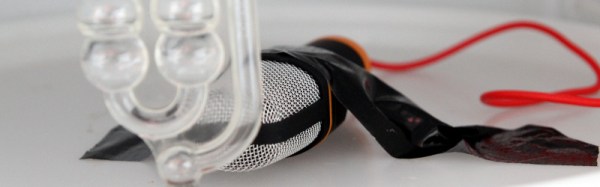
[Chris] automated this listening for fermentation bubbles, placing a microphone next to his airlock and detecting amplitude spikes through two techniques: one using an FFT algorithm and the other a bandpass filter. Both techniques yielded similar graphs for fermentation activity over time.

He has a few ideas for improvement, but notes that his system is vulnerable to external noises. There is also an admission that using light to detect bubbles might be a more practical solution as we have shown you more than once with other projects, but as with so many projects on these pages, it is the joy of the tech as much as the practicality that matters.

Looking Forward To SHA2017

We’re at the start of August, which can only mean one thing. Europe’s hackers and makers are about to converge in a field somewhere for a long weekend of sitting around drinking beer and Club-Mate, eating unhealthy street food, being assaulted by some of the most underground chiptune electronic dance music on the planet, sharing the fruits of their labours with their peers, and gazing lovingly upon other people’s hacks. This year it’s the turn of the Netherlands, for over the first full weekend in August that country will host the SHA2017 outdoor hacker camp in a scouting camp on the polders. It promises to be quite an event, with just short of 4000 attendees spread over several fields, arenas, and social areas, and we’re going to be there. Tent and power lead with Schuko plug sorted, massive pile of stickers secured, DECT phone charged, emergency supplies of PG Tips packed.

There is so much to take in at these events that it can sometimes be difficult to catch everything. One can do the rounds as diligently as possible and still miss some of the cool stuff, so this is where you come in. Are you going to SHA? Are you bringing anything you consider cool to the event? Tell us about it in the comments, we’d love to hear about it as would we’re sure the rest of our readers.

Meanwhile, if you think you’ve missed the boat, don’t panic! At the time of writing, there are about 180 tickets still unsold, but they’ll be going fast! Head over to the SHA2017 tickets site to get yours.

(The stripey header, in case you were wondering, is SHA2017’s branding using as you might have guessed, the SHA algorithm to generate HTML colours. What you see are the colours for “Hackaday”.)

Unholy Mashup Of SpaceMouse And Sculpt Keyboard Is Rather Well Done

What do you do if you have a pair of input device peripherals for your computer, but they are from different manufacturers and thus not available as a single unit? If you are [Marco van Nieuwenhoven], you combine the two to make a mashup single peripheral.

[Marco]’s two peripherals were a 3Dconnexion SpaceMouse Wireless, and a Microsoft Sculpt Keyboard. His mashup isn’t featured here because it simply is a mashup, after all anyone with a hot glue gun could combine the two, instead he’s created a single peripheral that almost looks as though it could have been manufactured that way. It’s not complexity we’re looking at here, but elegance!

The Sculpt keyboard fortunately has a large palm rest in which the electronics and batteries sit, and he’s carefully measured the footprint of the top half of the SpaceMouse before hand cutting a very neat aperture to take it. The SpaceMouse PCB is attached below the aperture, and the bottom of the palm rest is attached with a little bit of padding to ensure a snug fit. The result: a combined input device to be proud of!

Of course, if this keyboard isn’t special enough for you, how about a typewriter?

Fail Of The Week: How Not To Use Pushbuttons

If you are a regular at creating printed circuit boards, it is likely that somewhere in your shop there will be a discard pile of boards on which you placed a component in the wrong orientation such that it would not work. It’s easily done, and don’t be shy to admit it if it’s happened to you.

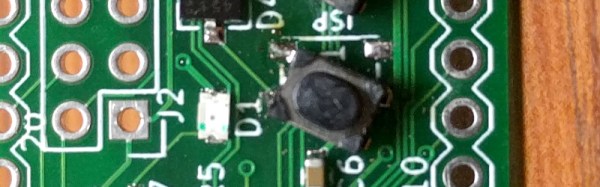
[Bill] was making his own ARM developer board, taking inspiration from the ARM Pro Mini. He produced his PCB design and sent it off to the board house, and in due course received and reflow soldered a batch of beautiful dev boards. On power-up though, something was wrong! No USB device detected on his computer, a disaster. A lot of studying board and schematic led to the discovery that his push-button switches had been placed at 90 degrees to the orientation it should have had, leaving them in a permanently “on” position.

The PCB bug makes this is a Fail Of The Week post, but he transformed into a win with some experimentation with the switch outline in KiCAD before finding a way to mount the switches on the pads at 45 degrees, covering three of the pads. Well done, and well done for admitting the error.

[Editor’s note: been there, done that. One way to prevent the error is to only connect to diagonally opposite pins of the tact switch, so the rotation doesn’t matter.]

Having earlier asked others to come clean with their PCB mistakes, it’s probably appropriate to admit that Hackaday scribes are just as fallible as [Bill] when it comes to PCB layouts. Somewhere there may still be a board on this bench with a QFN microcontroller bodged on at 90 degrees to its original orientation, with cut tracks and tiny wire runs.

Whether you are a seasoned PCB pro or a wet-behind-the-ears rookie, our Creating a PCB In Everything series should be of interest.

Make A Bit Of Cloth With This 3D Printable Loom

When the hackspace where this is being written created their textile room, a member who had previously been known only for her other work unexpectedly revealed herself to be a weaver, and offered the loan of a table-top loom. When set up, it provided an introduction to the art of weaving for the members of all different interests and backgrounds, and many of them have been found laying down a few lines of weft. It’s a simple yet compelling piece of making which  captivates even people who might never have considered themselves interested in textiles.

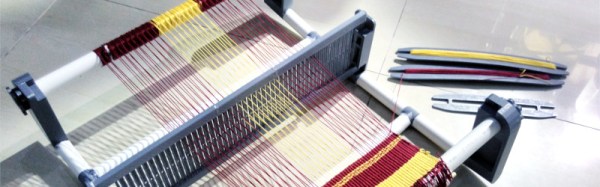
If you are not lucky enough to have a friendly hackspace member with a spare loom when you wish to try your hand at weaving, you may be interested in this Thingiverse project, a 3D printable rigid heddle loom. It’s not the most complex of looms, the heddle is the part that lifts the warp threads up and down, and it being the rigid variety means that this loom can’t do some of the really fancy tricks you’ll see on other types of loom. But it’s a functional loom that will allow you to try your hand at weaving for the expenditure of not a lot of money, some 3D printer filament, and some PVC pipe. If your hackspace or bench has an area devoted to textiles, it may find a place.

We’ve shown you a few looms on these pages over the years, but mostly of the more mechanised variety. A Raspberry Pi automated loom for example, or a CNC Jacquard loom.

Thanks to our Shenzhen contributor-at-large, [Naomi Wu] for the tip.

Review: TS100 Soldering Iron

Temperature-controlled soldering irons can be cheap, lightweight, and good. Pick any two of those attributes when you choose an iron, because you’ll never have all three. You might believe that this adage represents a cast-iron rule, no iron could possibly combine all three to make a lightweight high-performance tool that won’t break the bank! And until fairly recently you’d have had a point, but perhaps there is now a contender that could achieve that impossible feat.

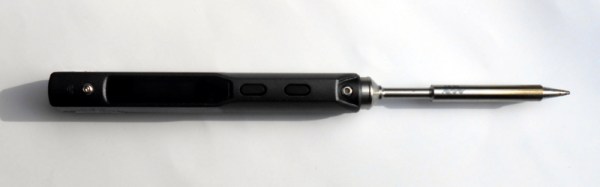
The Miniware TS100 is a relatively inexpensive temperature-controlled soldering iron from China that has made a stealthy entry to the market, and which some online commentators claim to be the equal of far more expensive professional-grade irons. We parted with just below £50 (around $60) to place an order for a TS100, and waited for it to arrive so we could see what all the fuss was about. Continue reading “Review: TS100 Soldering Iron”