3D-Printed Automated Development Tank For Classic Photo Films

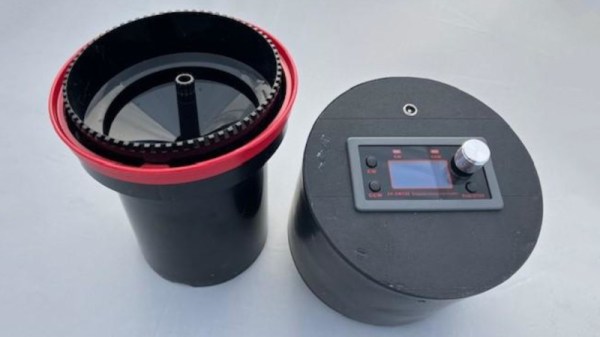
[packetandy] had a problem. He was still into classic analog photography, but local options for development were few and far between. After some frustration, he decided to take on the process himself, creating an automatic development tank for that very purpose.

For black and white film, developing is fairly straightforward, if dull and time consuming. The film requires constant agitation during development, which can be dull to do by hand. To get around this, [packetandy] decided to build a development tank rig that could handle agitation duties for him by wiggling the film around in his absence.

The tank itself is created by Patterson, and has a stick on top for agitating the film inside. The rig works by attaching a NEMA stepper motor to this stick to jerk it around appropriately. Rather than go with a microcontroller and custom code, [packetandy] instead just grabbed a programmable off-the-shelf stepper controller that can handle a variety of modes. It’s not sophisticated, but neither is the job at hand, and it does just fine.

It’s a nifty build that should see [packetandy]’s black-and-white photography on the up and up. Meanwhile, if simple development isn’t enough for you, consider diving into the world of darkroom robot automation if you’re so inclined!


The DeDeterminator Uses Quantum Physics To Make Decisions So You Don’t Have To

Are you making your own decisions and mainlining causality like a sucker? Why go through the agony, when you could hand over the railway switch of determinism to a machine that can decide things for you! Enter the DeDeterminator, a decision machine from [Oliver Child].

The construction is simple enough, being built inside a small tin. One kind of wishes it had a secret third “PERHAPS” bulb that illuminates only when the universe’s continued existence has been called into question.

The idea is simple. At the press of a button, the DeDeterminator illuminates a bulb—indicating either yes or no. The decision for which bulb to illuminate is truly random, as it’s determined by the radioactive decay of a Americium-241 alpha particle source. A Geiger-Muller tube is used to detect alpha particles, with the timing between detections used to determine the yes-or-no output of the device.

It’s a neat concept, and it’s kind of fun knowing that your decision is both out of your hands and as random as it could possibly be. Would the universe guide you wrong? Who could possibly question the reasoning of the particles? The only rational move could be to comply with whatever directive the box hath given. Just don’t ask it to make any decisions with dangerous outcomes.

We’ve featured other projects using radioactive decay for random number generation before, though they weren’t quite as philosophically intriguing as the DeDeterminator. Mostly they’re just about cryptographic security and such, but some do deal with causality in imaginary spaces, which has its own magic about it.

Meanwhile, if you’ve untangled the quantum chains of cause and effect, or you’ve just found a way to break RSA encryption using a Pi Pico, do drop us a line, won’t you?

TuneShroom Is An Artistic Mushroom-Themed MIDI Controller

Most MIDI controllers are modelled after traditional instruments, like pianos, flutes, or guitars. [Oliver Child] went in a different direction for the TuneShroom, instead modelling his DIY controller after the terrifying, unclassifiable living organism we call the mushroom.

The project was a fun way for [Oliver] to try creating a project with an artistic PCB design, and it worked out well in that regard. He penned a circuit board in the shape of a toadstool, with conductive pads serving as capacitive touch points to activate various notes.

The design is based around the Sparkfun Pro Micro, but it’s not programmed in Arduino. [Oliver] wanted to make full use of the ATmega32U4 microcontroller and have freedom to use the pins at will, so instead the project was programmed with a patched version of LUFA to handle the USB side of things. MIDI data is naturally piped out over this interface to an attached computer.

Files are on Github for the curious. Alternatively, contemplate turning an entire saxophone into a MIDI controller in your spare time. Video after the break.

Continue reading “TuneShroom Is An Artistic Mushroom-Themed MIDI Controller”

Internet Radio Built In Charming Cassette-Like Form Factor

You can listen to plenty of broadcast radio these days. There’s a lot of choice too, with stations on AM, FM, and digital broadcasts to boot. However, if you want the broadest possible choice, you want an internet radio. If that’s your bag, why not build a fun one like [indoorgeek’s] latest design?

The build is based around a PCB and 3D-printed components that roughly ape the design of a cassette tape. It even replicates the typical center window of a cassette tape by using a transparent OLED screen, which displays the user interface. In a neat way, the graphics on the display are designed to line up with those on the PCB, which looks excellent.


An ESP32 is the heart of the operation, which is responsible for streaming audio over the Internet via its WiFi connection. It’s powered by a small lithium-polymer battery, and hooked up with a MAX98357 Class D amplifier driven via the chip’s I2S hardware. Audio is played out over a small speaker salvaged from an old smartphone.

While it’s obviously possible to play whatever you like on a smartphone these days, sometimes it’s fun to have simple devices that just do a single job. Plus, we can’t deny this project looks really neat. Video after the break.

Continue reading “Internet Radio Built In Charming Cassette-Like Form Factor”

MovieCart Plays Videos On The Atari 2600

The original Xbox and PlayStation 2 both let you watch DVD movies in addition to playing games. Seldom few consoles before or since offered much in the way of media, least of all the Atari 2600, which was too weedy to even imagine such feats. And yet, as covered by TechEBlog[Lodef Mode] built a cartridge that lets it play video.

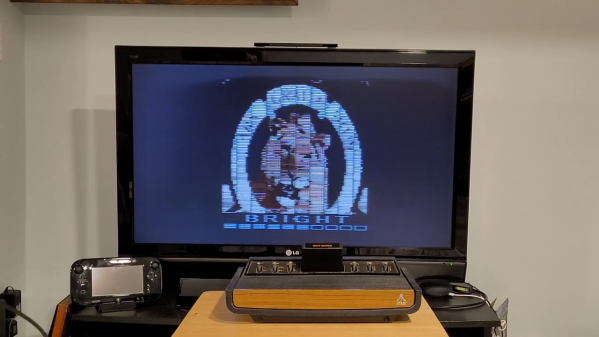
It’s pretty poor quality video, but it is video! The MovieCart, as it is known, is able to play footage at 80×192 resolution, with a color palette limited by the capabilities of the Atari 2600 hardware. It’s not some sneaky video pass-through, either—the Atari really is processing the frames.

To play a video using the MovieCart, you first have to prepare it using a special utility that converts video into the right format for the cart. The generated video file is then loaded on a microSD card which is then inserted into the MovieCart. All you then have to do is put the MovieCart into the Atari’s cartridge slot and boot it up.  Sound is present too, in a pleasingly lo-fi quality. Control of picture brightness and sound volume is via joystick. You could genuinely watch a movie this way if you really wanted to. I’d put on House of Gucci.

Thanks to the prodigious storage available on microSD cards, you can actually play a whole feature length movie on the hardware this way. You can order a MovieCart of your very own from Tindie, and it even comes with a public domain copy of Night of the Living Dead preloaded on a microSD card.

We don’t see a big market for Atari 2600 movies, but it’s neat to see it done. Somehow it reminds us of the hacked HitClips carts from a while ago. Video after the break.

Continue reading “MovieCart Plays Videos On The Atari 2600”

Measuring Trees Via Satellite Actually Takes A Great Deal Of Field Work

Figuring out what the Earth’s climate is going to do at any given point is a difficult task. To know how it will react to given events, you need to know what you’re working with. This requires an accurate model of everything from ocean currents to atmospheric heat absorption and the chemical and literal behavior of everything from cattle to humans to trees.

In the latter regard, scientists need to know how many trees we have to properly model the climate. This is key, as trees play a major role in the carbon cycle by turning carbon dioxide into oxygen plus wood. But how do you count trees at a continental scale? You’ll probably want to get yourself a nice satellite to do the job.

Continue reading “Measuring Trees Via Satellite Actually Takes A Great Deal Of Field Work”

A Badge For AI-Free Content – 100% Human!

These days, just about anyone with a pulse can fall on a keyboard and make an AI image generator spurt out some kind of vaguely visual content. A lot of it is crap. Some of it’s confusing. But most of all, creators hate it when their hand-crafted works are compared with these digital extrusions from mathematical slop. Enter the “not by AI” badge.

Screenshot from https://notbyai.fyi/business

Basically, it’s exactly what it sounds like. A sleek, modern badge that you slap on your artwork to tell people that you did this, not an AI. There are pre-baked versions for writers (“written by human”), visual artists (“painted by human”), and musicians (“produced by human”). The idea is that these badges would help people identify human-generated content and steer away from AI content if they’re trying to avoid it.

It’s not just intended to be added to individual artworks. Websites that have “at least 90%” of content created by humans are invited to host the badge, along with apps, too. This directive reveals an immediate flaw—the badge would easily confuse someone if they read the 10% of content by AI on a site wearing the badge. There’s also nothing stopping people from slapping the badge on AI-generated content and simply lying to people.

You might take a more cynical view if you dig deeper, though. The company is charging for various things, such as a monthly fee for businesses that want to display the badges.

We’ve talked about this before when we asked a simple question—how do you convince people your artwork was made by a human? We’re not sure we’ve yet found the answer, but this badge program is at least trying to do something about the issue. Share your human thoughts in the comments below.