Speech Synthesis On A 10 Cent Microcontroller

Speech synthesis has been around since roughly the middle of the 20th century. Once upon a time, it took remarkably advanced hardware just to even choke out a few words. But as [atomic14] shows with this project, these days it only takes some open source software and 10-cent microcontroller

The speech synth is implemented on a CH32V003 microcontroller, known for its remarkably low unit cost when ordered in quantity. It’s a speedy little RISC-V chip running at 48 MHz, albeit with the limitation of just 16 KB of Flash and 2 KB of SRAM on board.

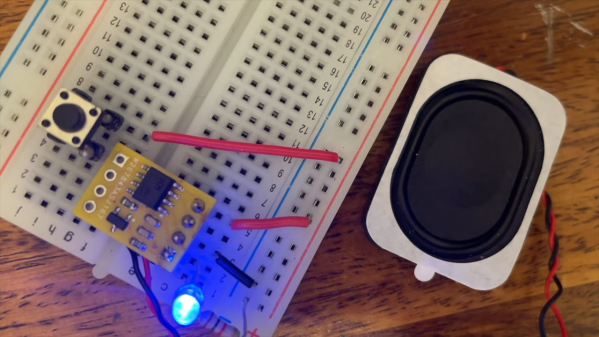
The microcontroller is hooked up to a speaker via a simple single-transistor circuit, which allows for audio output. [atomic14] first demonstrates this by having the chip play back six seconds of low quality audio with some nifty space-saving techniques to squeeze it into the limited flash available. Then, [atomic14] shows how he implemented the Talkie library on the chip, which is a softwarehttps://www.youtube.com/watch?v=RZvX95aXSdM implementation of Texas Instruments’ LPC speech synthesis architecture—which you probably know from the famous Speak & Spell toys. It’s got a ton of built in vocabulary out of the box, and you can even encode your own words with some freely available tools.

We’ve seen [atomic14] tinker with these chips before, too.

Continue reading “Speech Synthesis On A 10 Cent Microcontroller”

Hacking Together An Expensive-Sounding Microphone At Home

When it comes to microphones, [Roan] has expensive tastes. He fancies the famous Telefunken U-47, but doesn’t quite have the five-figure budget to afford a real one. Thus, he set about getting as close as he possibly could with a build of his own.

[Roan] was inspired by [Jim Lill], who is notable for demonstrating that the capsule used in a mic has probably the greatest effect on its sound overall compared to trivialities like the housing or the grille. Thus, [Roan’s] build is based around a 3U Audio M7 capsule. It’s a large diaphragm condenser capsule that is well regarded for its beautiful sound, and can be had for just a few hundred dollars. [Roan] then purchased a big metal lookalike mic housing that would hold the capsule and all the necessary electronics to make it work. The electronics itself would be harvested from an old ADK microphone, with some challenges faced due to its sturdy construction. When the tube-based amplifier circuit was zip-tied into its new housing along with the fancy mic capsule, everything worked! Things worked even better when [Roan] realized an error in wiring and got the backplate voltage going where it was supposed to go. Some further tweaks to the tube and capacitors further helped dial in the sound.

If you’ve got an old mic you can scrap for parts and a new capsule you’re dying to use, you might pursue a build like [Roan’s]. Or, you could go wilder and try building your own ribbon mic with a gum wrapper. Video after the break.

Continue reading “Hacking Together An Expensive-Sounding Microphone At Home”

100-Year Old Wagon Wheel Becomes Dynamometer

If you want to dyno test your tuner car, you can probably find a couple of good facilities in any  nearby major city. If you want to do similar testing at a smaller scale, though, you might find it’s easier to build your own rig, like [Lou] did.

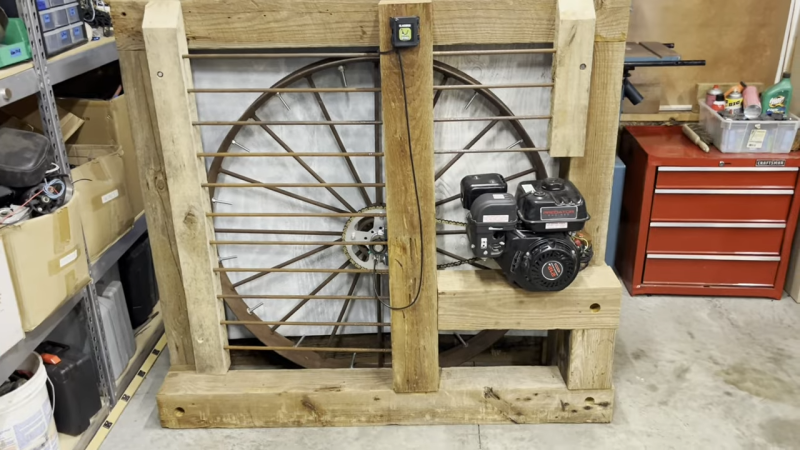
[Lou’s] dynamometer is every bit a DIY project, relying on a 100-year-old wagon wheel as the flywheel installed in a simple frame cobbled together from 6×6 timber beams. As you might imagine, a rusty old wagon wheel probably wouldn’t be in great condition, and that was entirely true here. [Lou] put in the work to balance it up with some added weights, before measuring its inertia with a simple falling weight test. The wheel is driven via a chain with a 7:1 gear reduction to avoid spinning it too quickly. Logging the data is a unit from BlackBoxDyno, which uses hall effect sensors to measure engine RPM and flywheel RPM. With this data and a simple calibration, it’s possible to calculate the torque and horsepower of a small engine hooked up to the flywheel.

Few of us are bench testing our lawnmowers for the ultimate performance, but if you are, a build like this could really come in handy. We’ve seen other dyno builds before, too. Video after the break.

Continue reading “100-Year Old Wagon Wheel Becomes Dynamometer”

Build Your Own Force-Feedback Joystick

Force feedback joysticks are prized for creating a more realistic experience when used with software like flight sims. Sadly, you can’t say the same thing about using them with mech games, because mechs aren’t real. In any case, [zeroshot] whipped up their own stick from scratch for that added dose of realistic feedback in-game.

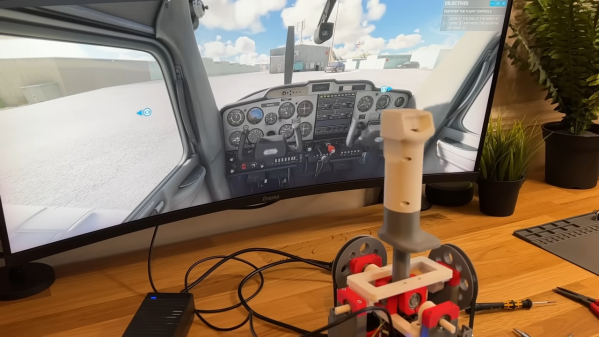
[zeroshot] designed a simple gimbal to allow the stick to move in two axes, relying primarily on 3D-printed components combined with a smattering of off-the-shelf bearings. For force feedback, an Arduino Micro uses via TMC2208 stepper drivers to control a pair of stepper motors, which can apply force to the stick in each axis via belt-driven pulleys. Meanwhile, the joystick’s position on each axis is tracked via magnetic encoders. The Arduino feeds this data to an attached computer by acting as a USB HID device.

We’ve seen some other great advanced joystick projects over years, too. Never underestimate how much a little haptic feedback can add to immersion.

Continue reading “Build Your Own Force-Feedback Joystick”

Analog Surround Sound Was Everywhere, But You Probably Didn’t Notice

These days, most of the media we consume is digital. We still watch movies and TV shows, but they’re all packaged in digital files that cram in many millions of pixels and as many audio channels as we could possibly desire.

Back in the day, though, engineering limitations meant that media on film or tape were limited to analog stereo audio at best. And yet, the masterminds at Dolby were able to create a surround sound format that could operate within those very limitations, turning two channels in to four. What started out as a cinematic format would bring surround sound to the home—all the way back in 1982!

Continue reading “Analog Surround Sound Was Everywhere, But You Probably Didn’t Notice”

The Channel Crossing Bridge That Never Was

Full marks for clarity of message. Credit: Euro Route materials

When the Channel Tunnel opened in 1994, the undersea rail link saw Britain grew closer to the European mainland than ever before. However, had things gone a little differently, history might have taken a very different turn. Among the competing proposals for a fixed Channel crossing was a massive bridge. It was a scheme so audacious that fate would never allow it to come to fruition.

Forget the double handling involved in putting cars on trains and doing everything by rail. Instead, the aptly-named Euro Route proposed that motorists simply drive across the Channel, perhaps stopping for duty-free shopping in the middle of the sea along the way.

Continue reading “The Channel Crossing Bridge That Never Was”

Making WiFi Sound Like Dial-Up Internet

Dial-up modems had a distinctive sound when connecting, with the glittering, screeching song becoming a familiar melody to those jumping online in the early days of the Internet. Modern digital connections don’t really have an analog to this, by virtue of being entirely digital. And yet, [Nick Bild] decided to make WiFi audible in a pleasing tribute to the modems of yore.

The reason you could hear your dial-up modem is because it was actually communicating in audio over old-fashioned telephone lines. The initialization process happened at a low enough speed that you could hear individual sections of the handshake that sounded quite unique. Ultimately, though, once a connection was established at higher speed, particularly 33.6 k or 56 k, the sound of transmission became hard to discern from static.

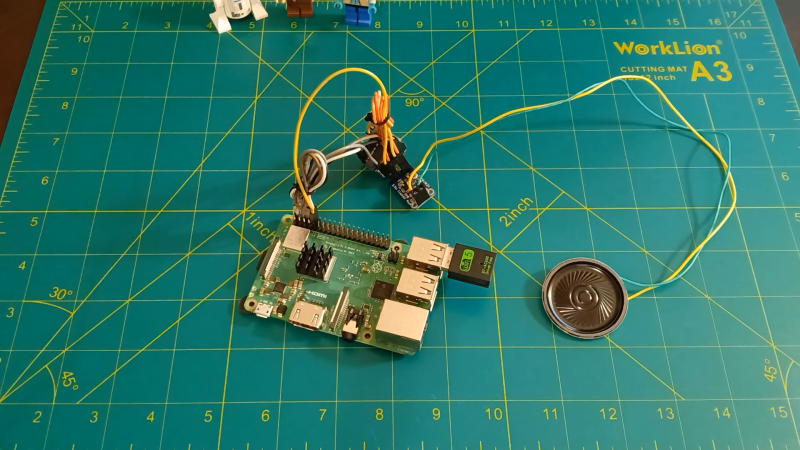
Modern communication methods like Ethernet, DSL, and WiFi all occur purely digitally — and in frequencies far above the audible range. Thus, you can’t really “listen” to a Wi-Fi signal any more than you can listen to the rays of light beaming out from the sun. However, [Nick] found an anachronistic way to make a sound out of WiFi signals that sounds vaguely reminiscent of old-school modems. He used a Raspberry Pi 3 equipped with a WiFi adapter, which sniffs network traffic, honing in on data going to one computer. The packet data is then sent to an Adafruit QT Py microcontroller, which uses the data to vary the amplitude of a sound wave that’s then fed to a speaker through a digital-to-analog converter. [Nick] notes this mostly just sounds like static, so he adds some adjustments to the amplitude and frequency to make it more reminiscent of old modem sounds, but it’s all still driven by the WiFi data itself.

It’s basically WiFi driven synthesis, rather than listening to WiFi itself, but it’s a fun reference to the past. We’ve talked a lot about dial-up of late; from the advanced technology that made 56 k possible, to the downfall of AOL’s long-lived service. Video after the break.

Continue reading “Making WiFi Sound Like Dial-Up Internet”