A Modern Homage To The TIL311 Display

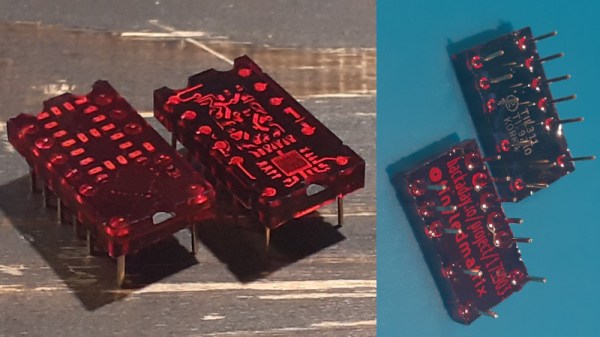
Back in the 1970s, there were a huge variety of esoteric LED displays on the market. One of those was the DIP-packaged TIL311 from Texas Instruments, capable of displaying hexadecimal, from 0-9 and A-F. While these aren’t readily available anymore, the deep red plastic packages had some beauty to them, so [Alex] set about making a modern recreation.

The build consists of a small PCB fitted with 20 LEDs, and a STM8S microcontroller to run the show. This can be used to emulate the original decoder logic on the TIL311, or programmed with other firmware in order to test the display or enable other display functions. Where the project really shines however is in the visual presentation. [Alex] has been experimenting with potting the hardware in translucent red resin to properly emulate the look of the original parts, which goes a long way to getting that cool 70s aesthetic. Attention to detail is top notch, with [Alex] going so far as to carefully select pins that most closely match the square-cut design on the original TIL311 part.

It’s a fun build that could be useful for a project when you can’t get working new old stock. We’ve seen similar efforts for Nixie tubes in the past. Video after the break.

Continue reading “A Modern Homage To The TIL311 Display”

Ice40 Runs DOOM

Spec sheets are an important tool in determining the performance of a given part or system, but they’re not the be all and end all when it comes to engineering. However, specs alone don’t prove whether a given system can complete a given task. Sometimes, you need to actually do the work to prove it instead – as [Sylvain] has done, running DOOM on the iCE40 FPGA.

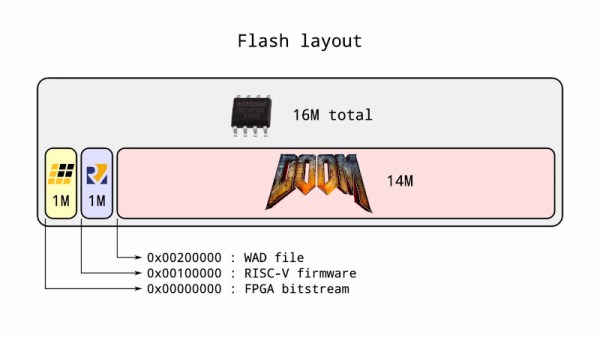
DOOM’s minimum specifications demand a 386 with 4MB RAM minimum, but it’s commonly agreed that a 486 DX2 running at 66MHz with 8MB of RAM is required to play the game smoothly. With an iCEBreaker v1.0b running a RISC V softcore at 25MHz, it may seem like a difficult task, but the RISC V core has the benefit that many instructions run in a single clock cycle that take many on the 486. While the iCEBreaker doesn’t have much RAM onboard, it’s a simple job to piggyback an 8MB SPI device on top of the existing flash storage. Control of the game is via keystrokes sent to the iCEBreaker over serial, while video is handled over a PMOD video interface with an HDMI connector.

[Sylvain] does a great job of explaining all the minute details of the work that was required to get things working, and has provided files on Github for those keen to replicate the feat or expand upon the code. Music is notably absent but MIDI output could likely be achieved without much hassle. “Does it run DOOM?” is still a question asked of many platforms, even the new Nintendo Game & Watch. Video after the break.

Continue reading “Ice40 Runs DOOM”

Cap-Gun Lighter Built From Scratch

For most of us, a lighter is a cheap $2 plastic tool that serves a purpose, and little more. Some of us may go so far as to have a nice Zippo, or perhaps a windproof lighter for better outdoor performance. But if you’re a machinist, you could consider whipping yourself up something special, like this build by [W&M Levsha].

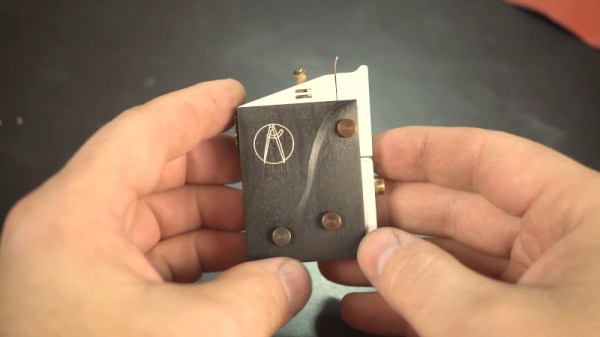
There’s plenty to love here for those who love making chips. The body is crafted out of brass and copper, soldered together by blowtorch. The lighter works by an unusual mechanism. The fluid tank is stuffed with cotton wool and filled with lighter fluid, which feeds a wick, which by itself, is fairly ordinary. However, ignition is via a spring-loaded aluminium hammer, which fires off a paper cap, igniting the wick. The flame can then be extinguished by blowing it out.

It’s a lighter that’s sure to be a conversation piece, though we wonder how welcome it’s cracking report will be at a quiet, reserved cigar bar. The mechanism may have more consumables than a typical lighter, but that’s the price paid to be truly unique. There are other creative designs out there too, like this lighter which uses a platinum catalyst for ignition. Video after the break.

Continue reading “Cap-Gun Lighter Built From Scratch”

Super Mario Original Sound Tracks Get High Quality Remaster Thanks To Gigaleak

2020 saw many gigabytes of internal Nintendo data leaked on the broader internet. Known as the “Gigaleak”, it contained source codes and assets from many games. Using data from this leak, a group of enthusiasts has put together high-quality renditions of the SNES Super Mario World Original Sound Tracks (OST).

The work was made possible when source code from the Gameboy Advance remake of Super Mario World was found in the leaked data. The source code included the names of the samples, which were the same as were used in the original SNES game. This allowed the team to find the original samples amongst the gigabytes of leaked files.

We wondered what would be done with all that code, speculating that it would be a poison pill for the emulator scene. This type of hack wasn’t even on our radar and we’re delighted to see the project come to light. The reproduced songs have an altogether different quality than the original SNES soundtrack. This is largely due to the samples not having to be compressed or cut down to fit on a cartridge and work with the console’s sound chip. Other variances in the sound also come from the fact that unlike in the game, the samples in these renditions don’t match the play lengths in the original game.

Regardless of the changes, it’s interesting to hear a more full, rounded sound of these classic video game tunes. It reminds us somewhat of the later CD console era, when sound designers were able to break free of the limitations of earlier hardware. Of course, we still bow at the alter of chiptune, though — and this MIDI Gameboy mod is a great place to start if you’re curious. Video after the break.

Continue reading “Super Mario Original Sound Tracks Get High Quality Remaster Thanks To Gigaleak”

Building A Continuously Variable Transmission With Lego

The first continuously variable transmission fitted to an automobile actually has its roots in the late 19th century, though the technology has only become popular in the last two decades or so. While a relatively complex technology in its modern automotive form, it’s still possible to illustrate the basic principles with everyone’s favourite mechanical learning toy – Lego.

The transmission as built isn’t great at high torque delivery, as the belt tends to slip on the smooth plastic of the cones. Increasing friction would help.

The build consists of a Lego motor driving the transmission’s input shaft, upon which a cone is mounted. A similar cone is mounted on the output shaft, and a rubber belt stretched between the two. With the cones mounted in opposing directions, the gear ratio can be continually varied by changing where upon the cones the belt rides. By riding on the small diameter section of the input cone, the belt correspondingly rides on the large diameter section of the output cone, leading to a slower, high torque output. By sliding the belt to the other end of the cone, the ratios are reversed, leading to high output speed with less torque.

The demonstration works somewhat differently than modern automotive models, but the basic concept is the same. It’s also limited in its torque transfer ability by the coefficient of friction of the plastic Lego parts. Despite this, it’s a quick way to illustrate the mechanisms at play, and where some of the common losses are in such a system. If you prefer your gearboxes of a more classic sequential design, we’ve seen those too, of course. Video after the break.

Continue reading “Building A Continuously Variable Transmission With Lego”

Custom Ignition For A Citroën Mehari

The 20th century saw a great many cheap, utilitarian vehicles enter the marketplace. Cars like the Mini and the original Jeep offered low-cost, no-frills motoring. However, they were also decidedly low-tech, and not as reliable as modern cars by a long shot. The Citroën Mehari fits into this category neatly, and when [FVFILIPPETTI] grew tired of the unreliable points ignition system, he decided to build a more modern replacement.

The system is based around at ATmega328, the venerable chip many are familiar with from its starring role in the Arduino Uno. The chip tracks engine position with a magnet mounted on the flywheel combined with a hall-effect sensor, passed through an optocoupler to avoid nasty high-voltage spikes from the spark system interfering with the microcontroller. The chip then charges the ignition coil and fires it at the necessary time to ignite the air fuel mixture.

Old-school mechanical ignition systems were, if we’re honest, terrible compared to more modern solutions. This build has rewarded [FVFILIPPETTI] with a far more reliable ride, which we’re sure is very satisfying. If all this hacking has you thirsty for an automotive project of your own, dive into our primer on how to get into cars!

Cooking Eggs With Hand Warmers

Handwarmers are great to keep your fingers functional in icy weather, but can they do more? [Greg] wondered if they could be put to good use cooking an egg, and got down to work.

The handwarmers in question are the HotHands brand, based on an iron chemistry. The warmers create their heat from the exothermic reaction between iron and oxygen that creates rust. Thus, these handwarmers need plenty of airflow to heat up. To enable this, [Greg] 3D printed a small crate with plenty of vents, into which he stacked six hand warmer sachets. An egg was nestled in the center – a perfect choice as it can be cooked in its own packaging. The pile reached temperatures of 160 F and was able to maintain that level for an hour, important as egg proteins tend to start coagulating and denaturing around 150 F. Once removed, [Greg] hoped to find a solid egg, but instead was rewarded with a somewhat gooey, semi-solid result instead. Regardless, the egg had reached an elevated temperature and shown some signs of cooking, and as [Greg] appears to be still putting out videos, we’ll assume he hasn’t yet died of salmonella.

We’d love to see this turn into an engineering competition, though, with prizes for the best cooked egg with the least amount of handwarmers. We’ve featured other egg cooking apparatus before, too. Video after the break.

Continue reading “Cooking Eggs With Hand Warmers”