The United Kingdom is somewhat unique in the world for requiring those households which view broadcast television to purchase a licence for the privilege. Initially coming into being with the Wireless Telegraphy Act in 1923, the licence was required for anyone receiving broadcast radio, before being expanded to cover television in 1946. The funds generated from this endeavour are used as the primary funding for the British Broadcasting Corporation.
Of course, it’s all well and good to require a licence, but without some manner of enforcement, the measure doesn’t have any teeth. Among other measures, the BBC have gone as far as employing special vans to hunt down illegally operating televisions and protect its precious income.
The Van Is Coming For You
To ensure a regular income, the BBC runs enforcement operations under the TV Licencing trade name, the entity which is responsible for administering the system. Records are kept of licences and their expiry dates, and investigations are made into households suspected of owning a television who have not paid the requisite fees. To encourage compliance, TV Licencing regularly sends sternly worded letters to those who have let their licence lapse or have not purchased one. In the event this fails, they may arrange a visit from enforcement officers. These officers aren’t empowered to forcibly enter homes, so in the event a homeowner declines to cooperate with an investigation, TV Licencing will apply for a search warrant. This may be on the basis of evidence such as a satellite dish or antenna spotted on the roof of a dwelling, or a remote spied on a couch cushion through a window.
Alternatively, a search warrant may be granted on the basis of evidence gleaned from a TV detector van. Outfitted with equipment to detect a TV set in use, the vans roam the streets of the United Kingdom, often dispatched to addresses with lapsed or absent TV licences. If the van detects that a set may be operating and receiving broadcast signals, TV Licencing can apply to the court for the requisite warrant to take the investigation further. The vans are almost solely used to support warrant applications; the detection van evidence is rarely if ever used in court to prosecute a licence evader. With a warrant in hand, officers will use direct evidence such as a television found plugged into an aerial to bring an evader to justice through the courts.
After early experiments with supervised learning, [Yosh] decided to implement a genetic algorithm to produce an AI to drive in the game. The AI takes distance from the track walls as an input, and has steering and accelerator values as an output. Starting with 100 AIs in generation 1, [Yosh] iterated by choosing the AIs that covered the longest distance in 13 seconds. Once the AIs started to get the hang of the first few corners, he changed the training to instead prioritize the lowest time taken to traverse each of the checkpoints along the track.
The design intelligently makes use of PCBs to form the entire structure of the glasses. One PCB makes up the left arm of the glasses, carrying an ESP12F microcontroller and the requisite support circuitry. It’s fitted to the front PCB through a slot, and soldered in place. The V+, GND, and DATA connections for the WS2812B LEDs also serve as the mechanical connection. The right arm of the glasses is held on in the same way, being the same as the left arm PCB but simply left unpopulated. A little glue is also used to stiffen up the connection.
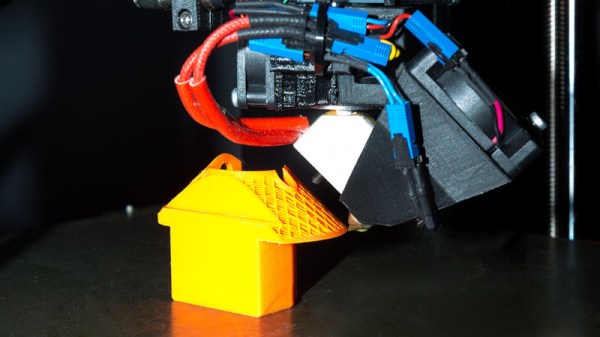
Fused Deposition Modelling (FDM) 3D printers which squirt out molten plastic layer by layer are by far the most popular type in general use. Most machines extrude plastic through a nozzle above print bed, and struggle to produce parts with overhangs without using support material. However, a German team of researchers have recently come up with a solution.
In a prototype built by researchers at the Zurich University of Applied Sciences (ZHAW), a standard Cartesian printer has a third rotary axis added, upon which the nozzle can rotate. Additionally, the nozzle is angled at 45 degrees to the print bed, rather than the usual perpendicular setup. This allows layers of a print to be built up in such a way that support material is not needed for the vast majority of typical overhangs. This is particularly useful for hollow parts, where removing support material can be particularly difficult.
The team believes that such technology could be implemented on existing printers by way of a simple upgrade kit, and we can imagine a few experimenters will be champing at the bit to try it out. If you do, be sure to drop us a line. Alternatively, consider using a marker to make removing supports easier. Video after the break.
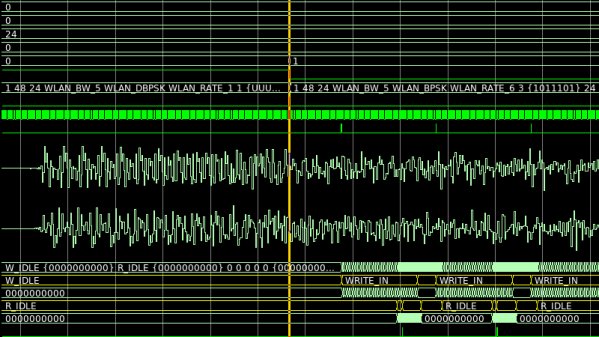
Software defined radio lets RF hardware take on a broad spectrum of tasks, all based on how that hardware is utilized in code. The bladeRF 2.0 micro xA9 is one such device, packing a fat FPGA with plenty of room for signal processing chains on board. As a demonstration of its abilities, [Robert Ghilduta] set about writing a software-defined WiFi implementation for the platform.
The work is known as bladeRF-wiphy, as it implements the PHY, or physical layer of the WiFi connection, in the 7-layer OSI networking model. Modulation and demodulation of the WiFi signal is all handled onboard the Cyclone V FPGA, with the decoded 802.11 WiFI packets handed over to the Linux mac80211 module which handles the MAC level, or medium access control. Thanks to the capability baked into mac80211, the system can act as either an access point or an individual station depending on the task at hand.
[Robert] does a great job of explaining the why and the how of implementing WiFi modulation on an FPGA, as well as some basics of modem development in both software and hardware. It’s dense stuff, so for those new to the field of software defined radio, consider taking some classes to get yourself up to speed!
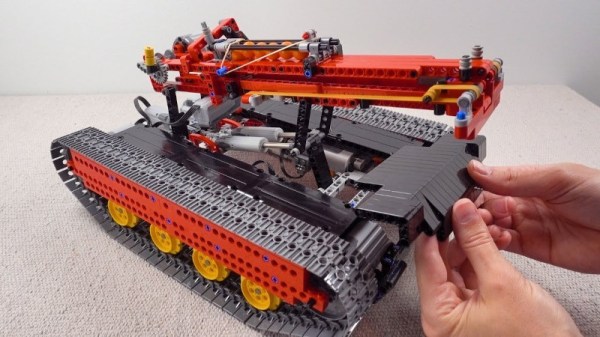
Back in the 20th century, Lego Technic was a popular toy designed to teach kids about mechanical technology, and be a lot of fun to boot. Motors and pneumatics were available, but by and large you had to move your creations and make the noises yourself. That’s not the case these days, as the [Brick Experiment Channel] demonstrates with this impressive Lego tank.
The drivetrain is straightforward, using standard Lego tank treads with each side given its own motor for easy skid steering. However, the real party piece is the slingshot cannon, which launches Lego soccer balls at 60 km/h. Utilizing several motors, it’s complete with elevation adjustment for accurate ranging, and a 6 round magazine so you can (slowly) prosecute your targets with rounds downrange.
What really makes this build great is the control system, with the tank being controlled by a PS4 controller via Sbrick, a device that lets Lego motors be controlled via Bluetooth. We’d love to build a couple of Lego vehicles and have them blast away at each other. We’ve seen the technology used before for a secret heist robot. Video after the break.