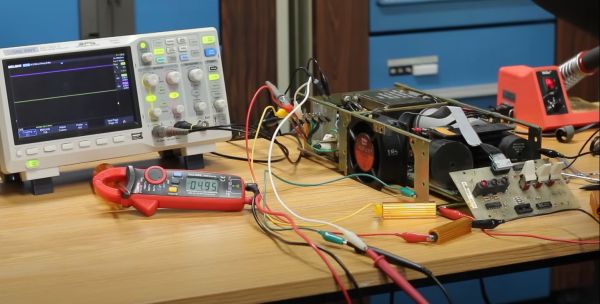
Fixing A PDP-11/03 Power Supply Is Easy When You Understand It

After we last saw [David Lovett] of [Usagi Electric], he was knee-deep in trying to fix a DEC PDP-11/03 power supply, which fortunately led to a fixed PSU and a very happy PDP-11/23 system installed in the enclosure, as he covers in today’s video. Previously, we had covered his debugging attempt of this very much dead power supply, which had led [David] down many fruitless rabbitholes. By the time he was taking various components off the board to try and induce certain results, he threw in the towel and went back to the drawing board, assisted with many community comments.
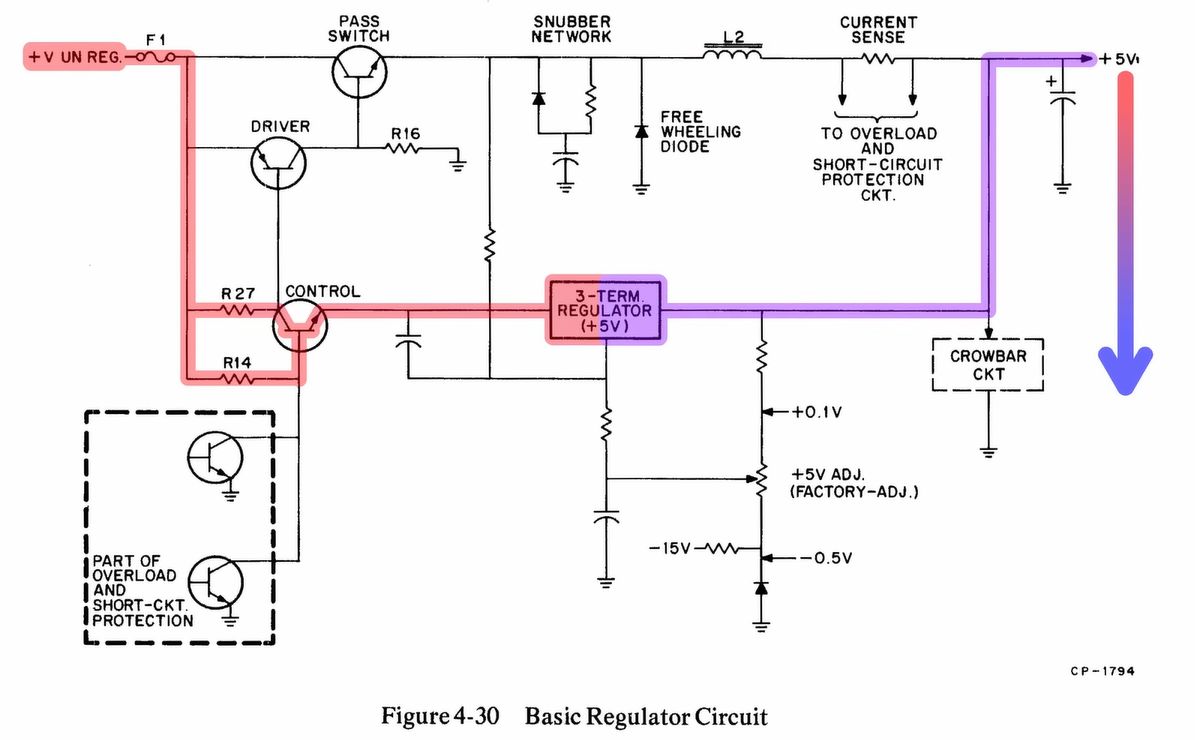
The 5V rail on a DEC PDP-11/03 power supply. (Credit: David Lovett)

Much of the confusion came down to not really understanding how this PDP-11/03 PSU design works, which isn’t that crazy in hindsight, considering how quaint it is. Although [David] originally focused on the +5V rail, a small detail that was in the schematics is that the 5V rail is based around a 7805 that has its ground referenced to the -15V rail.

It is this 7805 that provides a linearly regulated 5V rail up till its current limit, at which point the control transistor gets biased sufficiently to start conducting, which eventually triggers the driver transistor that is responsible for driving the pass switch transistor. This then charges L2 from the unregulated supply, which is used effectively as a switching mode power supply until the current across the 7805 drops sufficiently that it becomes the primary 5V rail source again. This repeats at a kHz rate, making it more or less an SMPS as we know it today, but heavily reliant on the -15V rail as can be observed in the schematic. Continue reading “Fixing A PDP-11/03 Power Supply Is Easy When You Understand It”

Haier Europe Eases Off On Legal Threat And Seeks Dialogue

After initially sending a cease and desist order to [Andre Basche] – the developer of a Haier hOn plugin for Home Assistant – Haier Europe’s head of Brand and IoT has now penned a much more amicable response, seeking to enter into dialogue in search of a solution for both parties.

This latest development is detailed both in the ongoing GitHub issue, as well as the Takedown FAQ and Timeline document that [Andre] created to keep track of everything that’s going on since we last checked in on the situation. As things stand, there is hope that Haier Europe may relent, especially as the company’s US division has shown no inclinations to join in on the original C&D.

In the confusion following the initial C&D announcement demanding the take-down of [Andre]’s hOn-related repositories, it was not clear to many which Haier was involved. As it turns out, Haier Europe as a separately legal entity apparently decided to go on this course alone, with Haier US distancing themselves from the issue. In that same Reddit thread it’s noted that GE Appliances (part of Haier US) has had a local API available for years. This makes Haier Europe the odd one out, even as they’re attempting some damage control now.

Amidst this whirlwind of developments, we hope that Haier Europe can indeed reach an amicable solution with the community, whether it’s continued API usage, or the development of a local API.

Reverse-Engineering The Web-@nywhere Watch For 2001-Era Smartwatch Action

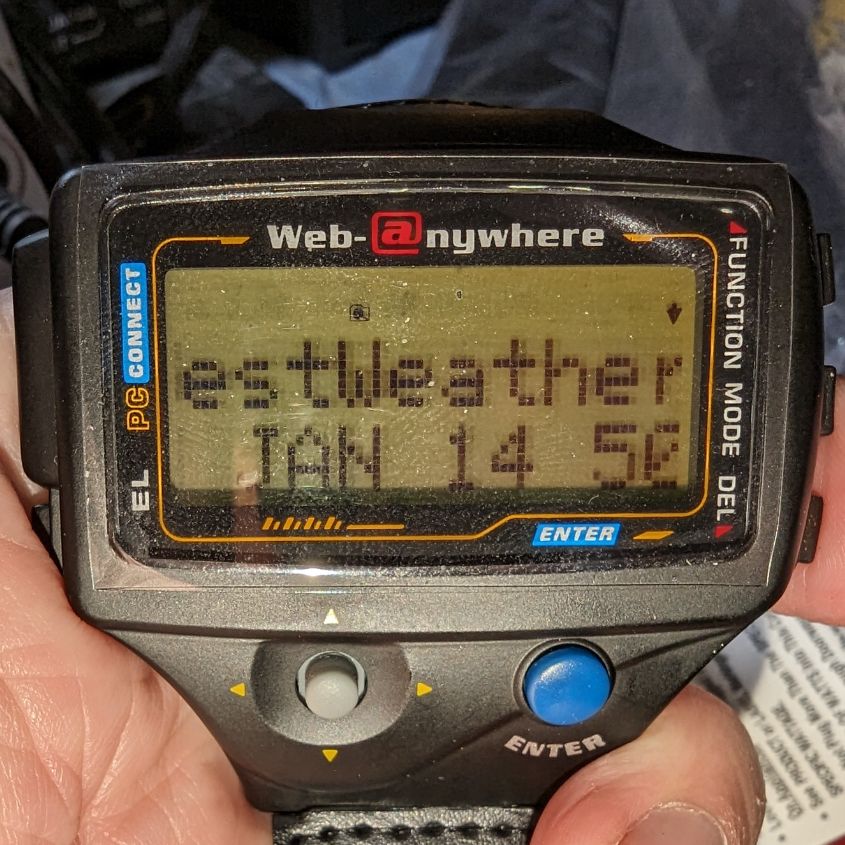
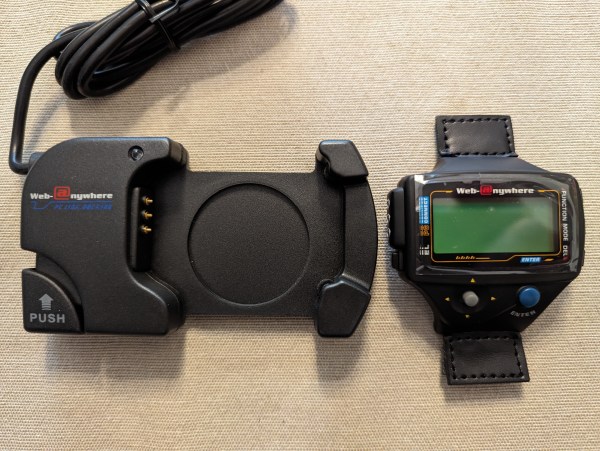
Although smartwatches seem to be just a recent fad, people have been strapping wristwatches to their wrists with all kinds of functionality. Whether a miniscule calculator, a remote control, an organizer or as in the case of the Web-@nywhere Watch a web browser. In the last case only sort of, naturally, as it was released in 2001 and this little early 2000s marvel cost only $85 (or $150 in 2024 USD), so what could it really be capable of? This is the million dollar question that [Cameron Kaiser] sought to find out as he found a new-in-box unit for sale.

The Web-@nywhere watch in action. (Credit: Cameron Kaiser)

Beforehand he knew already that the unit required interaction with a PC-based application to sync the 93 kB of on-watch data, with the required software and remote servers now being very much outdated and/or gone. This required some reverse-engineering to once more bring this watch widget back to life. Along the way it became also quite clear that this watch was designed as a cheap rip-off of the much better 1998 Seiko Ruputer – which later got sold also as the onHand PC – using the same joystick-driven interface.

After some poking around with the Windows-based software that came with the watch [Cameron] quickly realized that while it could establish a serial link with the watch in its cradle, it fully relied on a now defunct FTP server formerly run by the manufacturer, Kinger, along with any games and content on it. Since FTP servers were never archived like HTTP sites, this content is likely gone forever.

Fortunately, the protocol between the PC and the watch is a standard serial link (with parity), so [Cameron] was able to sniff the serial traffic and figure out the protocol, the results of which he has made available on GitHub in the form of a Perl script for transforming text and a C-based application to do the uploading. Now once again Web-@nywhere users can proudly roam the streets with 2024-era website content on their wrists.

How A Steam Bug Once Deleted All Of Someone’s User Data

In a retrospective, [Kevin Fang] takes us back to 2015, when on the Steam for Linux issue tracker [keyvin] opened an issue to report that starting the Steam client after moving the Steam folder had just wiped all of his user data, including his backup drive mounted under /media. According to [keyvin], he moved the standard ~/.local/share/steam to a drive mounted under /media and symlinked ~/.local/share/steam to this new location on the external drive. He then tried starting Steam, which failed, before Steam crashed and tried reinstalling itself. That’s when [keyvin] realized that Steam had apparently recursively deleted everything owned by his user from the root folder.

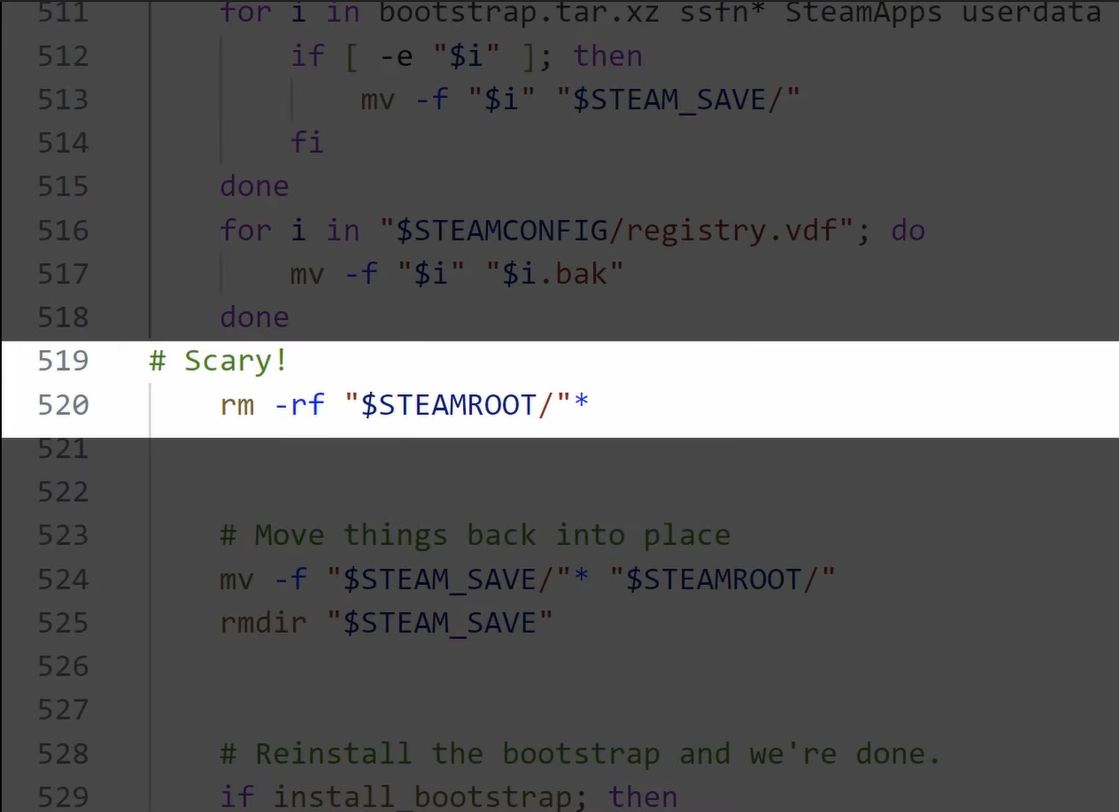
The infamous Valve code that made Linux users sad.

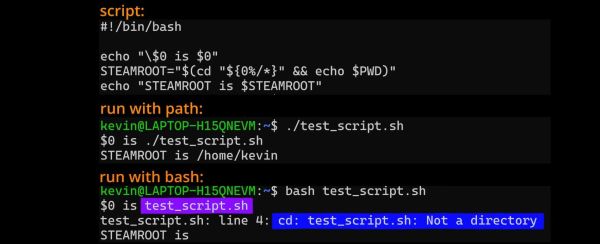
In the issue thread, user [doofy] got hit by the same bug when trying to directly start the ~/.local/share/steam/steam.sh script with debugging enabled. He then was the first to point out the rm -rf in that steam.sh script, but since this particular line is in a function only called when Steam tries to remove and reinstall itself to ‘fix’ a botched start, how did this happen? Ultimately it seems to be because of the STEAMROOT variable being set to an empty string, and another unset variable triggering the reset_steam() function, leading to the demise of all the user data.

Since then Valve has presumably fixed the issue, as no further users have filed tickets, but it’s concerning that a similar issue seems to still exist on Windows. Whether or not the original Linux issue has been fixed, it shows clearly how one should always check return values and perhaps, just maybe, never do an automated rm -rf or equivalent.

Continue reading “How A Steam Bug Once Deleted All Of Someone’s User Data”

Testing The Atlas ICBM: A 1958 Time Capsule Video

The control room during the 1958 Atlas B 4B test. (Source: Convair)

Recently the [Periscope Film] channel on YouTube published a 1960 color documentary featuring the 1958 launch of the Atlas B (SM-65B) ICBM, in its second, Missile 4B iteration. This was the second model of the second prototype, which earned the distinction of being the first truly intercontinental ballistic missile upon its successful test completion, which saw the payload plummeting into its designated part of the Atlantic Ocean. This was a much better result than the previous test of the 3B, which suffered a yaw gyro issue that caused the missile to disintegrate partway into the flight.

In this historic documentary, the Atlas B’s manufacturer – Convair – takes us through all the elements of the test range, including all the downrange stations, their functions and how all the data from the test is captured, recorded (on reel to reel tape) and integrated into one coherent data set. This includes radar data, telemetry received from the missile, as well as the data tape that the ICBM ejects from the payload section shortly before impact.

Although it’s also a promotion piece for Convair Astronautics, this does little to mar the documentary aspect, which is narrated by William Conrad, who manages to both instill a sense of technological wonder and grim foreboding against the scenery of 1950s military high-tech in the midst of a heating up Cold War.

Continue reading “Testing The Atlas ICBM: A 1958 Time Capsule Video”

Haier Threatens Legal Action Against Home Assistant Plugin Developer

Appliance manufacturer Haier has been integrating IoT features into their newer products, and as is so common these days, users are expected to install their “hOn” mobile application to access them. Not satisfied with that limitation, [Andre Basche] reverse engineered the protocol used by the app, and released a Python library and associated Home Assistant plugin to interface with a wide array of Haier appliances, which includes brands like Hoover, Candy, GE Appliances and others.

Unfortunately, it looks like his efforts have gotten him into a bit of legal hot water. In an issue recently opened on the project’s GitHub page, [Andre] explains the circumstances and legal options that have led him to consider pulling the repositories completely — mostly due to the cost of mounting a legal defense to the cease & desist from Haier Europe.

What’s ironic here is that Haier has been part of the Connectivity Standard Alliance (CSA) since 2022, whose goal is to ‘promote universal open IoT standards’, including Matter.

It’s possible that a legal defense will be mounted against this C&D from Haier within the coming days. Yet regardless of the outcome here, it remains problematic that these IoT-enabled Haier appliances are connected to the Haier servers. Ideally they would be controlled locally, which is the goal of projects like [Miguel Ángel López Vicente]’s ESP Haier, that uses an ESP8266 to connect Haier AC units to the local WiFi and e.g. HA instances, all without requiring internet access.

This is sadly just one more example of why building your own off-line smart home can be such an incredible struggle.

Thanks to [Ar3itrary] for the tip.

Turning A 1:150 Scale Model Car Into A Real Driving Car With Lights

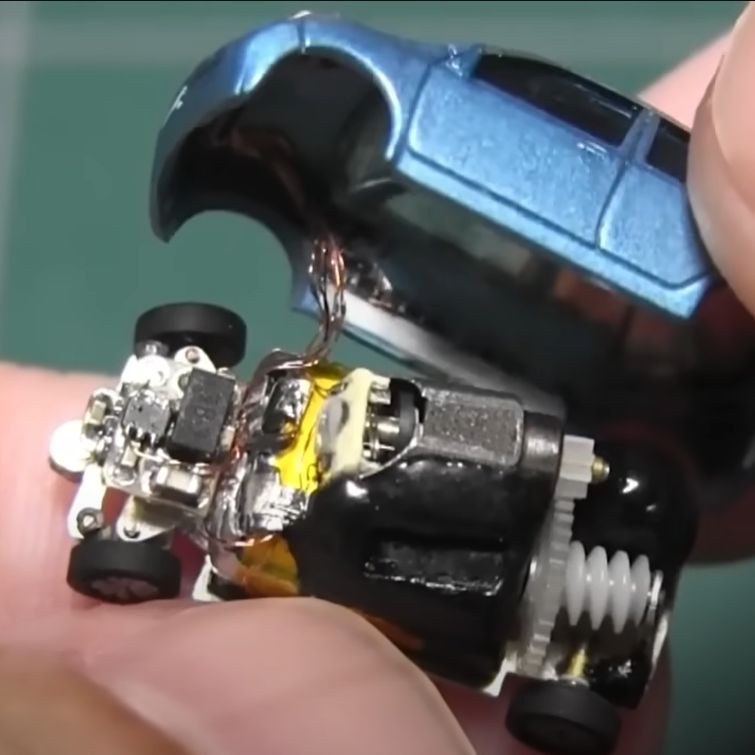
Closing up the remotely controlled 1:150 scale model car. (credit: diorama111)

For many people having a miniature version of something like a car is already a miracle in itself, but there’s always the possibility to take matters a bit further, as YouTube channels like [diorama111] demonstrate. In this particular case, they took a 1:150 scale model of a Nissan Micra and installed a microcontroller, battery, remote steering and front, rear and indicator lights. Considering the 24.5 x 11.4 x 10.5 mm (LxWxH) size of the scale model, this is no small feat.

The original plastic bottom and wheels are removed, and replaced with a metal frame, as well as steerable front wheels that have a neodymium magnet attached to follow a metal guidance track that can be underneath the road surface. For the brains an ATtiny1616 MCU in QFN format is used to receive commands from the PIC79603 infrared receiver module and drive the motor attached to the rear axle via a DRV8210 motor controller IC. The remaining MCU pins are mostly used for turning the LEDs on the lights and signals on or off.

In the video the miniscule RC car is driven around a course with traffic lights, which gives a good impression of how this could be used in a large scale model of a city, with a hidden rail system to determine car routes. As for keeping the 30 mAh Li-Po battery charged, there’s a charge port on the bottom, but at these low current rates you could have hidden conductive charging points throughout the route as well, assuming you can fit a small enough charging coil in this little space.

(Thanks to [Keith Olson] for the tip)

Continue reading “Turning A 1:150 Scale Model Car Into A Real Driving Car With Lights”