Swapping Dev Board Crystals To Suit Your Needs

Microcontroller Dev Boards have the main hardware choices already made for you so you can jump right into the prototyping by adding peripherals and writing code. Some of the time they have everything you need, other times you can find your own workarounds, but did you ever try just swapping out components to suit? [Andy Brown] documented his process of transplanting the clock crystal on an STM32F4 Discovery board.

Even if you don’t need to do this for yourself, the rework process he documented in the clip after the break is fun to watch. He starts by cleaning the through-hole joints of the crystal oscillator with isopropyl alcohol and then applies some flux paste to each. From there the rest is all hot air. The crystal nearly falls out due to gravity but at the end he needs to pluck it out with his fingers. We’re happy to see others using this “method” as we always feel like it’s a kludge when we do it. Next he grabs the load caps with a pair of tweezers after the briefest of time under the heat.

We’d like to have a little bit of insight on the parts he replaces and we’re hoping there are a few crystal oscillator experts who can leave a comment below. [Andy] calculates a pair of 30pf load caps for this crystal. We understand the math but he mentions a common value for board and uC input capacitance:

assuming the commonly quoted CP + CI = 6pF

So we asked and [Andy] was kind enough to share his background on the topic:

It’s a general “rule of thumb” for FR4 that the stray capacitance due to the traces on the board and the input (lead) capacitance of the the MCU is in in the range of 4-8pF. I’m used to quoting the two separately (CP,CI) but if you look around you’ll see that most people will combine the two and call it just “CP” and quote a value somewhere between 4 and 8pF. It’s all very “finger in the air” and for general purpose MCU clocks you can get away picking the mid-value and be done with it.

That leaves just one other question; the original discovery board had an in-line resistor on one of the crystal traces which he replaces with a zero ohm jumper. Is it common to include a resistor and what is the purpose for it?

Continue reading “Swapping Dev Board Crystals To Suit Your Needs”

Your Marble Machine Doesn’t Need To Change The World

It’s easy to get sucked into the increasing the complexity when sometimes the craftsmanship can be what makes the project. [Alex Weber] proves the point with his minimalist marble machine. There are no death-defying twists and turns, no convoluted path forks or overly-complex lifting mechanisms. This is about a clean and simple design that looks amazing whether running or stationary.

For the uninitiated, marble machines route marbles (or quite often steel ball bearings) through a set of paths usually guided by gravity for the delight of onlookers. Traditionally, making them complicated is the point. Take this offering which highlights years worth of marble machine builds all exercising different concepts. Sometimes they occupy entire rooms. We’ve seen them make a clock tick. And who can forget marble-based flip-flops that combine to form things like binary adders?

Have we scared you off from building these yourself yet? No, that’s the entire point of this one… it can be excruciatingly simple, while elegantly crafted. Check out the video demo below to see how one oval, one battery, and one motor have no problem bringing a smile to your face.

Continue reading “Your Marble Machine Doesn’t Need To Change The World”

Portable 120V To 240V Converter; Or How To Fast Charge At Your In-Law’s House

[Nick Sayer] falls into the “would rather build it than buy it” category. This particular project is a clone of a fast electric vehicle charger. There are commercially available versions sold under the Quick 220 brand name. The idea is that for fast charging, some electric vehicles call for a 240V outlet and Americans without electric cars often don’t have one. If they do it’s for an appliance like a stove or clothes dryer and probably not found in the garage.

The device uses two hot and one ground to supply the 240V output which is, in some business where there is three phase power this will be closer to 208V but should still work. Obviously you shouldn’t be doing this unless you know exactly how it works, and we applaud [Nick] for airing these hazards while at the same time supplying the knowledge behind the concerns.

Two inputs for the beefy converter are supplied from outlets not just on separate circuits, but on two circuits whose hot lines are 180 degrees out of phase. That means identifying where there are two plugs, not protected by GFCI outlets or breakers, which are on two separate hot lines of split phase power. To protect the user, [Nick] designed in a set of relays which kill the circuit when one of the two supplies is unplugged. A system that didn’t have these protections would have mains voltage on the prongs of the disconnected plug.

We’ve seen very few car charging hacks. If you know of one, or have been working on your own, let us know!

Rebraining An LED Marquee With A SparkCore

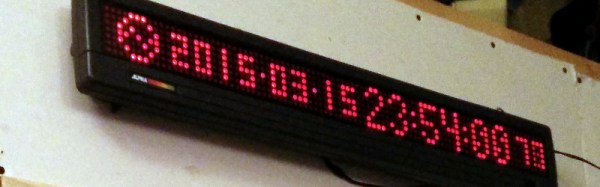
Wires? Where this LED scroller is going we don’t need wires. Well, except for power but everything needs power. The 90×7 LED marquee hangs over the entrance to NYC Resistor’s laser cutter room. Thanks to a Spark Core and a bit of work from [Trammell Hudson], the sign is working and attached to the network.

The original unit called for an RS485 connection for input. Other than that there wasn’t really a reason it had been collecting dust. Closer inspection of the internals proved that the display is driven exactly as you would expect: transistors for the rows and shift registers for the columns. Well, actually the columns are split into separate shift registers for the even and odd but that doesn’t complicate things too much. GPIO takes the seven row-driving transistors, two shift register clocks, data, latch, and enable for a total of twelve pins.

The Spark Core completely replaces the Atmel 80C32X2 and its RTC by pinging the network for UTC time synchronization once per day.

[via NYC Resistor]

Measure Laser Wavelength With A CD And A Tape Measure

Obviously the wavelength of a laser can’t be measured with a scale as large as that of a carpenter’s tape measure. At least not directly and that’s where a Compact Disc comes in. [Styropyro] uses a CD as a diffraction grating which results in an optical pattern large enough to measure.

A diffraction grating splits a beam of light up into multiple beams whose position is determined by both the wavelength of the light and the properties of the grating. Since we don’t know the properties of the grating (the CD) to start, [Styropyro] uses a green laser as reference. This works for a couple of reasons; the green laser’s properties don’t change with heat and it’s wavelength is already known.

It’s all about the triangles. Well, really it’s all about the math and the math is all about the triangles. For those that don’t rock out on special characters [Styropyro] does a great job of not only explaining what each symbol stands for, but applying it (on camera in video below) to the control experiment. Measure the sides of the triangle, then use simple trigonometry to determine the slit distance of the CD. This was the one missing datum that he turns around and uses to measure and determine his unknown laser wavelength.

Continue reading “Measure Laser Wavelength With A CD And A Tape Measure”

Auto-sleep Hacked In PC Speakers

We can commiserate with [HardwareCoder] who would rather not leave his PC speakers on all the time. The Creative T20 set that he uses turn off when you turn the volume knob all the way down until it clicks. So shutting them off means repositioning the volume each time they’re switched on again. This hack kills two birds with one stone by turning on and off automatically without touching that knob.

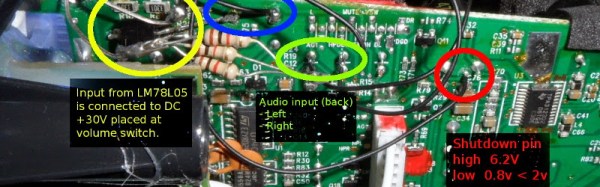
The system is based around an ATtiny45 and a few other simple components. It uses two ADCs to monitor the rear input channels of the PC speakers. If no sound is detected for more than one minute, the shutdown pin of the speakers’ amp chip is triggered. That’s not quite where the hack ends. We mentioned it monitors the rear input of the speakers, but it doesn’t monitor the front AUX input. An additional push button is used to disable the auto-sleep when using this front input. There is also a fancy PWM-based heartbeat on an LED when the speakers are sleeping.

[HardwareCoder] was worried that we wouldn’t be interested in this since it’s quite similar to a hack we ran a few years ago. We hope you’ll agree it’s worth another look. He also warned us that the demo video was boring. We watched it all anyway and can confirm that there’s not much action there but we embedded it below anyway.

Continue reading “Auto-sleep Hacked In PC Speakers”

Clever Chemistry Leads To Much Faster 3D Printing

Resin printing, it can be messy but you get really great resolution thanks to the optical nature of curing the sticky goo with light from a projector. Soon it will have a few more notches in its belt to lord over its deposition cousins: speed and lack of layers. A breakthrough in resin printing makes it much faster than ever before and pretty much eliminates layering from the printed structure.

The concept uses an oxygen-permeable layer at the bottom of the resin pool. This inhibits curing, and apparently is the source of the breakthrough. The resin is cured right on the border of this layer and allows for what is described as a continuous growth process rather than a layer-based approach. One of the benefits described is no need for resin to flow in as the part is extracted but we’re skeptical on that claim (the resin still needs to flow from somewhere). Still, for us the need to work with resin which is expensive, possibly messy, and has an expiry (at least when compared to plastic filament) has kept deposition as a contender. The speed increase and claims of strength benefits over layer-based techniques just might be that killer feature.

The technology is coming from a company called Carbon3D. They are branding it CLIP, or Continuous Liquid Interface Production. After the break you can see a video illustration of the concept (which is a bit too simple for our tastes) as well as a TED talk which the company’s CEO, [Joseph Desimone] gave this month. Of course there is also the obligatory time-lapse print demo.

So what do you think: game changer or not, and why do you feel that way? Let us know in the comments.

Continue reading “Clever Chemistry Leads To Much Faster 3D Printing”