Cadence Meter Proves Wearable Development Is All About Just Doing It

wearables-just-start-doing


The tech involved in the fitness world really empowers athletes, whether they’re serious or not, to improve their performance by providing empirical evidence. The Striker project focuses on cadence, which is the frequency of strides when running, or revolutions when pedaling. It uses a force sensitive resistor in the shoe to measure footfalls or power strokes.

The concept behind the device is solid, and there are consumer-grade devices already on the market that are capable of performing the same functions. In fact, a Garmin device is used to help measure the accuracy of the system. But we love to see bootstrapped projects, and this one distinguishes itself not only in finished product, but in the process itself. To us it screams: “What are you waiting for, build a prototype and then iterate!”.

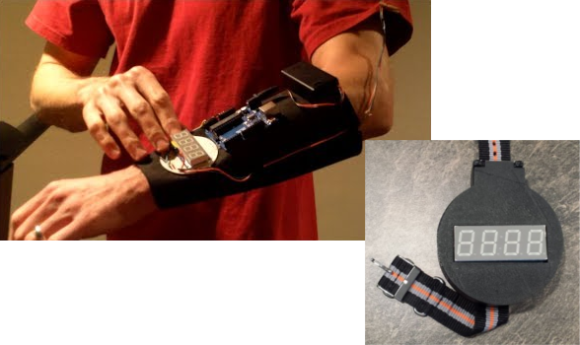
The larger image above shows the earliest working version which is just a piece of fabric that wraps around the forearm to hold a 4-digit 7-segment display. The wire following the arm of the wearer snakes all the way down to the shoe to connect with the force sensor. The image to the right is the first wireless version of the readout. But the project has already seen at least two more versions after this one, mostly using SparkFun components.

We think this is but one example of the kind of stuff we want to see as contenders for The Hackaday Prize. The project uses Open Design and it’s arguably a connected device because the sensor and readout connect to each other (but ideally you’d want to add more connectivy to get at the data). The open nature of the build could lead to leaps forward in the technology by affording talented people wider development access.

Continue reading “Cadence Meter Proves Wearable Development Is All About Just Doing It”
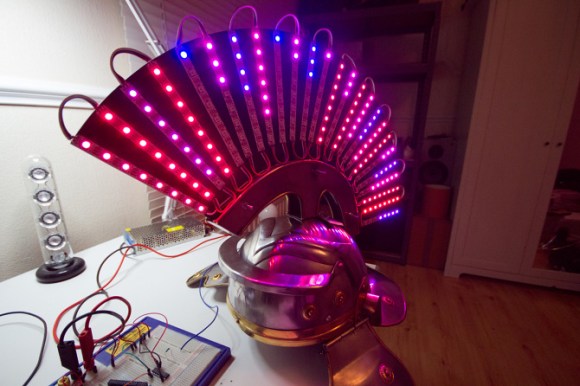
Roman Headgear Looks Less Silly With Lots Of Blinky

centurion-project

Look, it’s not Steam-Punk because the period is way out of whack. And we’ve never seen ourselves as “that guy” at the party. But it would be pretty hard to develop The Centurion Project and not take the thing to every festive gathering you could possibly attend. This sound-reactive helm compels party-going in a toga-nouveau sort of way.

[Roman] tells us that it started as a movie prop. The first build step was to remove the plume from the top of it. The replacement — seven meters worth of addressable RGB LEDS — looks just enough like an epic mohawk to elicit visions of the punk rock show, with the reactive patterns to make it Daft. The unexpected comes with the FFT generated audio visualizations. They’re grounded on the top side of each of the LED strips. Most would call that upside-down but it ends up being the defining factor in this build. Seriously, watch the demo after the break and just try to make your case that this would have been better the other way around.

As a final note, this project was written using Cinder. It’s an Open Source C++ library that we don’t remember hearing about before.

Continue reading “Roman Headgear Looks Less Silly With Lots Of Blinky”

Japanese Edition: 3Dプリンターで24時間以内に住宅建設。しかもリサイクル材料を用いたエコ建築。

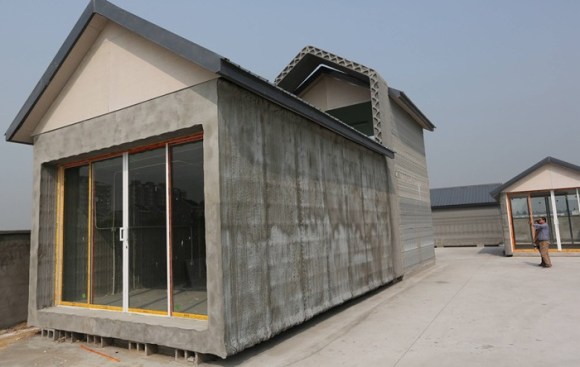
3d printed house in china

by: [Hideyuki Yamamoto] based on this feature.

3Dプリンターメーカーが小さくて精度が高いプリンターを開発するのに躍起になっている中でShanghai WinSun Decoration Design Engineering Companyという中国にある会社がオリンピックプールの半分程度の大きさの巨大な3Dプリンターで実験を重ねているとBBCなどは報じている。

http://3dprinterplans.info/3d-printer-plans-news-round-up-for-wednesday-16042014/

縦32m、横10m、高さ6.6mものマンモスプリンターで400m2の平屋一戸建て住宅がプリント出来る。FDM技術によりセメントと建築廃材混合の壁が作られ、その会社によると一軒あたり5000ドル以下で建てられ、1日あたりなんと10戸の製作が可能とのこと。

そのプリンターは数年前に設計され、WinSunが海外から部品を調達し、蘇州工場で組み立てられた。
この会社は街全体の家をプリントする計画を立てており、リサイクル施設を建設するための部材を集めているという。この家は、まずは青島にて販売される予定だ。

FDM技術を使えば軽量で耐久性のある家がプリント可能になる。この手法は間違いなくオランダのKamerMaker社による建築よりも早いであろう。耐久性や安全性に関してはまだまだ改善の余地があると思われるが、安くて短期間に家が建つ可能性が拡がる話題である。

Continue reading “Japanese Edition: 3Dプリンターで24時間以内に住宅建設。しかもリサイクル材料を用いたエコ建築。”

Hack A Camera, Win A Nikon

nikonchallenge_620x250_01jbr1

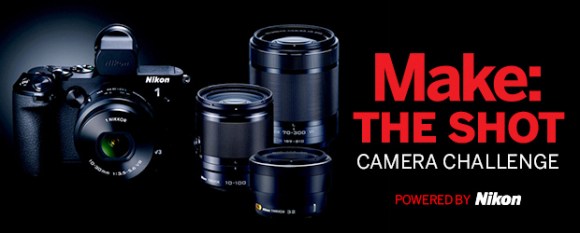
Several juicy prizes from Nikon are ripe for the plucking. Our friends at MAKE are hosting a Nikon sponsored challenge. Grand prize is an Nikon 1 V3 with three extra lenses, and there are two runner-up prizes which offer the same without the extras. They’re basically asking for your best camera hack. Now the submission process is a one-shot deal (no posting and iterating) which may explain why the contest — which started 4/15 and ends 5/13 — only has two entries. Still, we’d love to see a Hackaday reader waltz in and claim the loot.

Need some examples to get you rolling? Connectivity is a fun topic; try interfacing your camera with something like a Nintendo DS. Everyone needs to make at least one motion rig like this Ikea slider. We can’t stop listing examples without at least one shutter trigger. Here’s a sound activated one to capture things that happen extremely quickly.

If you end up winning make sure to tell us so we can share in your delight.

Community Weigh-In For Sci-Fi Contest

sci-fi-community-weigh-in

The entry period for the Sci-Fi Contest ended at mid-night yesterday morning. Now’s the time to weigh-in as ten prizes will be awarded based on the community outpouring for the project. Go check out all of the projects that were entered and register your opinion through “Follow Project” and/or “Give a Skull” buttons.

We’re hoping to announce judging decisions for the contest on Thursday, May 8th.

Roboartist Draws What It Sees

roboartist-vector-image-machine

The perfect balance of simplicity and complexity have been struck with this automated artist. The Roboartist is a vector drawing robot project which [Niazangels], [Maxarjun], and [Ashwin] have been documenting for the last few days. The killer feature of the build is the ability to process what is seen through a webcam so that it may be sketched as ink on paper by the robotic arm.

The arm itself has four stages, and as you can see in the video below, remarkably little slop. The remaining slight wiggle is just enough to make the images seem as if they were not printed to perfection, and we like that effect!

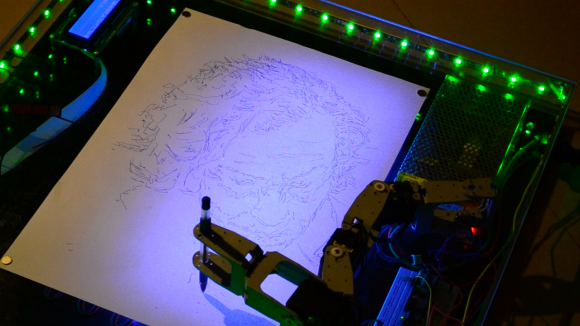
Above is a still of Roboartist working on a portrait of [Heath Ledger] in his role as Joker from The Dark Knight. The image import feature was used for this. It runs a tweaked version of the Canny Edge Detector to determine where the pen strokes go. This is an alternative to capturing the subject through the webcam. For now MATLAB is part of the software chain, but future work seeks to upgrade to more Open Source tools. The hardware itself uses an Arduino Mega to take input via USB or Bluetooth and drives the quartet of servo motors accordingly.

Continue reading “Roboartist Draws What It Sees”

The Hackaday Prize: You Build Open Hardware, We Send You To Space

[youtube=https://www.youtube.com/watch?v=Dh5yzP4ZINA&w=580]


For weeks we’ve been teasing you that something BIG was coming. This is it. Six months from now one hardware hacker will claim The Hackaday Prize and in doing so, secure the grand prize of a trip into space.

You have the skills, the technology, and the tenacity to win this. Even if you don’t take the top spot there’s loot in it for more than one winner. To further entice you, there are eyebrow-raising prizes for all five of the top finishers, and hundreds of other rewards for those that build something impressive. You can win this… you just need to take the leap and give it your all.

Continue reading “The Hackaday Prize: You Build Open Hardware, We Send You To Space”