Adding An Auto-shutoff To The Simplest Of Drip Coffee Makers

[Jerry Pommer] and his wife have relied on a percolating coffee pot for years. We have fond memories of camping trips with these things; they make great coffee which tastes even better on a cold morning in the back woods. But a recent package from the stork means that they no longer have time to sit and watch the coffee perk. After several days of boil-overs [Jerry] switched to this very basic drip coffee maker he salvaged from the trash pile. It has one switch that turns it on and off and nothing else. In order to make sure he doesn’t forget to turn it off, he hacked together his own shut-off timer for the device.

His write-up is all back story, but the 34 minute video embedded after the break takes us through the hack itself. We like it that he starts by discussing the different options that he could have chosen. Of course it might have been a microcontroller, or a 555 timer keeping time. But in the end he went with a simple resistor-capacitor timer. The carefully calculated component pair drives a Darlington transistor which keeps a relay closed. When the slowly draining capacitor lets the voltage drop past a certain threshold it also kills the power to the hot plate. In this case it will only stay on for about a half hour.

Continue reading “Adding An Auto-shutoff To The Simplest Of Drip Coffee Makers”
Another Switch Mode Regulator Swap For The Raspberry Pi

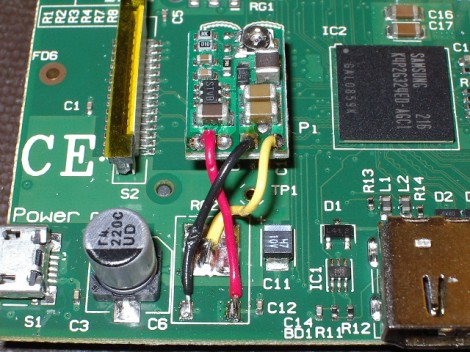
[Karl Lunt] is working to slim the Raspberry Pi current draw as much as possible. The first step in his journey was to replace the linear voltage regulator with this switch mode version. It’s a step-down voltage regulator circuit with a tiny footprint and a matching price tag (about $10) made by Pololu. It’s small enough to be mounted in the empty space between the LCD ribbon connector and the main processor.

The project was based on the hack we saw at the end of June. But we give much more credit to [Karl] for removing the old part in a safer way. He clipped the two small leads on the bottom of the old part, then used a beefy iron to sufficiently heat the large pad before removing the body of it. With the old part out of the way it’s just a matter of connecting the three wires in the right configuration.

This cut consumption by about 50 mA. He’s hoping to do more by removing the on-board LEDs. His goal is a draw of under 250 mA in order to make it last a reasonable amount of time when running from batteries.

All-terrain Electric Scooter Build

This all-terrain electric scooter can destroy the speed limit in a school zone without even trying. [Ben Katz] built from the ground-up and did an amazing job of documenting the journey.

He strated by redesigning the suspension of a plain old kick-scooter to use these large inflatable wheels. This includes a suspension system that helps cushion the rider from the bumps of an uneven driving surface. The increased deck height leaves plenty of room for the locomotive parts. You can see the three cylinders mounted near the rear wheel. Those are the motors, connected to a single drive shaft with a gear box which [Ben] built. The drive shaft powers the rear wheel via chain drive. Batteries are housed in the rectangular enclosure in front of the motors.

Don’t miss the video after the break. [Ben] takes the thing on and off-road, averaging 15 MPH while topping out at 24!

Continue reading “All-terrain Electric Scooter Build”

Resurrecting A Hi-Fi Cabinet

[VintagePC] pulled this old stereo out of a barn. It was in pretty shabby shape, but he managed get it running again and make it look great as well.

While it had been protected from the elements, it had not been protected from the rodents. Mice had chewed their way through the fiberboard backing and made a nice home inside. He mentions that they chewed the string which operates the tuning dial, and we’re sure they were the cause of other problems as well. He gives the wise advice of not powering on an old set like this until you have a chance to assess the situation.

The insides of the amplifier were about as disorderly as the last radio repair we looked at. But after carefully working his way through the circuits, replacing capacitors and resistors as needed, he started to make some progress. The receiver coil needed to be rewound and he used wire from an old CRT monitor for this purpose. The loop antenna was remounted and the record player arm was given a new cartridge and balanced using a clever LEGO apparatus. Some veneer work and wood finishing brought the case itself back to its original beauty. We’d say the hard work was well worth it. He’s got a big piece of furniture he can always be proud of!

Monitoring A Clothes Washer With An Accelerometer

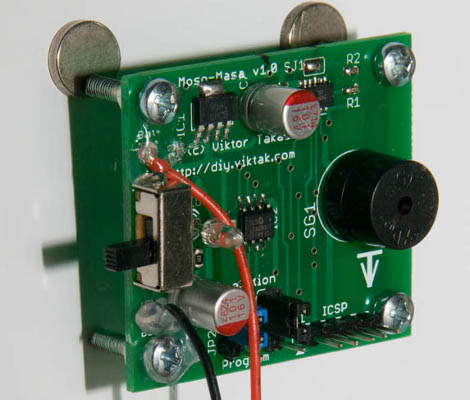
[Viktor’s] washing machine did a good job of cleaning his clothes, but it kept a bit too quiet about it. The machine doesn’t have an audible alert to let him know the cycle has finished. He decided to build his own alarm which can just be slapped on the side of the machine.

You can see that a couple of magnets hold the board to the metal housing of the washer. The board doesn’t actually connect to any of the machine’s circuitry so this should work about equally as well for any unit. The detection is based on motion, thanks to a Freescale MMA7361 3-axis accelerometer. When he starts a load of wash he flips the power switch for the board on. The PIC 12F683 that drives the device starts monitoring the accelerometer for changes. If it goes for more than about one minute without reading motion the piezo buzzer starts beeping. It’s a fun and easy solution along the same line of this oven pre-heat alarm add-on.

Keyless BMW Cars Prove To Be Very Easy To Steal

A lot of higher end cars are now coming out with RF fobs that unlock and start the car. There is no longer a physical key that is inserted in the ignition. It turns out that for BMW this means stealing the cars is extremely easy for a sophisticated criminal. We always liked the idea of metal keys that ALSO had a chip in them. The two-tiered security system makes sense to us, and would have prevent (or at least slowed down) the recent  rash of BMW thefts that are going on in the UK.

So here’s the deal. A device like the one seen above can be attached to the On-Board Diagnostic (ODB) port of the vehicle. It can then be used to program a new keyfob. This of course is a necessary feature to replace a lost or broken device, but it seems the criminals have figured out how to do it themselves. Now the only hard part is getting inside the car without setting off the alarm. According to this article there are ultrasonic sensors inside which are designed to detect intrusion and immobilize the vehicle. But that’s somehow being circumvented.

You can check out a keyfob programming demo, as well as actual theft footage, after the break.

Continue reading “Keyless BMW Cars Prove To Be Very Easy To Steal”

Taking A Moon Light From Grayscale To Full Color

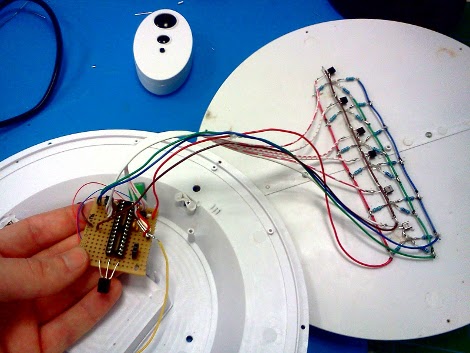
[Terry Miller] picked up a moon light on the cheap. All it does is light up some white LEDs to simulate moon phases after sensing nightfall via an LDR. He figured he could do better and set out to replace the electronics with a more colorful offering.

He chose to use an ATmega328 because he already had it on hand. The chip drives a series of RGB LEDs in a multiplex arrangement. To protect the I/O pins (and drive the LEDs at their target current) he is using a set of high and low side MOSFETs. Rather than rely on the light sensor to switch on the lamp he decided to add an IR receiver. In the video after the break you can see that this lets him cycle through colors and effects, in addition to switching the lamp on and off with a remote control.

With the enclosure put back together he is still able to reprogram the chip thanks to a serial header included in the design. The device is battery operated and the life estimates are included in his write-up.

Continue reading “Taking A Moon Light From Grayscale To Full Color”