Computer-aided Paint Brush

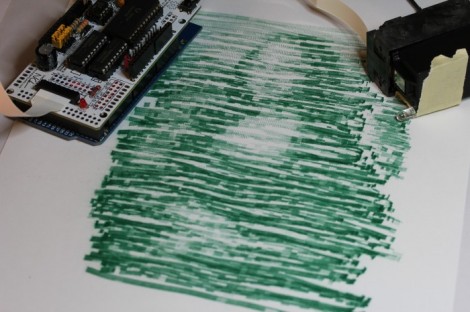
[Nirav] painted this masterpiece by hand… with a little help from a computer. He calls it the semi-automatic paintbrush because you do need to move it over the canvas by hand, but a computer decides when to dispense the ink.

He’s using a piece of hardware we looked at back in September called the InkShield that got a boost from Kickstarter. It’s an Arduino shield that drives an inkjet printer cartridge. The trick is how to know when the cartridge is in position for printing.

The system uses visual processing for that. [Nirav] added an IR led to the cartridge, and uses a camera to extrapolate its position. He actually reused a Python homography module which he had written for use with a projector. That setup was developed as a digital white board, but works just as well for this purpose.

He mentions that results like this won’t be featured in an art museum. But the look is unique, and we’d love to make a set of geeky thank-you notes using the technique.
Retrofitting Modern LEGO Train Tracks For Use With Older Version

So you’re really looking for that [Norman Rockwell] Christmas and want to set up your train to encircle the Christmas tree this year. The problem is that all you’ve got is an old LEGO train set and not enough track for it. You can’t just buy some more, because the technology has changed; or can you?

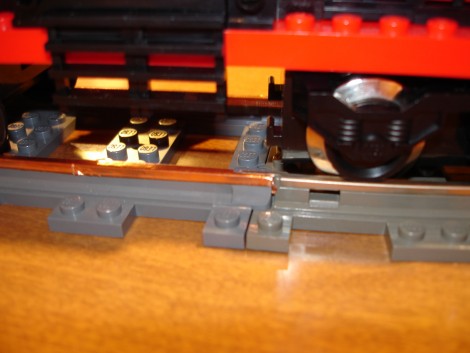
[Chris] was dismayed to find that newer LEGO train sets have gone to battery operation rather than drawing power through metal tracks. The new tracks are plastic, and buying extra segments of the older version is cost prohibitive. He figured out a way to add power conductors to the new track pieces.

It turns out the design of the new tracks matches the old, except they’re all in plastic instead of having metal rails. He bought a plastic add-on set, then picked up some copper foil from the hobby store which is meant for stained-glass work. It’s adhesive backed, and after working out the best way to apply it, he coated the rails with the stuff. As you can see above, the new mates perfectly with the old, and keeps that locomotive chugging along.

If you’ve got copper foil left over after this hack, there’s tons of other uses for it. Perhaps building your own flex sensors is worth a try.

Smelting Metal In Your Microwave Oven

Grab some scrap metal and a microwave oven and you’ll be casting your own metal parts in no time. [Mikeasaurus], who is known for doing strange things like making Silly Putty magnetic or building his own spray paint bottles, doesn’t disappoint this time around. He read about microwave smelting in Popular Science and is giving it a shot himself.

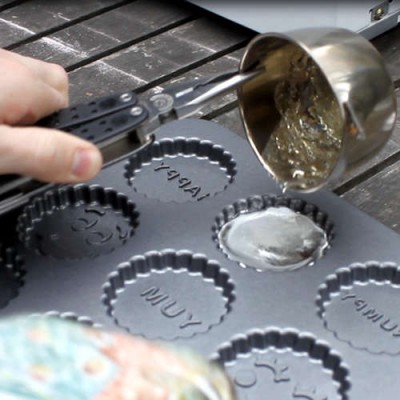
The image above shows him pouring an ingot. He build an insulated brick enclosure inside of the microwave oven, then set it to go ten minutes for a 50/50 lead/tin mixture, or fifteen minutes for silver. This will vary based on the power rating of your microwave. You can see in the video after the break that the setup gave him some trouble shortly after pouring. It wasn’t a problem with the molten metal, but spontaneous combustion of the rigid foam insulation that did him in. We shouldn’t say ‘I told you so’, but that insulation says right on it that it’s flammable!

This isn’t the first time we’ve looked at casting metal melted in a microwave. Check out this other version posted back in 2005. Continue reading “Smelting Metal In Your Microwave Oven”

Hacking Old Server Hardware For New Home Use

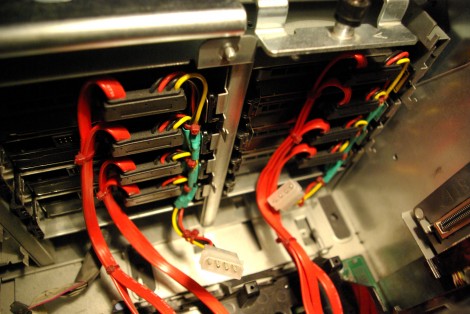
[Arnuschky] was looking for a network storage solution that included redundancy. He could have gone with a new NAS box, but didn’t want to shell out full price. Instead, he picked up a Dell PowerEdge 2800 and hacked it for SATA drives and quiet operation.

It’s not surprising that this hardware can be had second-hand at a low price. The backplane for it requires SCSI drives, and it’s cheaper to upgrade to new server hardware than it is to keep replacing those drives. This didn’t help out [Arnuschky’s] any, so he started out by removing the SCSI connectors. While he was at it, he soldered wires to the HDD activity light pads on the PCB. These will be connected to the RAID controller for status indication. The image above shows the server with eight SATA drives installed (but no backplane); note that all of the power connectors in each column are chained together for a total of two drive power connectors. He then applied glue to each of these connectors, then screwed the backplane in place until the glue dried. Now the device has swappable SATA drives!

His server conversion spans several posts. The link at the top is a round-up so make sure you click through to see how he did the fan speed hack in addition to the SATA conversion.

If your tolerances don’t allow you to glue the connectors like this, check out this other hack that uses shims for spacing.

Xbee Remote Sensors Tell You When Someone Enters Your Home

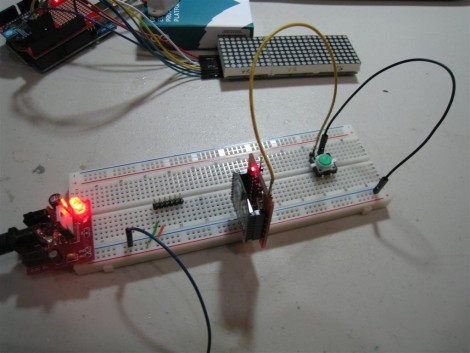
[Bill Porter] is helping a friend out by designing a simple security system for her home. It relies on Xbee modules to alert a base station when doors are opened, or a pressure mat is stepped on.

The door sensors are quite simple, and you’re probably already familiar with them. One part mounts to the door and has a magnet in it, the mating part mounts to the jamb and has a reed switch that closes a contact when the magnet is in place. The floor mat uses two sheets of conductive material separated by bits of foam. When it is stepped on a circuit is completed and can be sensed by the Xbee as a button press.

These sensors report back to an Arduino base station that has a buzzer and three 8×8 LED modules to scroll a message saying which sensor was tripped. [Bill] does a good job of showing what goes into configuring an Xbee network if you’ve never worked with the hardware before.

You’ll find his demo video after the break.

Continue reading “Xbee Remote Sensors Tell You When Someone Enters Your Home”

Cloud Mirror Adds Internet To Your Morning Ritual

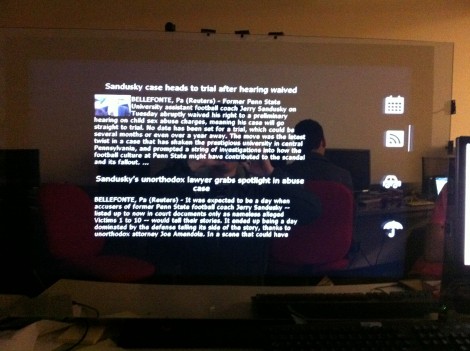
This mirror has a large monitor behind it which can be operated using hand gestures. It’s the result of a team effort from [Daniel Burnham], [Anuj Patel], and [Sam Bell] to build a web-enabled mirror for their ECE 4180 class at the Georgia Institute of Technology.

So far they’ve implemented four widget for the system. You can see the icons which activate each in the column to the right of the mirror. From top to bottom they are Calendar, News, Traffic, and Weather. The video after the break shows the gestures used to control the display. First select the widget by holding your hand over the appropriate icon. Next, bring that widget to the main display area by swiping from right to left along the top of the mirror.

Hardware details are shared more freely in their presentation slides (PDF). A sonar distance sensor activated the device when a user is close enough to the screen. Seven IR reflectance sensors detect a hand placed in front of them. We like this input method, as it keep the ‘display’ area finger-print free. But we wonder if the IR sensors could be placed behind the glass instead of beside it?

Continue reading “Cloud Mirror Adds Internet To Your Morning Ritual”

Data Logging With A Cheap Lux Meter

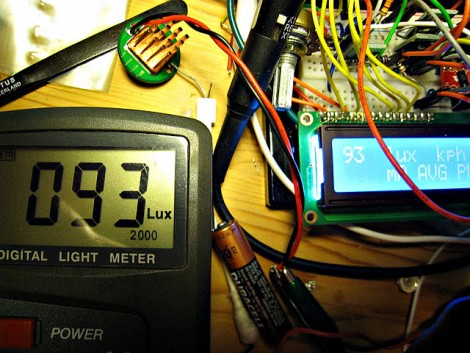
[Minisystem] has a thing for dynamo powered bike lights. He wanted to measure how well his latest is working, but just logging the current flow through the LEDs wasn’t enough for him. He picked up a cheap Lux meter and hacked into the circuit to log measurements while he rides.

He started by cracking open the case to see what the meter held inside. There’s a Texas Instruments Op-Amp that connects to the light sensor. The datasheet for the part didn’t help much, but [Minisystem] did find that the current output on one of the pins changes with light intensity. Further testing led him to discover that the signal is a multiple of 10 for what is shown on the Lux meter’s readout. All he needs to do is take regular measurement of this current and save that data.

To do this, he grabbed his trusty Arduino and made a connection between one of its analog inputs and the op-amp pin. It should be easy enough to dump measurements into the Arduino’s own EEPROM, or use an external storage chip or SD card.

[Thanks Jason]