Advent Calendar Of Circuits

We missed 60% of it already, but luckily you can easily watch the back catalog of [Alan Yates’] 2011 Advent Calendar of Circuits. As with traditional Advent Calendars he’s got a treat for every day in December leading up to Christmas. Instead of chocolate, the treat is a video about a different electronic circuit.

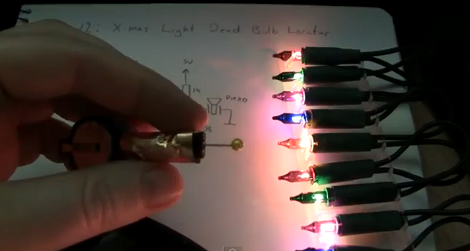
We didn’t find a playlist link, but you can just head over to his YouTube channel as each day is clearly labelled in the video titles. He starts off with a current limiting voltage regulator. A couple of days later he busts out a metal detector that will be fun to play with. Day 7 brings an AM transmitter/receiver pair, and Day 12 illustrates a burnt-out Christmas light detecting tool which we’ve embedded after the break.

The sheer volume of projects he’s putting out every day is remarkable and delightful. He doesn’t even limit himself to one video a day, but has posted several ‘extra’ editions with quick, circuit demos. Continue reading “Advent Calendar Of Circuits”


Saleae Logic Analyzer Knockoff Hacking

Despite what this module says on the case, it’s certainly not official Saleae Logic Analyzer hardware. [Jack Andrews] picked up this Chinese knockoff on eBay for about $18. When plugged into the computer the Saleae software picks it up as the official hardware. But [Jack] has seen other knockoffs which have a jumper to select between Saleae cloning and USBee cloning so he found a way to switch software with this dongle.

He pulled the board out of the case and discovered a Cypress CY7C68013A microcontroller on a poorly-soldered board (imagine that). This is an 8051-compatible processor that includes USB functionality. There’s also an EEPROM on the bottom of the board which stores the VID/PID pair identifying it as Saleae Logic hardware. The trick to getting this working with the USBee software is to change that pair. [Jack] managed to do this without an external programmer. He uninstalled the Saleae driver and installed a Cypress driver. Then he wrote a bit of code for the CY7C68013A to rewrite the EEPROM and flashed it via the USB connection. Now the dongle enumerates as USBee Logic Analyzer hardware.

Decorating An Ent For Christmas

These images may look the same, but if you peer closely at the one on the left you’ll notice the eyes staring back at you. It seems animatronic decor is in this year, and we think [Fjord Carver’s] talking Christmas tree is one of the better offerings.

He picked up the diminutive tree at the dollar store, then started added the pieces that put on the show seen after the break. A small strand of battery operated lights, and a bit of garland are traditional. But the Arduino and pair of servo motors are a new holiday tradition. They move parts of the tree to reveal a set of eyes and animate a mouth. He drives the display by sending serial commands from a computer to the Arduino. This way you can script your performances, with flapping jaw, moving eyelids, and blinking lights while the computer supplies the sound.

Is it just us, or does anyone else really want to see this guy singing the Chipmunk’s Christmas Song? Or if that’s a bit too wholesome you could go the more vulgar route.

Continue reading “Decorating An Ent For Christmas”

Impromptu Lamp Runs Linux

This LED lamp, which uses a soda cup as a lampshade, is Internet enabled thanks to a Linux board (translated). To say the system is overpowered would be a gross understatement. But at least there’s plenty of room for growth.

The lamp is really just a hardware extension for the Linux board. A half-dozen colored LEDs are driven by an ATmega8 and a few transistors. A Fox LX832 board pushes color instructions to the microcontroller via the i2c protocol. [Gibus] chose this board because it has a built-in Ethernet port which makes it perfect for communicating via a smart phone browser. This is where the majority of the work on the project happened. He coded a Flash application that lets you select color, hue, and saturation data from any device that doesn’t run iOS. These commands are processed by a C application running on the Linux board. See a demo of the web app, and the resulting color changes in the clip after the break.

Continue reading “Impromptu Lamp Runs Linux”

Smother Yourself In Addressable LEDs

Guess where this guy’s headed in his suit of many colors? If you said Burning Man give your self a pat on the back. After making a half-hearted EL suit for the festival in 2010 [Sander] decided he needed to step it up this year. He bought and affixed 200 LED modules to this suit so that he could light up the night.

They’re mounted in a grid, and in order to keep the changing patterns orderly he mapped the physical location of each in his code using a two-dimensional array. The controller uses an Arduino nano to push the patterns out to the array via SPI.

[Sander] included several different visual effects for the controller. One strobes the suit starting from the right cuff when he shakes someone’s hand. There’s also an audio spectrum analyzer chip and microphone that let him pulse the lights to music. You can see how bright this thing is in the image above, but to get the full effect shouldn’t skip the video after the break.

He’s entered the project into the Full Spectrum Laser Cutter giveaway. If he wins, we expect laser cut goodness for next year’s festival!

Continue reading “Smother Yourself In Addressable LEDs”

Geared System Adds RFID To Regular Door Locks

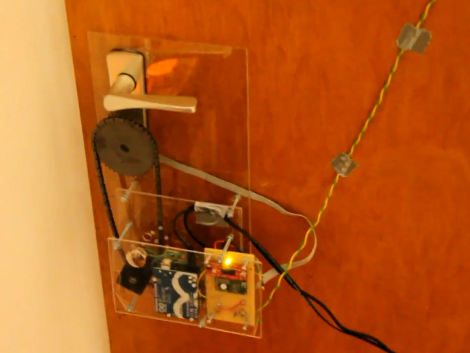
[Flowolf] added an auto-locking RFID entry system to his front door. He used our favorite fabrication system, acrylic and threaded rod (we also like to throw in aluminum angle bracket from time to time). The support structure mounts underneath the escutcheon plate for the lockset, keeping the main acrylic sheet flat against the door.

An RFID reader and Arduino run the system, with a button inside to unlock the door. But if power were to fail, you will still be able to get in or out manually. When you are using the electronic system, a stepper motor connected to the geared lock knob by a chain is what grants access, then revokes it again five seconds later. The wire going up out of the this image is for a switch that lets the unit sense when the door is closed.

As shown in the video after the break, you can turn the auto-lock feature off. But we’d like to see an emergency entry feature, like a knock-based lock, because eventually you will leave without your keys!

Continue reading “Geared System Adds RFID To Regular Door Locks”

High Speed Stepper Driving: 25k Steps Per Second

Stepper motors are pretty easy to control with a microcontroller. But if you’re looking to run then at a high number of revolutions per second things get tricky pretty quickly. [Uwe’s] been learning about and building stepper drivers for years, and recently he decided to build a high-performance driver based on a MicroChip reference design.

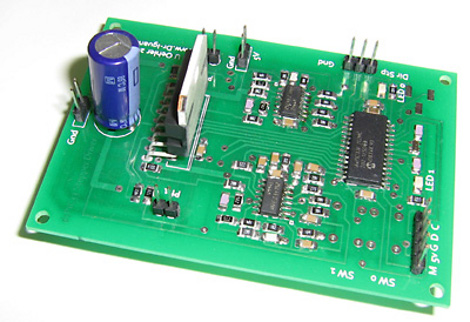
As with the reference design, his board uses a dsPIC33. But instead of using a series of discrete MOSFETS to switch the signals to the motor, he sourced an L298N motor driver. That’s it sticking up next to the large capacitor. When driven hard it needs its own heat sink, which [Uwe] cut from a larger CPU heat sink. During development, he decided to use interrupt-based PWM rather than the hardware PWM offered by the dsPIC. It works, but he would go the other route if doing it again.

For the pedestrian, the video after the break has all the details you need. For those that really want to dive in, [Uwe’s] multi-paged write-up is worth bookmarking.

Continue reading “High Speed Stepper Driving: 25k Steps Per Second”