Update: Tiny Line-follower And More

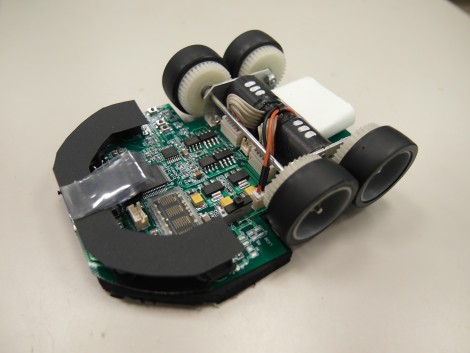
This tiny line-following robot is quite impressive. It’s [Ondrej Stanek’s] second take on the design, which he calls PocketBot 2. Just like the earlier version, this robot is small enough to fit in a matchbox, but it’s received several upgrades in this iteration.

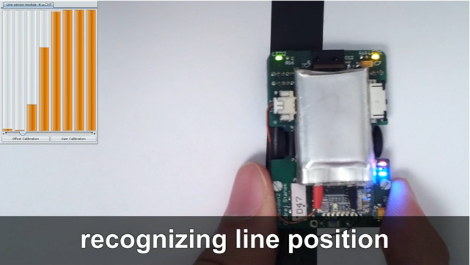
The coin cells that ran the previous version have been replaced by a rechargeable Lithium Ion cell. The ATmega8 which controlled the first robot has been swapped out for an ATmega128 running at 32 MHz. You won’t find an IR receiver on this one either, it’s been traded for a Bluetooth module which adds a quantum leap in functionality. For instance, the graph in the upper left of this photograph shows the reflective sensor data readings used to follow the line.

There’s all kinds of great engineering in this design, which is shown off in the video after the break. One of our favorite parts is that the axles are attracted to the center of the robot by one rare-earth magnet. This keeps the rubber tires pressed against the motor spindles rather than use a gearing system.
Continue reading “Update: Tiny Line-follower And More”

Slowing A Bopit So The Littles Ones Can Play Too

[Johnny Halfmoon] wanted to help out his three-year-old who was fascinated by the Bopit electronic game. In its stock condition it’s a bit too fast for the young one, so he cracked it opened and added the option to slow things down.

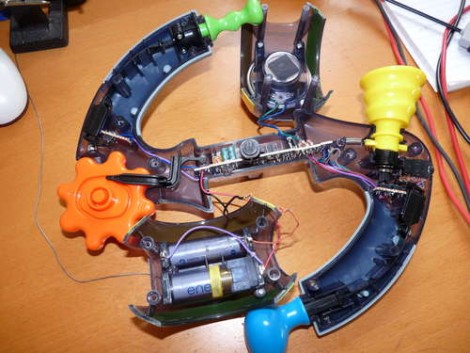
Above you can see the Bopit Extreme with the top half of the case removed. Although not hard to get open (there’s just 12 screws to remove) the spring-loaded appendages will fly apart when you do. He warns to pay attention at how they go back together.

There’s one axial resistor which affects the running speed of the game. [Johnny] desoldered this, replacing it with a circuit that toggles between that original resistor and a potentiometer. Now, one switch position allows for normal play, the other allows for adjustable speed based on the potentiometer position. Check out the results in the clip after the break.

Looking for some other fun electronic toy hacks? Why not try out this cursing Simon Says?

Continue reading “Slowing A Bopit So The Littles Ones Can Play Too”

Web-enabled Coffee Maker Over-complicates Your Break Time

Some think that grinding the beans and filling the coffee maker is part of the coffee-drinking ritual, but [Jamie] isn’t one of them. Instead, he’s been working to make this coffeemaker a web-enabled device. He built it as part of a class project, and has implemented most of what you need to make a cup of Joe automatically.

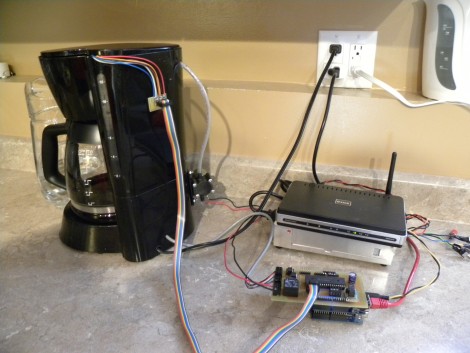
You can see a small pump attached to the back of the coffee maker. It sucks water from a pitcher (slightly visible to the left of the coffee maker) to fill the reservoir. He experimented with a couple of different water level sensing solutions. His most recent is a PCB with several traces of different length. As those traces are covered by water, a voltage can be read via ADC to establish water level.

He’s using an Arduino and Ethernet shield to add connectivity for the device. The problem is that there aren’t enough ADC pins left on the Arduino to read the water level sensor. Because of this, he added a self-build shield that uses a PIC to do the ADC measurements and push digital data across to the Arduino. A bit complicated, and it doesn’t load the grounds automatically (yet?). But that’s not to say we don’t appreciate complicated coffee hacks.

Reverse Engineering Bluetooth Using Android And SPOT As An Example

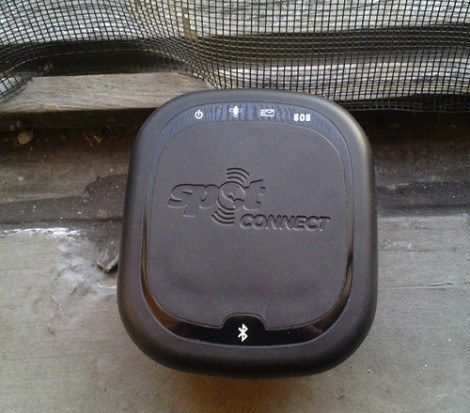
[Travis Goodspeed] wrote in to tell us about his work reverse engineering the Bluetooth communications on this SPOT module. He’s targeted the post as a general guide to sniffing Bluetooth transmissions, but was inspired to use the SPOT as an example after seeing this other SPOT hack. We know he’s a fan of getting things to work with his Nokia N900, and that’s exactly where he ended up with the project.

This module was manufactured to be controlled by an Android phone. But there’s no control app available for the Nokia handset. Since Android uses the open-source Bluez package for the Bluetooth protocol, it’s actually pretty easy to get your hands on the packets. After grabbing a few test sets he shows how he deciphered the packets, then wrote a quick Python script to test out his findings. After working his way through the various commands available (grabbing the SPOT serial number, getting position data from it, etc) [Travis] wrote up a frontend in QT mobility for use on the N900.

Micromouse Wins 2011 Maze Race In Under 4 Seconds

It’s off to the races once again with the Micomouse maze solving contest at the 2011 RoboGames. This is a picture of the winner, a bot called Min7 (main page) which was built by [Ng Beng Kiat]. Using four phototransistors and a flash sensor it managed to first map the contest maze, then speed run it in under four seconds. See both runs in videos after the break. He’s certainly got a leg up on the bots we saw last year. Min7 beats them both in time, and overall control during the speed run.

[Ng] mentions that this year is the first time he’s built a micromouse with four wheels instead of two. There’s a gyro on board which aids navigation by feeding the orientation data to the STM32 chip which controls the device. We took a moment to page through his past designs. It’s remarkable how they’ve evolved through the years. Continue reading “Micromouse Wins 2011 Maze Race In Under 4 Seconds”

Eight-dollar Airplane For Really Bad Pilots

Have a habit of hitting the bottle before getting into the cockpit? Find that your mind wanders mid-flight? Lack the hand-eye coordination to keep that RC creation of yours in the air? Worry not, you can build this flyer and crash it with impunity.

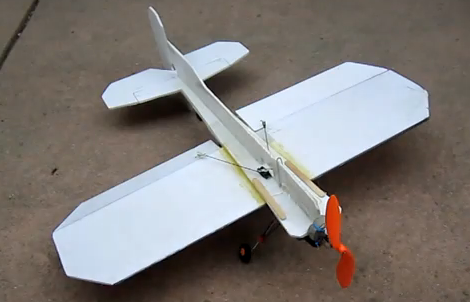
[HammyDude] built the RC aircraft out of laminated foam board. He’s had it for years and it’s survived multiple crashes. You can see the one real injury suffered, a snapped fuselage at the leading edge of the wings. He repaired it with popsicle sticks and it’s been going strong ever since.

In addition to the wooden reinforcements he’s covered the fuselage with fibrous packing tape (you know, the stuff with the strings running in it). There’s also a carbon fiber tube at the leading edge of each wing. It’s light, strong, and robust (with the exception of the propeller of which he’s broken about 10).

Check out the video after the break for an explanation of the aircraft, list of materials, and HD images of the patterns you need to make them yourself. The only thing you won’t see is flight footage.

Continue reading “Eight-dollar Airplane For Really Bad Pilots”

Printable Solar Cells That Can Be Folded Up When Not In Use

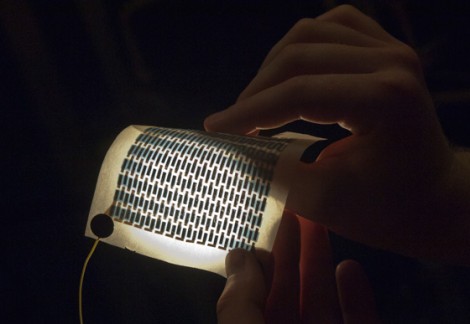
Here’s a photovoltaic cell that can be printed onto paper. The manufacturing technique is almost as simple as using an inkjet printer. The secret is in the ink itself. It takes five layers deposited on the paper in a vacuum chamber. But that’s a heck of a lot easier than current solar cell fabrication practices. In fact, is sounds like the printing process is very similar to how potato chip bags are made. This is significant, because it could mean a fast track to mass production for the technology.

It isn’t just the easy printing process that excites us. Check out the video after the break where a test cell is placed on top of a light source while being monitored by a multimeter. It’s been folded like a fan and you can see a researcher sinch up the cell into a small form for storage. It’s a little counter-intuitive; for instance, you wouldn’t want to make a window shade out of it because it would have to be down during the day to get power. Be we think there’s got to be some great use for these foldable properties. Continue reading “Printable Solar Cells That Can Be Folded Up When Not In Use”