Update: Acrobatic Quadcopters Team Up

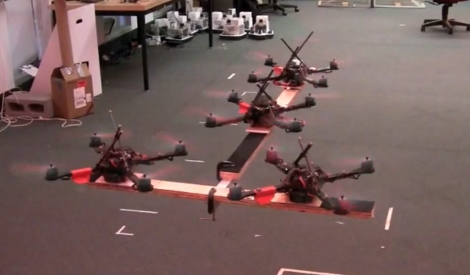
We usually envision small wheeled robots when we thing about swarm robotics but these cooperative quadcopters make us think again. This is an extension of the same project that produced those impressive aerial acrobatics. It may not be as flashy, but watching groups of the four-rotored flyers grab onto and lift loads is quite impressive. There is also a shot of one dropping a 2×4 and immediately compensating for the loss of weight. We’re not certain, but it looks like team lifting doesn’t require the 20 high-speed camera rig that the acrobatics did. We’ve embedded the demonstration video after the break.
Continue reading “Update: Acrobatic Quadcopters Team Up”

Stretch-bike

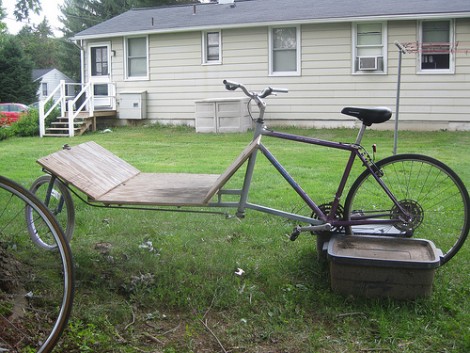
This long bike is built for haulin’. After needing to find a truck to transport his welding equipment (ironically in order to build another bike) [Nick Johnson] decided it was time to make a two-wheeled cargo transport. He extended the frame in order to add a cradle in the front. Eventually there will be sides on that box but for now it works like a charm for transporting his groceries. With the long wheel-base this should be pretty stable as long as you balance your cargo. We’d certainly be more apt to try a ride on this rather than the double-decker death-trap from a few weeks ago.

Chess Table: Physical Interface For Internet Games

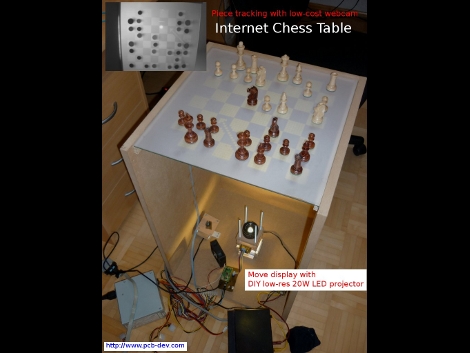
Wanting to get back to playing with actual pieces, [Thomas Pototschnig] built a chess table that interfaces with the Internet. The table uses an custom setup to project the board on the frosted surface of the table. Chess moves from your internet opponent are displayed as arrows on the board so you can move the pieces. Your moves are detected by a webcam below the surface as this table actually functions as a multitouch display. From the description, it sounds like the projector was made from a 128×64 graphic LCD display. A 64×64 pixel area is used, with an LED below and a lens above. This works remarkably well. See for yourself after the break.

Want some other options for your chess setup? You can play against a robot arm, or if you’ve got 144 square feet of extra space you can build a really big board for the occasional game.

Continue reading “Chess Table: Physical Interface For Internet Games”

16-pixel Handheld Gaming

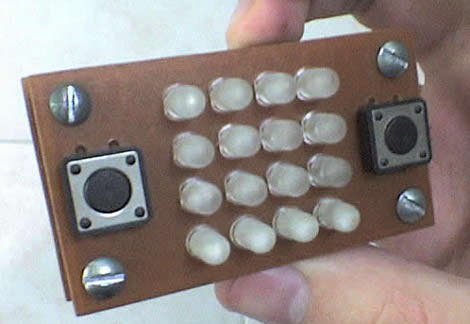
What we need in today’s handhelds is LESS resolution. Take a look at the video after the break to see the exciting action that [Bruno Pasquini] 4×4 LED matrix handheld game delivers. The device is made up of 16 bi-color LEDs, four buttons, and a PIC 16F628. There’s no schematic yet but it looks like there’s no need for shift registers, just some transistors to handle the current load for the rows of each color. We’ve seen a 64-pixel handheld that plays Super Mario Brothers, but this portable brings a top scrolling racing game with just 25% of that display size.

Continue reading “16-pixel Handheld Gaming”

CubeStormer; Quick Solutions From LEGO Parts

[youtube=http://www.youtube.com/watch?v=eaRcWB3jwMo]

CubeStormer solves Rubik’s cubes and it does it quickly! Made entirely out of LEGO, a Mindstorm web camera is used to scan in the cube with four mechanical hands for manipulation. The device is capable of solving a random cube in less than 11 seconds. That’s quite a bit faster than the last Minstorm solver we saw, and the CuBear solver we are so fond of.

[Thanks Ferdinand]

Try As You Might, Scooty Won’t Fall Over

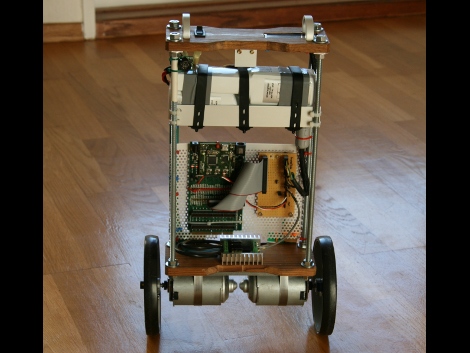
Scooty is a balancing robot based around a PIC32. The project is the first iteration in a long road toward a ridable version. The video after the break shows some incredible promise. Scooty is pitted against a large rubber ball. The two roll into each other but Scooty maintains balance thanks to that powerful processor, an inertial sensor, and a range finder.

Scooty versus a ball isn’t really fair to the ball. We’d like to see Scooty versus the ball balancing robot.

Continue reading “Try As You Might, Scooty Won’t Fall Over”

Electric Mountainboard With Wireless Control

[youtube=http://www.youtube.com/watch?v=AkhjeEDaagQ]

[Andres Guzman] is chauffuering himself around the University of Illinois campus thanks to his wirelessly controlled mountainboard. He added a brushless motor to drive the rear axel with the help of a chain. Power is provided by a Lithium Iron Phosphate battery which we’ve seen used in other electric vehicles due to its lightweight properties. A wireless PlayStation 2 controller operates the motor but steering remains a lean-to-turn system.