Great Interactive LED Puzzle

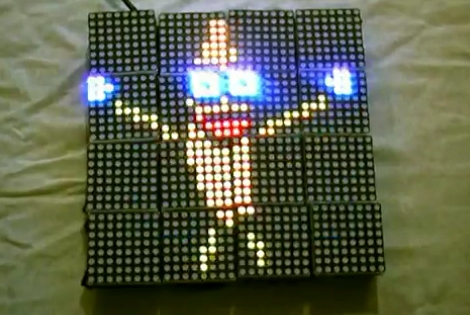
The GLIP project takes the delight of blinking LEDs and combines it with the ingenuity of modular communications. This takes the Puzzlemation concept a few steps further. In that project the modules were programmed through a base station and could be removed and used as a puzzle from there. The GLIP project uses a master block that you can see tethered in the photo. But the blocks communicate with each other via an infrared protocol. This way they can be continuously updated as they are place next to each other. Each module includes an STM32F105 ARM Cortex-M3 processor, quite a punch for the little blocks. Take a look at what they can do after the break.
Continue reading “Great Interactive LED Puzzle”

Arduino Webserver

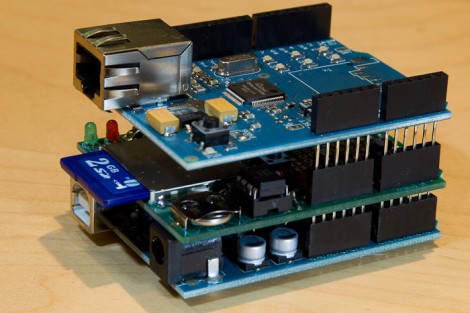
The Arduino platform should be perfect for throwing together a lightweight webserver because of the availability of quality shields that take care of the hardware for you. As [Ovidiu Predescu] found, there are a few hiccups along the way and he’s put together a guide that covers the workarounds. Specifically, using an Ethernet shield and data logging shield at the same time produces a bus conflict which he sidesteps by cutting the CS pin trace on the data logging board and moving it to a different pin. There is also a bug with one of the chips on the Ethernet shield that is fixed using a similar method. So if you’re not just going to etch your own webserver hardware maybe this is the next best thing.

Open Source Logic Analyzer Software

[Christian Weichel] has been hard at work developing LogicAnalyzer, an open source tool that may interest you. It is designed with SUMP Logic Analyzers in mind but a main goal is expandability. What this means is that it plays nicely with things like the Open Workbench Logic Sniffer or you can do a bit of fiddling to get it to work with your own designs. The program is based on Eclipse so you should be familiar with how it works and you can get it running easily on multiple platforms. Take a look at the wiki for a quick start.

Wasp Sucker Clears The Air

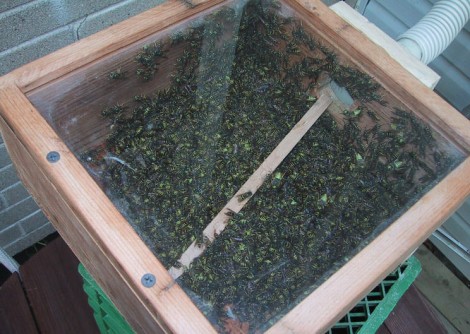
[Matthias Wandel] had something of a wasp problem so he built this trap to catch the pesky fliers. These look like Yellow jackets and they can build some huge nests (check out the picture of a 2-year old dwelling). We’ve experienced a large nest in the walls of an apartment and weren’t as clever at fixing the issue. [Matthias’] solution uses a 1/3 horsepower blower to snatch the wasps out of the air and retain them in the trap above. The trap sits on the blower with some insect netting as a filter, the hose acts as the inlet and is placed at the entrance to their lair. It took nine hours to fill this trap; we wonder where he chose to release them. Enemies of [Mr. Wandel] beware.

[Thanks Trebu]

RFID Transplant

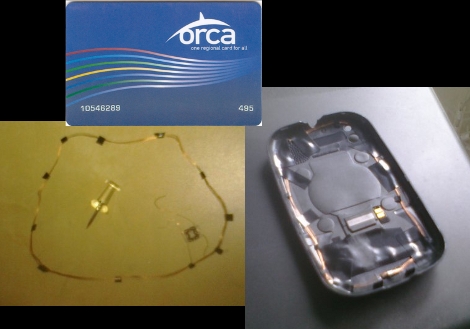
[Zach Charat] didn’t want to carry around yet another card with him so he transplanted the RFID guts from his card to his phone. Soaking the card in nail polish remover for twelve hours got him nowhere, but when he broke out the acetone the card was falling apart in 30 seconds. Above you can see the tiny chip and loop antenna that were left after ditching the plastic. The black bits are electrical tape which he then used to embed this in his Palm Pre’s touchstone charger plate ( which we just saw this in a hack last week).

This works, and while you’re waiting for the world to implement the Leeloo Dallas Multipass it’s a great solution.

[Thanks Coveredwagonkid via Pre Central]

Physical Tone Matrix

[Andrew Jenner] pulled off something amazing with this Physical Tone Matrix. He wanted to build a physical version of a flash applet he had seen. Two layers make up the main user interface. The top layer is a sheet of acrylic that acts as a touch interface and below there’s an LED matrix. [Andrew’s] touch interface uses wires running throughout the acrylic as contacts which are polled via transistor pairs. As you can see in the video after the break it works well and we like the fact that there’s a tactile component (due to the bumpy wires) you don’t get when working with a touchscreen.

The 16×16 grid of LEDs on the bottom layer correspond to each ‘button’ on the touch matrix hand have some extra functions such as playing Conway’s Game of Life. This fantastic build still has a couple of kinks to work out, most notably the interference in the audio circuit, but we’re quite impressed at what he’s achieved quickly. Plus, this is more economical than a monome and larger than some of the monome clones we’ve seen.

Continue reading “Physical Tone Matrix”

DIDJ Composite Video Out

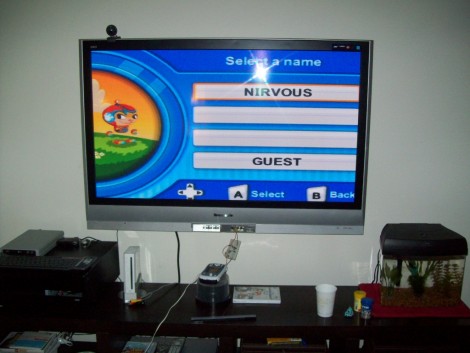
[Nirvous] managed to get composite video out working on the DIDJ. He knew that the CPU had the ability to generate the signal, and that similar devices already had this capability. After studying some DIDJ teardowns he figured out which connection on the processor should provide the appropriate signal. Next was the firmware side of things and after sifting through a lot of code he was pleased to find a flag that looked like it would enable video out. Some cross-compiling, soldering, and a low-pass filter got it to work.

If you’ve been hacking around on the device you might try this. The CPU uses a ball grid array so soldering is a bit difficult. We covered a BGA soldering trick that might be just the thing so check it out before you retreat into your soldering-fortress of solitude.