NES Controller To USB Gamepad

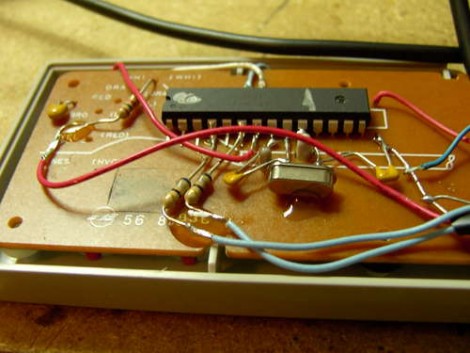
Regular Hackaday reader [Osgeld] is at it again with this USB conversion for an NES controller. This is a ubiquitous hack that we started seeing very early on, sometimes involving an adapter kit, and other times including things like a thumb drive and USB hub. But this time around is truly a bare-bones version. He’s using an Arduino but it’s really just an AVR ATmega168 running the bootloader. We’d wager this can be done with an ATmega8 just as easily. Grab a couple of diodes (we never seem to have the 3.6v zener diodes around when we need them), a couple caps and resistors, a crystal and you’re in business. The hack wires each button to a pin and implements a keyboard HID that can be mapped for any purpose you desire.
Power Cycling A Problematic Modem

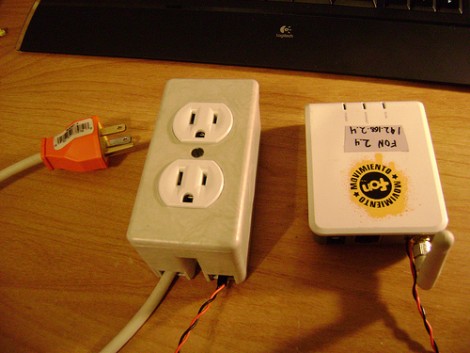
[Gigawatts] struggled against a shoddy Internet connection for quite some time. Changing modems, having the line serviced, and spending far too much time on the phone didn’t do any good. In fact, the only thing that fixed the problem was power cycling the modem once it stopped responding. His solution was to automate the power cycling process. He added a cron task to his router which is running DD-WRT, a favorite firmware alternative for hacked routers. The script monitored the WAN connection and when it went down it would toggle one of the serial port pins. He whipped up an outlet box with a relay in it and used that serial pin to cut the power going to the modem. A workaround yes, but it was the only thing that brought an end to his frustration.

Acrylic Hackintosh Housing

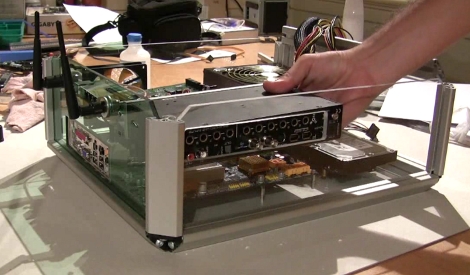
[Rui Gato] needed a powerful yet portable machine for his performances. If it’s on stage shouldn’t it look good too? We loved watching him construct an acrylic case for his setup. He’s skilled with a rotary tool and the work he put into the case fan grill alone is impressive. Video after the break.

Continue reading “Acrylic Hackintosh Housing”

FPC Arduino

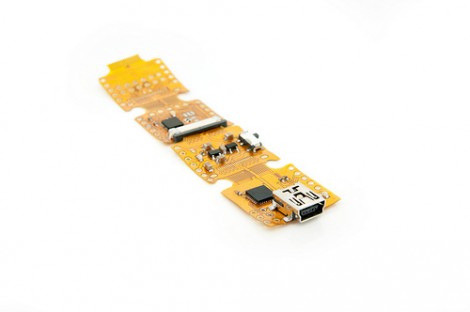
Seeed Studios has a new version of the Arduino that they’re calling the Seeeduino Film. Instead of the traditional fiberglass substrate they’ve used a resin material to produce a Flexible Printed Circuit (FPC). In addition to its flexibility their aim with this prototype was to keep it modular. From what we can see each of the four squares is a different component in the Arduino system. The photo above has the USB interface on the nearest node, then the power regulator, the microprocessor, and finally the remaining peripheral connections. This material can easily be cut with a pair of scissors so the programming section can be removed once the firmware is burned to the chip. It will be interesting to see final pricing and package options. We wouldn’t mind having an FPC ATmega168 breakout board around, but specifially this would fit nicely in a watch band if you were building your own wristwatch.

[Thanks Juan]

Sidecar Reminiscent Of Conjoined Twins

Finally, an answer to the problem of sidecar dorkiness. [François Knorreck] spent ten years hand crafting a sidecar with a beautiful design and a luxurious interior for two. The frame is aluminum, the body is mostly carbon fiber, and there are countless details such as automatic chain tension control and steering for the sidecar wheel that make this more than just a pretty paint job.

[Thanks Geekabit]

Cameras Perch On Power Lines, Steal Electricity

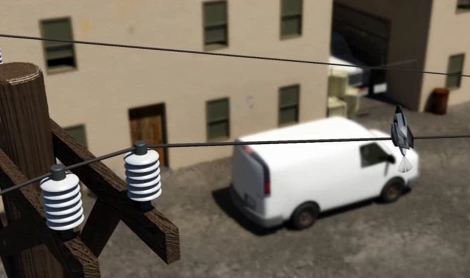
[Tim] let us know about a video outlining some covert camera devices the Air Force is developing (dead link, try the Internet Archive version). The video takes a lot of time to explain induction to those who’ve never heard of it but we liked to see the bird-like concept animations. They’ve already developed cameras that will clamp on to power lines in order to use induction as a power source. Shown in the video is an eight-rotor quadcopter they’re hoping to use to deliver the camera covertly. But the animations show a winged robot similar to a hawk that has a camera for a head. Having seen some of the other flying devices in development this may not actually be that far off.

Touchscreen Scooter Computer

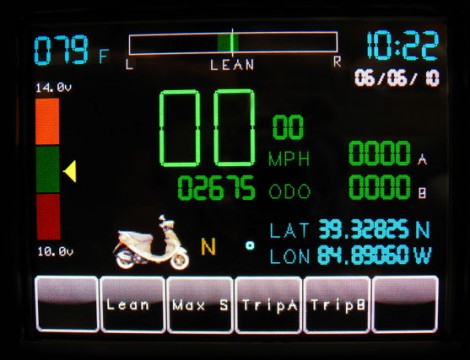
[Kurt’s] scooter computer started off as a way to use a couple of LEDs to show the battery charge on his hog. It was based on a Arduino and used a voltage divider to judge how much juice was left. But then he ran across a touch-screen OLED shield for the Arduino and the project started to take off. Now he’s got battery, temperature, real-time clock, and GPS running through the slick-looking display. It may not be a full-blown motorcycle but it gives the computer interfaces we’ve seen for other bikes a run for their money.

[Thanks Mowcius]