DIY Digital Pinball Console Plays Hundreds Of Games

pinball_console

Pinball machines, while likely considered pretty retro technology by most, are still a fun and engaging way to waste a little time. The problem with pinball machines is that they take up a lot of space, making the hobby of collecting them pretty prohibitive unless you have tons of spare room in your house.

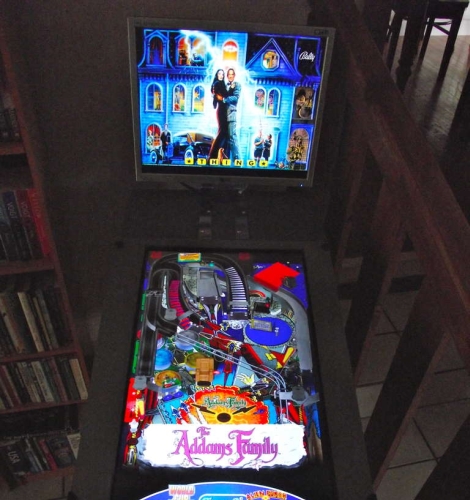
[tbarklay] loves pinball machines but doesn’t have to room for an elaborate collection. Rather than purchase one machine, he opted to build his own pinball table that can be used to play any number of games. He repurposed an old PC to power his table, connecting it to a 24″ LCD panel for the main display board. A custom cabinet was built to contain the large LCD panel as well as the computer. A 19″ LCD screen was mounted on top of the cabinet to serve as the backglass display. A set of arcade buttons were also added to the console to provide realistic paddle control.

While we don’t have a video of his particular table in action, check out this video we found of  a pinball machine that uses the same setup.

Continue reading “DIY Digital Pinball Console Plays Hundreds Of Games”
CNC Etch-a-Sketch Draws On Itself

cnc_etchasketch

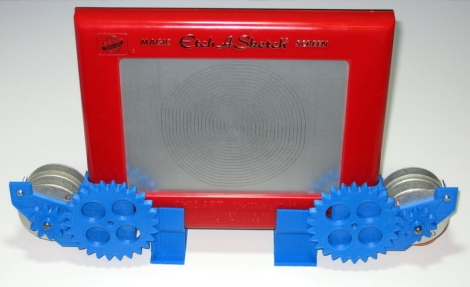
Having never been any good with an Etch-a-Sketch, [Ben] decided it was time to tame the children’s toy that had taunted him for so long. He received one in a gift exchange a few years back and hung onto it, recently digging it out again to fit it with some CNC components.

Using his RepRap, he printed a set of mounting plates and gears to drive the Etch-a-Sketch’s dials. He installed a pair of Airpax steppers to the gears and wired them up to an ATmega AT90 USB board he had sitting around. He installed RepRap firmware on the microcontroller, since it has a built-in gcode interpreter, making it easy for him to upload any gcode file to the Etch-a-Sketch for drawing.

You can see a quick demonstration of the device in action below. He converted a spiral image to gcode, then uploaded it to the Etch-a-Sketch – the machine does the rest. It draws pretty quickly as well – [Ben] even suggests that he could probably get it moving fast enough to melt the stylus!

It would be great to see the Etch-a-Sketch configured to support an online interface. That way he could allow people to upload images to the device, later showing off the artwork in a web gallery not unlike the LOL Shield Theatre we featured last week.

[via Make]

Continue reading “CNC Etch-a-Sketch Draws On Itself”

3D Modeling Out Of Thin Air

kinect_3d_modeling

It seems that with each passing day, the Kinect hacks that we see become exponentially more impressive. Take for instance this little number that was sent to us today.

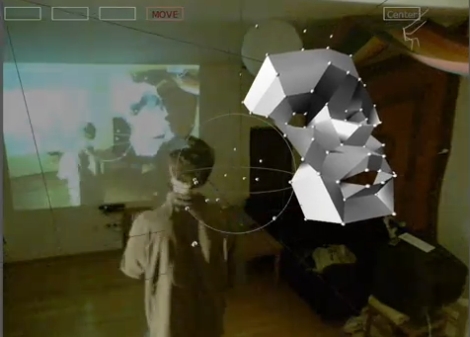
[sonsofsol] has combined several open source software packages and a little electronics know-how to create one of the more useful Kinect hacks we have seen lately. His project enables him to manipulate 3D models in GEM simply by moving his hands about in front of his Kinect sensor. Using OpenNI and Ubuntu, all of his actions are tracked by the computer and translated into actions within the GEM 3D engine.

To make things easier on himself, he also constructed a pair of electronic gloves that interface with the system. Using an Arduino, the gloves send different complex commands to the 3D modeling software, just by touching different pairs of fingers together.

You really need to take a look at the video embedded below to get a feel for how complex [sonsofsol’s] “simple” mesh modeler really is.

Looking for more Kinect fun? Check out these previously featured stories.

[Thanks, Jared]

Continue reading “3D Modeling Out Of Thin Air”

Control Your Home Theater From Anywhere In The World

ether_ir

Using IR repeaters for larger home theater setups is not uncommon, but they usually are quite simple. A series of IR receivers are placed throughout a home, all wired to repeat the signals in a central closet where all of the AV equipment is located. [Bill] constructed a solution that works much like a standard IR repeater setup, however his requires no receivers, and it can be used anywhere in the world, provided you have Internet access.

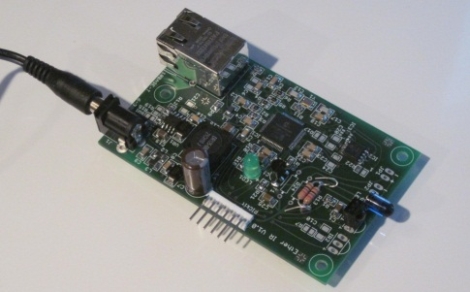
His project, called Ether IR, is an Internet-enabled IR repeater. It consists of an Ethernet-connected module with an IR LED mounted on it, capable of controlling your AV equipment. The board is hooked up to your LAN, and relays commands to your home theater via a simple web page. The equipment can then be controlled from any Internet-connected device, such as a mobile phone or tablet PC.

The entire project is open-source, so [Bill] has included schematics, instructions, and a bill of materials so that you can construct your own. The only issue at this point is the software portion of the project. The software is free, but the distribution method is in question – once things are sorted out, he will ensure that you can obtain the software for your Either-IR from him or directly from the Ethernet chip’s manufacturer.

Mini SATA Power Adapter Does Away With HDD Docking Stations

sata_power_adapter

[Marc] is pretty unsatisfied with hard drive docking stations as a whole. He says they are typically slow and unreliable, causing him all sorts of grief while he is troubleshooting a questionable hard drive. He decided to take some of the mystery out of the troubleshooting equation and built a standalone SATA power module.

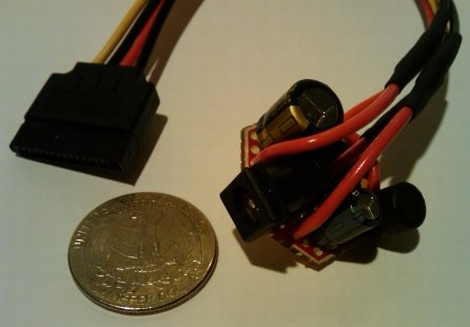
Aware that SATA drives require 5v and 12v for operation, he disassembled one of his docking stations to see how it provided both voltages. He discovered that it used a simple PWM buck converter and decided to replicate it in the smallest space possible. His plan was to use a standard 12v wall wart to power the circuit, passing that 12v straight to the drive. A simple voltage step-down circuit would be built to provide the required 5v.

[Marc] reports that the power adapter is performing nicely, and he is quite happy with the size as well. He says that one major benefit of this sort of adapter is that it can be used to power any SATA drive, not just hard drives. He does mention that if he built another one, he might consider regulating the 12v output as well, so that he can power the adapter with a laptop power supply instead of a separate dedicated wall wart.

CD Phonograph Brings Old-time Charm To Modern Music

phonograph

[Jozerworx] had always wanted to build a CD player that looked like an old-time Victrola Phonograph player, though he never seemed to be able to find the time to do it. With all of his other projects out of the way, he decided to finally get started on building his phonograph.

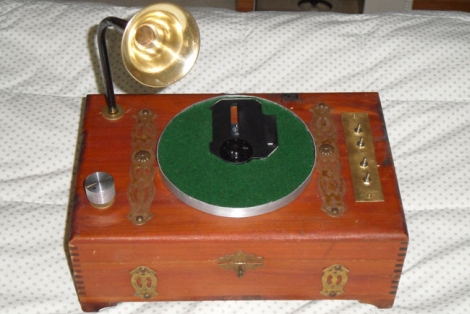
He went garage sale hunting and found the perfect base for his project – an old wooden box adorned with tarnished brass hardware. He started in on the project immediately, dismantling a cheap CD player and mounting the motor/laser assembly on the top of the box. The CD player internals were installed inside the wooden box, along with a small audio amplifier stripped from a portable iPod speaker.

A brass horn was fashioned out of an ornament, in order to complete the phonograph feel, but also to act as a passive amplifier. He then mounted a series of switches on the top of the box to allow him to control the CD player’s basic functions.

[Jozerworx] says that it sounds decent, though there are some things he would change. He plans on switching out the audio amplifier and possibly the speakers at some point in the future. He is also still keeping his eye out for a larger, and more effective horn.

DIY Laser Light Show Is Sure To Please

cigarbox_laserlightshow

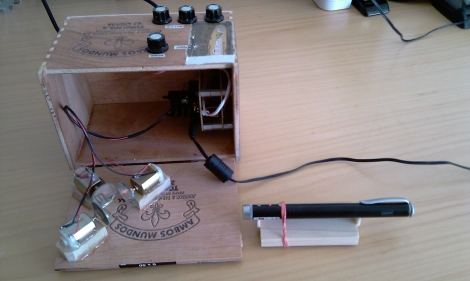
[Pete] had some spare time on his hands over his spring break, and he was itching to build something. He settled on a laser light show since, after all it was spring break, and what says “Party” better than a laser light show?

He glued three hobby mirrors to three small motors, mounting the motor assemblies on the lid of a wooden cigar box he bought for next to nothing. When the laser is pointed at the mirrors, they reflect the beam off one another, and finally against a projection surface, creating interesting shapes and motion. He programmed an Atmega328 to control the laser light show when in automatic mode, and added 4 pots to control the mirrors’ spin rate when set in manual mode.

The visuals are pretty cool, as you can see in the videos below. We love the laser light show concept, and [Pete] definitely gets extra points for his cigar-box casing as well.

Continue reading “DIY Laser Light Show Is Sure To Please”