
laser_pulse_gun

You’ll Shoot Your Eye Out…with A 1MW Laser Pulse Pistol

G.I. Joe used them to battle Cobra’s evil forces. Han solo shot his first in the Mos Eisley Cantina. For years, hand-held pulse laser guns have been something that existed only in the realm of cartoons and movies…until now.

German hacker [Patrick Priebe] recently constructed a laser pulse gun that looks so good, it could have easily come off a Hollywood movie set. Its sleek white and black exterior adds intrigue, but offers little warning as to how powerful the gun actually is.

Fitted with a Q-switched Nd:YAG laser, it fires off a 1 MW blast of infrared light once the capacitors have fully charged. The duration of the laser pulse is somewhere near 100ns, so he was unable to catch it on camera, but its effects are easily visible in whatever medium he has fired upon. The laser can burst balloons, shoot through plastic, and even blow a hole right through a razor blade.

[Patrick] says that he is more than happy to help out anyone looking to source parts and build one for their own use, so what are you waiting for?

Stick around for a quick demo video of the gun in action.

Continue reading “You’ll Shoot Your Eye Out…with A 1MW Laser Pulse Pistol”
PC Casemod-inspired Benchtop PSU

benchtop_psu

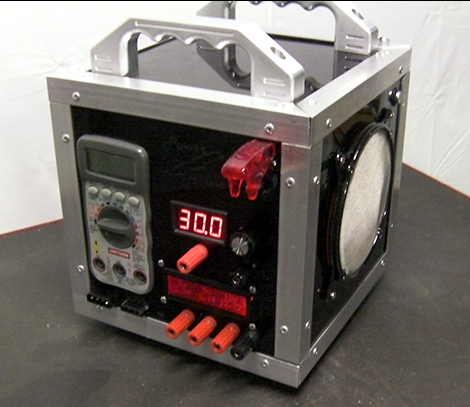
[Will] had a cheap power supply sitting around, and decided to turn it into a full-featured benchtop PSU. Inspired by some of the other benchtop supplies we have featured in the past, he decided that he wanted his PSU to be more than just a simple-looking box sitting on his work bench. Taking some cues from PC case modding, he put together a unit that is not only very useful, but also quite sharp looking.

The frame of the case was crafted from aluminum angle, while all of the other flat surfaces were made using black polycarbonate. He installed the standard 12v, 3.3v, and 5v terminals you would expect from any benchtop PSU, complete with an LCD display showing the voltages provided by each rail as measured by an Arduino stationed inside the case. Additionally, he installed a variable terminal capable of providing 1.3v-30v, along with its own LCD display. The most unique feature is the multimeter embedded in the front of the case, which makes it virtually impossible to lose.

The case is finished off as you might expect, if you have seen any of his previous work. It features LED lighting on the inside, large fans on either side of the case for optimal air flow, and a pair of machined aluminum handles.

Be sure to check out the quick video below of the PSU being powered on.

Continue reading “PC Casemod-inspired Benchtop PSU”

DIY Wireless Keylogger Makes You Feel Like James Bond (In Your Own Little World)

wireless_keylogger

Do you need to keep tabs on the kids while they browse the Internet? How about your husband/wife – do you suspect they are dabbling in extra-curriculars on the side? Hey, you’ve got your insecurities reasons, we won’t judge. We will however, show you what [Jerry] over at Keelog has been working on lately.

While the company sells hardware keylogger kits online, [Jerry] has relied on, and understands the importance of open source. Since we all benefit from things being open, he is giving away all of the details for one of his most recent projects, a wireless keylogger. The keylogger plugs in to a PC’s PS/2 port, and wirelessly sends data to a nearby USB dongle up to 20 yards away, all in real-time.

A detailed parts list is provided, as are schematics, PCB masks, firmware, and assembly instructions. However, if you prefer the easier route, you can always buy the completed product or a DIY kit.

This isn’t the first open source keylogger he has released, so be sure to check out his previous work if you prefer a wired keylogging solution.

Automatic Lock Cracker Makes Breaking And Entering A Breeze

automatic_lockcracker

For most people, forgetting the combination on a lock means breaking out the bolt cutters and chopping off the lock. Some students at the [Olin College of Engineering] decided there was a far more elegant way to do the job, so they built an automated lock-cracking machine.

The machine consists of a clamp to hold the lock, a solenoid to pull the lock open, and a stepper motor to run through the combinations. Most of the processing is done on the attached computer, using software they created. The application will brute-force all of the possible combinations if you request it, but it also allows you to enter the first, second, or third numbers of the combination if you happen to remember them.

Once the machine is started, the motor begins spinning the lock and the solenoid yanks on the latch until the combination is discovered, which takes a maximum of about two hours to complete. The opening of the latch trips a limit switch and causes the mechanism to stop. A simple button press then returns the lock’s combination to the user.

Be sure to check out the video embedded below of the lock cracker in action.

[via Wired]

Continue reading “Automatic Lock Cracker Makes Breaking And Entering A Breeze”

Lightweight Robosuit Is Like Stilts On Steroids

What would you do if you were a foot or two taller? How about if you had an arm span two times as wide as you have now?

A group of Japanese engineering students asked themselves the same question and built a wearable chassis that does just that. Their project is called “Sukerutonikusu”, which we believe roughly translates to: “This is freaking awesome, we’ll take two!”. [Thopter] however informs us that it translates to “Skeletonics”, a fusion of the words “skeleton” and “mechanics”.

The suit is comprised of lightweight aluminum pipes and sheeting, allowing for it to be powered solely by the person wearing it. Stepping inside the chassis looks like it lifts the wearer about a foot and a half off the ground, while increasing their wingspan by nearly 6 feet! In the video embedded below you can see that while in the suit, the wearer is quite agile, and even has the ability to run at a decent tick.

If this ever comes to market, you can bet we will buy one in a heartbeat – until then, we will have to settle for making RoboCop sounds as we walk about the office.

Continue reading “Lightweight Robosuit Is Like Stilts On Steroids”

DSLR Bellows-mounted Lens Retrofit

dslr_lens_retrofit

While digging through a pile of old camera equipment, [Jake] stumbled upon a camera that belonged to his grandfather and was curious to see what sorts of images the old lens would produce. He wasn’t interested in messing around with a film-based camera for his experiments, so he needed to find a way to mount the vintage lens on his newer Canon DSLR.

After considering several options including custom machined adapters and mounting rings built from old Canon lenses, he found a much cheaper solution. He purchased a lens adapter made to mount a particular type of lens to a modern DSLR, and then modified it to fit his lens. It worked perfectly, though he admits the resulting images are not that different than those taken with his regular lens.

Underwhelmed with the images, he decided to mount the lens on a set of bellows he picked up at the local dump. It looks pretty neat, but he has yet to get a chance to take any pictures with his new setup. Hopefully we’ll see some test shots soon.

If anyone has experience with using bellows lenses on a modern DSLR, we’re always up for seeing some sample pictures. In the meantime, check out this other DSLR/bellows hybrid project we featured a short while back.

[via BoingBoing]

Beginner Concepts In Electronics And Arduino

arduino_tutorial_series

[Jeremy] is all about the Arduino, but also into helping people get started working with electronics. He has put together a series of videos on his web site which discuss the basics of using an Arduino. Having just published his tenth tutorial, he dropped us a line to let us know. His videos cover a wide range of topics and include source code, schematics, and a full parts list to help you follow along with him.

While the core of his lessons focus specifically on how to use the Arduino to perform particular tasks, he does introduce the viewer to many different concepts along the way. He covers PWM, button debouncing, interrupts, SPI communications, analog inputs, and more – all of which are must-know topics that extend beyond the realm of experimenting with Arduinos.

The videos run anywhere from 6 to 20 minutes in length, so you will want to set a block of time aside if you plan on checking them out.

If Arduino-specific videos aren’t your thing, he also has a series of general tech-related videos on his site as well which may be of interest. Otherwise, stick around to see the latest in his series of tutorials.

Continue reading “Beginner Concepts In Electronics And Arduino”