Solar-powered Junkbot

solar_powered_junkbot

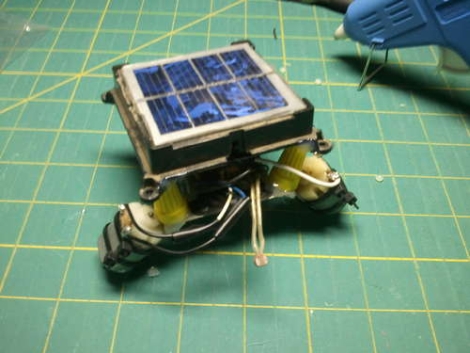
Instructables user [martzsam] recently built a simple robot using miscellaneous junk he found around his house. The first parts he scrounged up were a pair of 1.5v electric motors and some wire scraps, after which, he went to work on an old garden light. He detailed how to carefully remove the light’s solar panel as well as the charging circuit, which he used to power his robot. The pieces were mounted on some old erector set parts after a bit of rewiring, then the bot was set in motion. [martzsam] also mentions that he tweaked the solar panel’s charging circuit and battery to run the motors at half speed until light is shone on the panel, at which point the robot runs at full speed.

This project would be great to do with kids as it teaches the concepts of re-purposing common household items as well as allows them to use their imagination in designing a fun, yet simple robot. Gather up some old junk and your kids/nieces/nephews and get going!

Continue reading to see a quick video of the robot in action.
Continue reading “Solar-powered Junkbot”

Analog To Digital Converter Build

analogue_digital_converter

[Daniel Garcia] sent us a quick tutorial he put together demonstrating how to use an ATmega168 to perform analog to digital conversions. This timely tutorial would make for a nice complimentary project for those of you who decided to build your own digital to analog converter after reading our post from a few days ago.

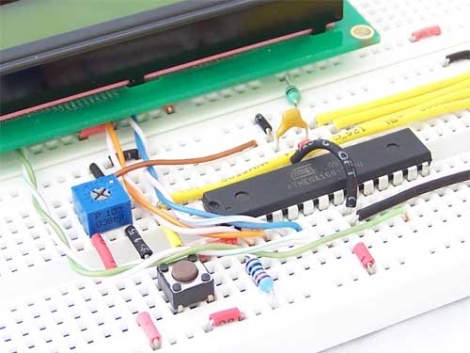
The ATmega168 has six pins that are typically used for digital I/O, but they can be used for analog input as well. In his example, he uses a trimpot as an analog input device, connecting it to one of the aforementioned analog pins. Its value is returned as a 16-bit number which is then displayed on the attached LCD. The LCD display and the breadboard layout used in this project are covered in his previous writeups, so be sure to give those a read through before working through this tutorial.

Bluetooth Tomy Omnibot Hack


tomy_omnibot_hack

[DJ Sures] sent us his most recent hack, and it’s one that is sure to please those who enjoy a good dose of 80’s nostalgia. He located a Tomy Omnibot on eBay and snatched it up immediately. While he was waiting for it to arrive, he planned out what he would add to it once it showed up at his door. Once the robot was delivered, he cleaned it up, painted it, then got down to business.

The original robot had no ability to move its arms or head, so he immediately added servos to enable those actions. A wireless camera was inserted between the Omnibot’s eyes, and a wireless mic was mounted in his chest. He has also added some features found in his previous projects, such as voice recognition, visual recognition, voice synthesis, and the ability to remotely control the bot. He plans on adding an ultrasonic ping sensor and IR floor sensors in the near future. This is a great build so far, and it sounds like he has plenty more in store.

Be sure to stick around for a video of the robot in action, and if you are interested in some of [DJ Sures’] previous work, check these out as well.

Continue reading “Bluetooth Tomy Omnibot Hack”

wireless_nunchuck

Bluetooth-enabled Wii Nunchuck

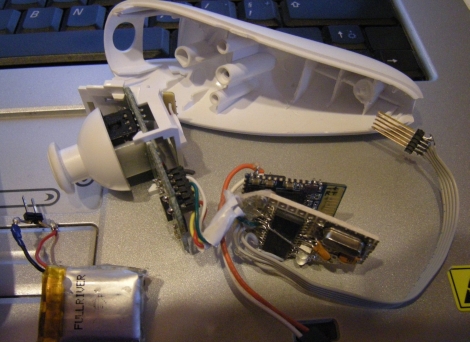
The wireless controller for the Nintendo Wii has been used in many a hack due to its simple to use Bluetooth interface. The nunchuck portion of the controller however, has always required a physical tether to the wireless controller, or an aftermarket wireless dongle. [Rousselmanu] is looking to change that with his Bluetooth-enabled wireless Wii nunchuck. He is able to retrieve a slew of data from the nunchuck, including information from all of the accelerometers, buttons, as well as the joystick. The data is read into a PIC MCU and relayed via serial to a Bluetooth module he purchased online.

The Bluetooth module looks fairly easy to interface in Linux, and [Rousselmanu] has a video showing off how well the nunchuck can be used to interact with 3D models. He admits that the controller is a bit ugly at the moment as all the components don’t quite fit so well, but future revisions will surely remedy that.

Keep reading to see a video of the nunchuck in action.

Continue reading “Bluetooth-enabled Wii Nunchuck”

Simple Household Status System

The-Household-Informer

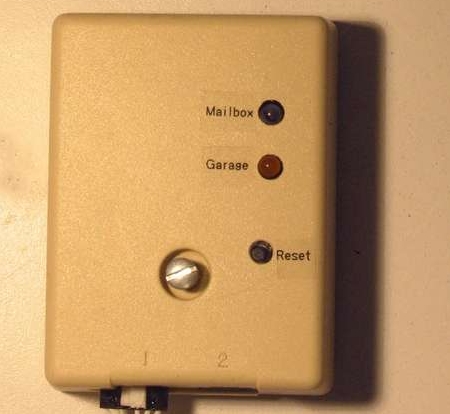
[BrianH] decided that he no longer wanted to venture outside on cold or rainy days just to check if the mail had come, so he built himself a notification system that would alert him if the postman had stopped by. Additionally, he admits to being forgetful on occasion and wanted a way to monitor whether or not he forgot to close the garage door. His Instructable details how he accomplished both of these tasks with the household monitor he built around an ATmega168. His project uses a mailbox mounted photoresistor to determine when the mailbox has been opened, and a reed switch that is triggered when the garage door has been opened. If either of these things occur, a beep is emitted from his notifier, and the appropriate status LED is lit. Simply monitoring whether the garage door has been opened is not all that helpful, so he programmed his notifier to beep persistently at 10-minute intervals if the garage has been left open for more than an hour.

His hack is pretty useful, but he does mention that there is an inordinate amount of wiring that needs to be laid, citing his driveway repaving as a great opportunity to do so.

NES Paul Game Controller

nes_paul_complete

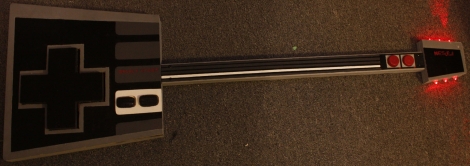
[NeoTechni] wrote in to share the new game peripheral she built, dubbed the NES Paul. The ultimate goal of the project was to build a NES-styled controller for an upcoming game she is working on, tentatively titled 8-bit Hero. The guitar is constructed primarily from wood, as well as some scrounged bits she had around the house. An Xbox 360 controller was dismantled and wired to provide input for the guitar’s buttons and D-Pad. Even the Xbox controller’s rumble packs were used in order to provide visual feedback of missed notes via LED tuning pegs on the guitar’s headstock.

The writeup is broken into several pieces as it was put together in a handful of Google Buzz posts, but it is still relatively easy to follow. We can’t wait to see how the project comes together once the game portion has been completed.

Model Rocket Radio Telemetry

rocket_telemetry_data-analysis

[Ken] sent us his Instructable in which he used radio telemetry to monitor the status of his air-powered model rocket through a series of launches. His setup is centered around an Arduino IDE-compatible board that looks to be about the size of a Boarduino, but has the benefit of an embedded 915 MHz radio module. The vendor he used also sells a good handful of add-on modules which he used for his in-flight recording, including a barometric pressure monitor and a 3-axis accelerometer. During flight, the rocket constantly sends data to a base station, provided it stays within radio operating range.

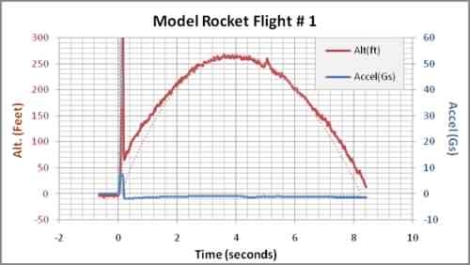
For is initial tests, [Ken] launched his rocket four times, getting usable data on half of them. He found out some interesting things about his model rocket, including the fact that it creates a maximum launch force of 60 Gs. He has plans to revise his setup in the future, such as lightening the battery load as well as adding a high-G analog sensor for recording the forces at take off. This kit, or a more reasonably priced clone, would make for a great addition to any rocket buff’s inventory.