Mini Google Street View Car Built From Lego

lego_street_view

[Mark] was playing around with a small GPS sensor when a light bulb lit over his head. He imagined it would be pretty cool to replicate one of Google’s Street View cars at a fraction of the scale using Lego NXT parts. He figured it would be easy enough to rig a few cameras to a remote controlled car, recording images and GPS coordinates as it went along.

The mini Street View car is controlled by a single NXT module that receives commands from a PS2 controller via a PSPNx sensor he purchased. A trio of cameras have been attached to the car, which are meant to take pictures in all different directions when triggered by his remote. A handful of additional motors are also used for driving the car, steering, and for activating the shutter release on the cameras.

The car worked decently during testing, but [Mark] says there is still plenty of room for improvement. He is having issues reliably triggering all cameras at the moment, but we’re sure he’ll have it sorted out soon enough.

Keep reading to see a video of his mini Street View car in action.

Continue reading “Mini Google Street View Car Built From Lego”

Mouse And HDD Combo Show Off Your Data Gluttony

databot_mouse

So we know you’ve got a lot of porn on your computer, but just how much is a lot? This concept mouse and hard drive combo aims to show you just how much digital junk you have acquired through physical feedback.

The DataBot mouse looks like a typical run of the mill scroll mouse that you might get with a new computer. Inside however, the designers have added a small servo which alters the ease with which the ball moves. The more files you have stuffed into the folder you are moving around, the more the mouse resists, giving you a sense of the physical “weight” of your computer’s contents.

The DataBot hard drive gives you a sense of how full your computer is by growing and shrinking based on space usage. During file transmissions the hard drive blinks its LEDs to indicate how fast or slowly your files are moving. When the inevitable file access error occurs, the LEDs switch to a bright red hue and the drive shakes to indicate there is a problem afoot.

With the price of data storage decreasing by the day, it’s easy to get lost in a glut of information without realizing just how much data you have. This is definitely an interesting way to get a different look at your data consumption.

Check out the videos below to see the pair in action.

[via Dvice]

Continue reading “Mouse And HDD Combo Show Off Your Data Gluttony”

Watch Out Segway, Here Comes Tilto

tilto_demo

While the Segway enjoyed a few years of fame before falling off the radar, [Marcelo Fornaso] is hoping his creation has quite a bit more staying power. Inspired by the Segway’s ability to balance itself, he started thinking about how the concept could be improved. He felt that one of the Segway’s shortcomings arose out of the fact that the base platform was rigid and required the user to lean back and forth outside the device’s frame in order to turn it. He thought that this made the riding experience uncomfortable as well as risked causing the rider to fall over.

His creation, the Tilto, aims to both improve on the turning ability of the Segway while eliminating the need for handlebars. Based on a tilting mountain board design he had been tossing around for a while, the Tilto uses accelerometers and gyros to keep its balance, much like the Segway. His goal was to keep the vehicle balanced while traveling forwards and backwards, but also allowing the device to tilt from side to side without tipping over. This design keeps the rider mostly upright, allowing the user to direct the vehicle by leaning much like you would on a bicycle.

As you can see in the video below, the Tilto works pretty well, even in its prototype form.

Finally, a people mover that lets us get our gangsta lean on!

Continue reading “Watch Out Segway, Here Comes Tilto”

Libyan Rebels Turn Toys Into Weapons Of War

scrapyard_weaponry

They say all’s fair in love and war – trust us, you don’t have to tell these guys twice.

With the war in Libya raging on, the rebels have turned to anything and everything to help give them the upper hand. Engineers and engineering students have put aside their work and studies to become the architects of the Libyan revolution. In a school playground-cum-weapons facility people from all walks of life work together creating powerful weapons from scrap parts.

[Rajab], the group’s chief weapons engineer, used to drive trucks for a living. Now he is directing his fellow fighters on how best to re purpose scrap materials and recovered military weaponry into effective killing machines. As you can see in the video below, everything is fair game. Their creations range from pickup trucks fitted with recovered fighter jet machine guns, to a Power Wheels chassis that has been converted into a remote controlled machine gun turret.

It’s amazing the things that can be produced with some scrap materials and a bit of ingenuity.

Continue reading “Libyan Rebels Turn Toys Into Weapons Of War”

An Instrument That Plays Along With You

muse

The crew over at Teague Labs was talking about musical instruments and how digital music creation seems to get bogged down under user interfaces littered with increasing numbers of buttons, knobs, and sliders. They decided to build a musical device that has its own musical inclinations and personality, while also allowing for two-way interaction with the user.

The resulting creation is Muze, a simple musical instrument with only a single user input. Muze has been programmed with a palette of notes that it can combine and remix into a nearly infinite number of musical combinations. Muze is perfectly happy composing on its own, and will create music that evolves over time, if left alone long enough.

As with all musicians, not every tune is a hit, so Muze can be gently nudged away from cacophonous melodies with a simple twist of a knob. Each of the device’s knobs represent a blend of functions, which are used to influence Muze when placed on the board. The interaction does not send Muze flying into a completely different direction, rather it tells Muze to shake things up a little bit, much like you would ask your guitarist to pick up the tempo during a jam session.

It’s a neat little instrument, and we can imagine it would be a big hit with kids and adults alike. Keep reading to see a video demonstration of Muze in action.

Continue reading “An Instrument That Plays Along With You”

MIT’s ESuperbike Takes On The Isle Of Man

mit_ebike

While the Isle of Man typically plays host to an array of gas-powered superbikes screaming through villages and mountain passes at unbelievable speeds, the island’s TT Race is a bit different. Introduced in 2009 to offer a greener alternative to the traditional motorcycle race, organizers opened up the course to electric bikes of all kinds. In order to entice participants, they even put a £10k prize on the line for the first bike that completes the race with an average speed of 100 miles per hour or faster. While no one has claimed the prize just yet, that didn’t stop the MIT Electric Vehicle team from tossing their hat into the ring this year.

Their entry into the race is the brainchild of PhD student [Lennon Rodgers] and his team of undergrads. They first designed a rough model of the motorcycle they wanted to build in CAD, and through a professor at MIT sourced some custom-made batteries for their bike. Through a series of fortunate events, the team found themselves in front of BMW management, who donated an S1000RR racing bike to the project. After a good number of alterations, including the addition of an Arduino to control the bike, they were ready for race day.

While the team didn’t take the checkered flag, they did finish the race in 4th place. Their bike managed to complete the course with an average speed of 79 mph, which isn’t bad according to [Rodgers]. He says that for their first time out, he’s happy that they finished at all, which is not something every team can claim.

EReader Battery Never Goes Flat (in The Sun)

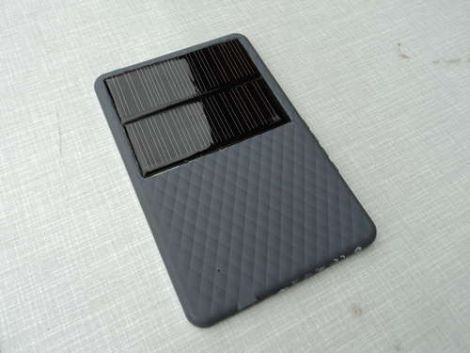
solar_powered_kobo

Instructables user [flapke] has a Kobo eReader and wanted to add some solar cells to it in order to charge the battery for free. The modification is similar to others we have seen recently, though his work was done so well that it almost looks stock.

He started out by sourcing a pair of solar panels from DealExtreme that purported to supply 5.5v @ 80mA. Like most of us are inclined to do, he tested them before use and found that they actually put out around 50mA instead. While the performance was a bit off, they still fit his needs pretty well, as the charge current needed to be at or less than 100mA to avoid damaging the battery.

He opened the Kobo’s case, and carefully removed a section of the back panel to make room for the solar panels. Once they were soldered together in parallel, he wired them to the eReader’s battery through a Schottky diode to prevent the battery from draining.

While we think his solar modification is a great way to ensure that he never runs out of juice while reading by the pool, we would certainly add a bit of extra charge circuitry to ours to prevent damage to the battery. What do you think?