Million Volt Guitar Rocks The House…for Science!

science_brothers_tesla_hero

[Bill Porter] and his friend [Dan Flisek] work together to put on a science-related educational stage show called “Science Brothers”, in which the pair try to convince school children that their field of expertise is the cooler science. While the two are competitive on stage, the main goal of the program is to get kids interested in science, no matter what the specialty.

The pair currently finance the project out of pocket, so they are always looking for ways to make things interesting while also keeping costs in check. With that in mind [Bill] came up with an awesome way to show off the Tesla coil he built a while back. His most recent educational creation is a little something he calls “Tesla Hero”.

Since he already had a solid state Tesla coil hanging around, he dug up a PS2 Guitar Hero controller and got busy getting the two acquainted. The guitar connects to the coil via a fiber optic isolator board, playing one of five notes as he strums along. A series of Arduino-driven LED strips adorn the guitar, flashing various colors while he plays, as you can see in the video below.

It’s quite a cool project, and we’re sure that his audience will be impressed!

Stick around to see a video of  Tesla Hero in action, and if you’re interested in learning more about the Science Brothers, be sure to check them out here.

Continue reading “Million Volt Guitar Rocks The House…for Science!”
Retro Video Games Sounds…for Your Toilet

super_mario_toilet

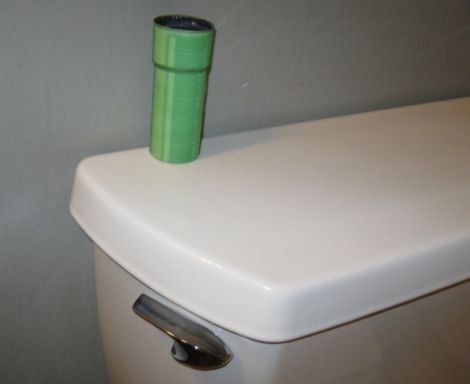
After reading about a Super Mario Brothers themed bathroom, [Jonathan] decided that it would be pretty cool to have his toilet play the “warp pipe” sound whenever anyone flushed.

He grabbed a small sound drop key chain on eBay and disassembled it to see how things worked. Once he figured out which solder pads corresponded to the warp pipe sound he added a few wires that, when shorted, trigger the sound effect.

He debated as to how the sound generator should be wired to the toilet, and was pretty reluctant to place the key chain inside the tank due to concerns about sound volume and water damage. He ultimately decided to trigger the sound effects using triboelectric charge, much like those touch lamps from the ’80s. He rigged up a simple circuit that is connected to both the toilet handle as well as the water intake valve on the wall. When someone touches the handle, the small charge that is present in their hand triggers the sound effect as you can see in the video below.

Instead of using a standard project box, he opted to build a small warp tube replica from cardboard and paper, which really brings everything together nicely.

While he says that the circuit is pretty sensitive, triggering at odd times or not at all, we still think it’s awesome.

Continue reading “Retro Video Games Sounds…for Your Toilet”

Vocera B1000A Teardown

vocera_teardown

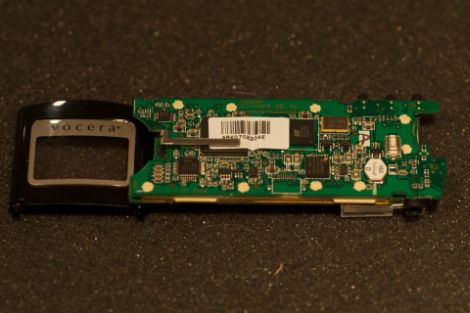
[Gray] over at Geek Chique had a bit of an eBay mishap and was suddenly the proud owner of 16 Vocera B1000A badges. If you are not familiar, these badges are small, lightweight communications devices similar to the famous Star Trek communicator, which allow users to talk to other individuals via VOIP. He was working on getting the remaining badges up and running by reimplementing the server software, and figured that since one of the badges he purchased was not working, he might as well take it apart.

It took him awhile to get the well-made badges apart, requiring a rotary tool and some elbow grease to get the job done. Inside, he found that the device was split into two circuit boards, one being the “WiFi” board, and the other the “CPU” board. The WiFi board uses a Prism WiFi chipset, which was incredibly common at the time of construction. The CPU board sports small SRAM and flash chips as you would expect, with a Texas Instruments 5490A DSP running the show.

While it remains to be seen if tearing the device down helps [Gray] to get things up and running again, it never hurts to take a closer look to see what you are working with.

Putting The Flex Back Into The RDS 80 Soldering Station

ersa_soldering_iron_fix

[Markus] was looking to upgrade his soldering station, and having had good luck with Ersa in the past, opted to purchase one of their new stations, the RDS 80.

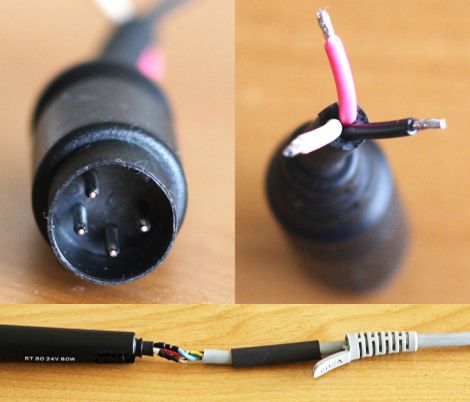
Once he got the iron home however, he was very disappointed to see that while his previous Ersa model used a silicone cable to connect the iron to the base station, his new iron used a stiff, non heat-resistant PVC cable instead. He found plenty of people complaining about the same issue online, but no one seemed to have a fix, so he set off to figure it out for himself.

He thought that he could disassemble the iron and change the wiring out once it was apart, but it seemed that there was no way of doing so without destroying it. Instead he chopped the wire off at the end of the soldering iron, replacing it with a new silicone cable. He did the same thing at the base station end, since he was forced to reuse the proprietary 4-pin plug Ersa decided to use there.

His modifications worked out nicely, and he is now happily soldering away.

If you happen to have one of these soldering stations, be sure to swing by his site to get a closer look at how he swapped out the cable.

Build Your Own Panoramic Pinhole Camera

panoramic_pinhole_cam

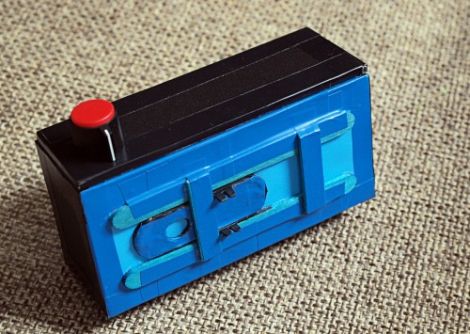
While it seems that the digital camera is king, some people still love shooting with good old 35mm film – [Costas Kaounas], a high school teacher and photographer certainly does. He recently published plans for a great-looking 35mm pinhole camera over at DIY photography that we thought you might enjoy.

[Costas] put together a set of simple hand-drawn plans for the camera, that you can easily replicate with a bit of free time. The camera is built mostly from card stock, both in 1mm and 3mm flavors, also incorporating popsicle sticks and an aluminum can. The popsicle sticks are used to create a manual shutter for the camera, while the pop can is used to form the pinhole aperture.

It’s a pretty simple hack as you can see, with nary an electronic part to be found. It will take you a bit of time to construct however, since you’ll need to let the glue dry between certain steps.

Love it or leave it, you’ve got to admit that the panoramic shots it takes are pretty nice!

If we’ve piqued your interest in pinhole cameras, be sure to check out this Lego pinhole camera as well as this beer can pinhole camera.

[via Lifehacker]

Amazing 3d Telepresence System

encumberance_free_telepresence_kinect

It looks like the world of Kinect hacks is about to get a bit more interesting.

While many of the Kinect-based projects we see use one or two units, this 3D telepresence system developed by UNC Chapel Hill student [Andrew Maimone] under the guidance of [Henry Fuchs] has them all beat.

The setup uses up to four Kinect sensors in a single endpoint, capturing images from various angles before they are processed using GPU-accelerated filters. The video captured by the cameras is processed in a series of steps, filling holes and adjusting colors to create a mesh image. Once the video streams have been processed, they are overlaid with one another to form a complete 3D image.

The result is an awesome real-time 3D rendering of the subject and surrounding room that reminds us of this papercraft costume. The 3D video can be viewed at a remote station which uses a Kinect sensor to track your eye movements, altering the video feed’s perspective accordingly. The telepresence system also offers the ability to add in non-existent objects, making it a great tool for remote technology demonstrations and the like.

Check out the video below to see a thorough walkthrough of this 3D telepresence system.

Continue reading “Amazing 3d Telepresence System”

DIY High Voltage Electric Field Detector

electric_field_detector

Who needs a Fluke high voltage detector when you’ve got one of these things?

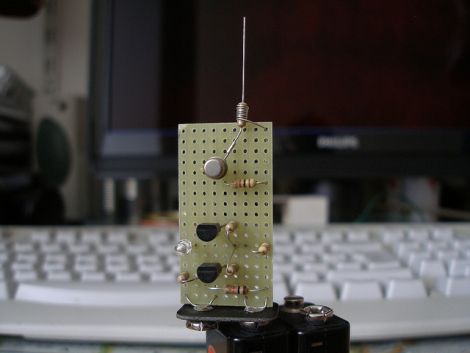
Actually, we still recommend a professional high voltage detector for serious work, but you’ve got to like this electric field detector that [Alessandro] recently put together.

The detector works by using a JFET to detect the high impedance electric fields that are generated by high voltage lines. The JFET amplifies the signal while dropping the impedance in order to drive a pair of NPN transistors which are used as a threshold amplifier. Once the voltage hits 3V, an LED is lit, indicating the presence of high voltage near the detector’s probe. A wire-wrapped resistor does double-duty serving as the probe while providing a high impedance path to ground, ensuring that stray charge does not accumulate on the JFET’s gate, causing false readings.

It’s a neat project, and something that can be constructed in no time, making it perfect for beginner electronics classes.

Keep reading to see a quick video of the HV detector in action.

Continue reading “DIY High Voltage Electric Field Detector”