Building An IR Thermometer That Fits On Your Keychain

Non-contact infrared (IR) thermometers used to be something of an exotic tool, but thanks at least in part due to the COVID-19 pandemic, they’re now the sort of thing you see hanging up near the grocery store checkout as a cheap impulse buy. Demand pushed up production, and the economies of scale did the test. Now the devices, and the sensors within them, are cheap enough for us hackers to play with.

The end result is that we now have projects like this ultra compact IR thermometer from [gokux]. With just a handful of components, some code to glue it all together, and a 3D printed enclosure to wrap it all up, you’ve got a legitimately useful tool that’s small enough to replace that lucky rabbit’s foot you’ve got on your keys.

If this project looks familiar, it’s because the whole thing is closely related to the LiDAR rangefinder [gokux] put together last month. It shares the same Seeed Studio XIAO  ESP32-C3 microcontroller, 0.49 inch OLED display, and tiny 40 mAh LiPo battery. The only thing that’s really changed, aside from the adjustments necessary to the 3D printed enclosure, is that the LiDAR sensor was replaced with a MLX90614 IR temperature sensor.

[gokux] has put together some great documentation for this build, making it easy for others to recreate and remix on their own. Assembly is particularly straightforward thanks to the fact that both the display and temperature sensor communicate with the ESP32 over I2C, allowing them to be wired daisy chain style — there’s no need for even a scrap of perfboard inside the case, let alone a custom board.

Hackaday Podcast Episode 278: DIY Subs, The ErgoRing, And Finding NEMA 17

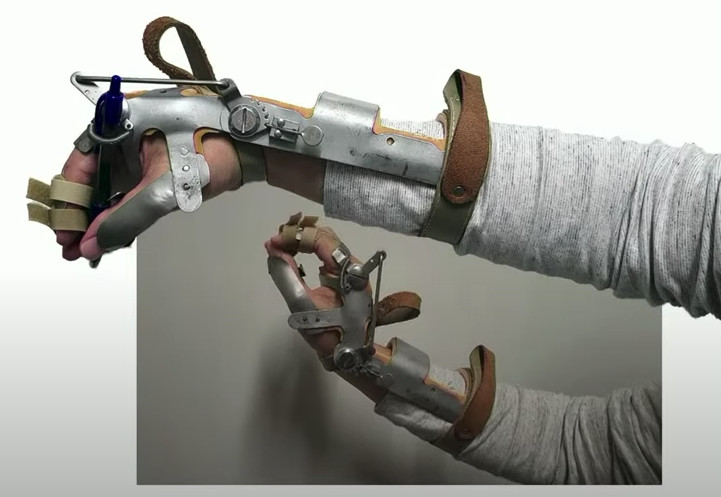
In this episode, Hackaday Editors Elliot Williams and Tom Nardi kick things off with a reminder about the impending deadline for Supercon talk and workshop proposals. From there discussion moves on to the absolutely incredible tale of two brothers who solved a pair of missing person cases with their homebrew underwater vehicle, false data sneaking into OctoPrint’s usage statics, and an organic input device that could give the classic mouse a run for its money.

You’ll also hear about cheap radar modules, open source Xbox mod chips, and lawnmowers from the grocery store. The episode wraps up with a look at the enduring mystique of perpetual motion devices, and the story of a legendary ship that might soon end up being turned into paper clips.

Check out the links below if you want to follow along, and as always, tell us what you think about this episode in the comments!

As always, this week’s episode is available as a DRM-free MP3.

Continue reading “Hackaday Podcast Episode 278: DIY Subs, The ErgoRing, And Finding NEMA 17”

Toyota Heater Switches Learn New Tricks

The look, the feel, the sound — there are few things more satisfying in this world than a nice switch. If you’re putting together a device that you plan on using frequently, outfitting it with high-quality switches is one of those things that’s worth the extra cost and effort.

So we understand completely why [STR-Alorman] went to such great lengths to get the aftermarket seat heaters he purchased working with the gorgeous switches Toyota used in the 2006 4Runner. That might not sound like the kind of thing that would involve reverse engineering hardware, creating a custom PCB, or writing a bit of code to tie it all together. But of course, when working on even a halfway modern automobile, it seems nothing is ever easy.

The process started with opening up the original Toyota switches and figuring out how they work. The six-pin units have a lot going on internally, with a toggle, a rheostat, and multiple lights packed into each one. Toyota has some pretty good documentation, but it still took some practical testing to distill it down into something a bit more manageable. The resulting KiCad symbol for the switch helps explain what’s happening inside, and [STR-Alorman] has provided a chart that attributes each detent on the knob with the measured resistance.

But understanding how the switches worked was only half the battle. The aftermarket seat heaters were only designed to work with simple toggles, so [STR-Alorman] had to develop a controller that could interface with the Toyota switches and convince the heaters to produce the desired result. The custom PCB hosts a Teensy 3.2 that reads the information from both the left and right seat switches, and uses that to control a pair of beefy MOSFETs. An interesting note here is the use of very slow pulse-width modulation (PWM) used to flip the state of the MOSFET due to the thermal inertia of the heater modules.

We love the effort [STR-Alorman] put into documenting this project, going as far as providing the Toyota part numbers for the switches and the appropriate center-console panel with the appropriate openings to accept them. It’s an excellent resource if you happen to own a 4Runner from this era, and a fascinating read for the rest of us.

A Second OctoPrint Plugin Has Been Falsifying Stats

The ongoing story of bogus analytical data being submitted to the public OctoPrint usage statistics has taken a surprising turn with the news that a second plugin was being artificially pushed up the charts. At least this time, the developer of the plugin has admitted to doing the deed personally.

Just to recap, last week OctoPrint creator [Gina Häußge] found that somebody had been generating fictitious OctoPrint usage stats since 2022 in an effort to make the OctoEverywhere plugin appear to be more popular than it actually was. It was a clever attempt, and if it wasn’t for the fact that the fake data was reporting itself to be from a significantly out of date build of OctoPrint, there’s no telling how long it would have continued. When the developers of the plugin were confronted, they claimed it was an overzealous user operating under their own initiative, and denied any knowledge that the stats were being manipulated in their favor.

Presumably it was around this time that Obico creator [Kenneth Jiang] started sweating bullets. It turns out he’d been doing the same thing, for just about as long. When [Gina] contacted him about the suspicious data she was seeing regarding his plugin, he owned up to falsifying the data and published what strikes us as a fairly contrite apology on the Obico blog. While this doesn’t absolve him of making a very poor decision, we respect that he didn’t try to shift the blame elsewhere.

That said, there’s at least one part of his version of events that doesn’t quite pass the sniff test for us. According to [Kenneth], he first wrote the script that generated the fake data back in 2022 because he suspected (correctly, it turns out) that the developers of OctoEverywhere were doing something similar. But after that, he says he didn’t realize the script was still running until [Gina] confronted him about it.

Now admittedly, we’re not professional programmers here at Hackaday. But we’ve written enough code to be suspicious when somebody claims a script they whipped up on a lark was able to run unattended for two years and never once crashed or otherwise bailed out. We won’t even begin to speculate where said script could have been running since 2022 without anyone noticing…

But we won’t dwell on the minutiae here. [Gina] has once again purged the garbage data from the OctoPrint stats, and hopefully things are finally starting to reflect reality. We know she was already angry about the earlier attempts to manipulate the stats, so she’s got to be seething right about now. But as we said before, these unfortunate incidents are ultimately just bumps in the road. We don’t need any stat tracker to know that the community as a whole greatly appreciates the incredible work she’s put into OctoPrint.

Long-Term OctoPrint Stat Manipulation Uncovered

Developing free and open source software can be a thankless experience. Most folks do it because it’s something they’re passionate about, with the only personal benefit being the knowledge that there are individuals out there who found your work useful enough to download and install. So imagine how you’d feel if it turns out somebody was playing around with the figures, and the steady growth in the number of installs you thought your software had turned out to be fake.

That’s what happened just a few days ago to OctoPrint developer [Gina Häußge]. Although there’s no question that her software for remotely controlling and monitoring 3D printers is immensely popular within the community, the fact remains that the numbers she’s been using to help quantify that popularity have been tampered with by an outside party. She’s pissed, and has every right to be.

Continue reading “Long-Term OctoPrint Stat Manipulation Uncovered”

Hosting Your Own PixMob Party Made Easy

Over the last few years, it’s been increasingly common for concertgoers to be handed a light-up bracelet from PixMob that synchronizes with the others in the crowd to turn the entire audience into a music visualizer. They’re a clever way of enhancing the concert experience, but unfortunately, they don’t do anything once you leave the show. Or at least, that used to be the case.

We’ve seen efforts to reverse engineer the IR (and occasionally radio) signals that drive these PixMob devices, but since we checked in last it seems like things have gotten a lot easier for the home gamer. [David Pride] has recently posted a brief write-up that shows how quickly and easily it is to get these devices fired up using nothing more exotic than an Arduino, an IR LED, and an audio sensor module.

With the audio sensor module connected to the Arduino’s digital input and the IR LED wired to digital out, all you need to do is flash firmware to the board and start playing some beats. The source code [David] has provided is a a remixed version of what’s previously been published by [Carlos Ganoza], which, in this case, has been tweaked to make the lighting patterns less random.

Presumably, this is to make the devices behave more like they do during an actual concert, but since nobody at Hackaday is cool enough to have seen a live musical performance in the last decade, we’re not really sure. All we can say is that the effect looks pretty sweet in the demo video.

Back in 2019, we saw a teardown of an early PixMob device, and by 2022, the efforts to reverse engineer their IR control protocol were well underway. We’re glad to see things have progressed to the point that you can piece together a transmitter from what’s in the parts bin, as it means at least some of these devices will have a lifespan longer than a single concert.

Solving Cold Cases With Hacked Together Gear

People go missing without a trace far more commonly than any of us would like to think about. Of course the authorities will conduct a search, but even assuming they have the equipment and personnel necessary, the odds are often stacked against them. A few weeks go by, then months, and eventually there’s yet another “cold case” on the books and a family is left desperate for closure.

But occasionally a small team or an individual, if determined enough, can solve such a case even when the authorities have failed. Some of these people, such as [Antti Suanto] and his brother, have even managed to close the books on multiple missing person cases. In an incredibly engrossing series of blog posts, [Antti] describes how he hacked together a pair of remotely operated vehicles to help search for and ultimately identify sunken cars.

Continue reading “Solving Cold Cases With Hacked Together Gear”