What’s The Difference Between Tang 9K And 20K (It Isn’t 11…)

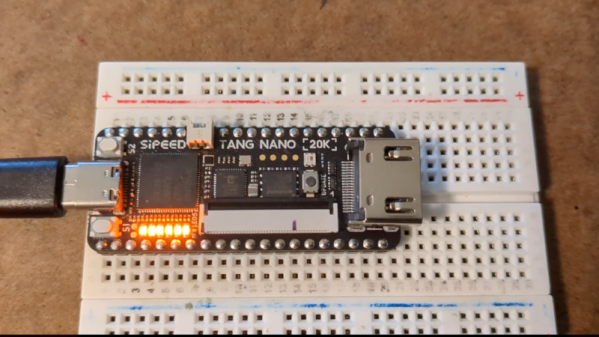
[Grug Huhler] has been working with the Tang Nano 9K FPGA board. They are inexpensive, and he noticed there is a 20K version, so he picked one up. Of course, you’d expect the 20K board has a different FPGA with more gates than the 9K, but there are also a number of differences in the host board. [Grug] was kind enough to document the differences in the video below.

In addition to the differences, there’s a good demo of the boards hosting a system-on-chip design. The little DIP package is handy for breadboarding. All of the 20K pins are 3.3 V, according to the documentation. The 9K does have some 1.8 V pins. There are more external devices on the 20K board but that eats up more uncommitted pins. Depending on your design, that may or may not be a problem.

We keep meaning to pick some of these up to play with. The Verilog is easy enough, and the tools look adequate. If you need a refresher on Verilog, we have a boot camp for you that would probably port easily enough to the Tang system. We’ve been following [Grug’s] work on these chips lately, and you should, too.

Continue reading “What’s The Difference Between Tang 9K And 20K (It Isn’t 11…)”
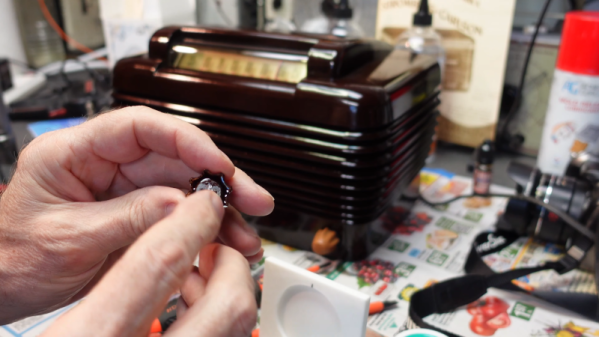
Old Knobs With A Cast Of Thousands

You have an old radio — in the case of [The Radio Mechanic], a Stromberg Carlson — and it needs new knobs. What do you do? You can’t very well pop down to the local store and find any knobs anymore. Even if you are lucky enough to be around an electronics store, they aren’t going to have knobs to do justice to an antique radio. You could 3D print them, of course, but there are a number of issues with transferring the old knob to a CAD file for printing. So [The Radio Mechanic] decided to cast them instead.

He printed some fixtures to help with the molding using two-part molding silicone. He mounted the knob on a shaft in a jig, filled the jig with silicone, and lowered the knob into the mix. The next day, he had a good-looking mold.

The next step, of course, is to cast with resin. Admittedly 3D printing would have been faster, but would not have as nice a surface finish. The epoxy resin is clear, but he was hopeful that some caramel pigment would match the original knob color. Spoiler alert: it didn’t. The resulting knob looked translucent, like a root beer barrel candy, rather than the brown sugar color of the original knob.

The knob needed a spring insert to hold the shaft, so he repurposed some from a different kind of radio. Overall, this is the kind of thing we always think we are going to do when we need something and then we rarely follow through. Then again, we rarely have the patience to wait as long as these two knobs took to make.

Of course, a casting guerrilla doesn’t have to make just knobs. You can even add metal powders to do cold metal casting.

Continue reading “Old Knobs With A Cast Of Thousands”

Fourier, The Animated Series

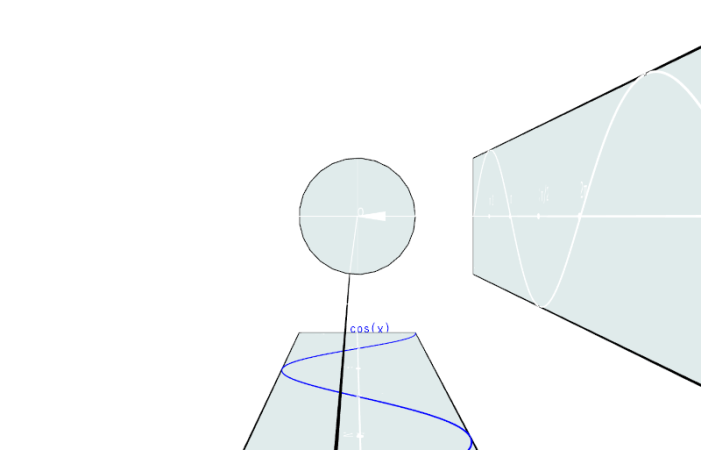
We’ve seen many graphical and animated explainers for the Fourier series. We suppose it is because it is so much fun to create the little moving pictures, and, as a bonus, it really helps explain this important concept. Even if you already understand it, there’s something beautiful and elegant about watching a mathematical formula tracing out waveforms.

[Andrei Ciobanu] has added his own take to the body of animations out there — or, at least, part one of a series — and we were impressed with the scope of it. The post starts with the basics, but doesn’t shy away from more advanced math where needed. Don’t worry, it’s not all dull. There’s mathematical flowers, and even a brief mention of Pink Floyd.

The Fourier series is the basis for much of digital signal processing, allowing you to build a signal from the sum of many sinusoids. You can also go in reverse and break a signal up into its constituent waves.

We were impressed with [Andrei’s] sinusoid Tetris, and it appears here, too. We’ve seen many visualizers for this before, but each one is a little different.

Mechanic Prince Of Tides

Lord Kelvin’s name comes up anytime you start looking at the history of science and technology. In addition to working on transatlantic cables and thermodynamics, he also built an early computing device to predict tides. Kelvin, whose real name was William Thomson, became interested in tides in a roundabout way, as explained in a recent IEEE Spectrum article.

He’d made plenty of money on his patents related to the telegraph cable, but his wife died, so he decided to buy a yacht, the Lalla Rookh. He used it as a summer home. If you live on a boat, the tides are an important part of your day.

Today, you could just ask your favorite search engine or AI about the tides, but in 1870, that wasn’t possible. Also, in a day when sea power made or broke empires, tide charts were often top secret. Not that the tides were a total mystery. Newton explained what was happening back in 1687. Laplace realized they were tied to oscillations almost a century later. Thomson made a machine that could do the math Laplace envisioned.

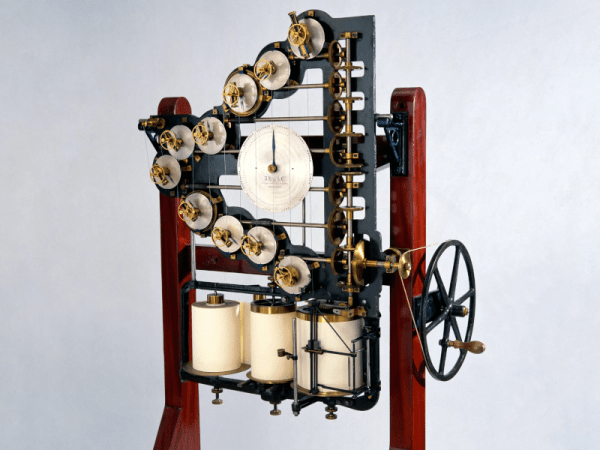
We know today that the tides depend on hundreds of different motions, but many of them have relatively insignificant contributions, and we only track 37 of them, according to the post. Kelvin’s machine — an intricate mesh of gears and cranks — tracked only 10 components.

In operation, the user turned a crank, and a pen traced a curve on a roll of paper. A small mark showed the hour with a special mark for noon. You could process a year’s worth of tides in about 4 hours. While Kelvin received credit for the machine’s creation, he acknowledged the help of many others in his paper, from craftsmen to his brother.

We actually did a deep dive into tides, including Kelvin’s machine, a few years ago. He shows up a number of times in our posts.

Ham Busts The Myth Of Ground

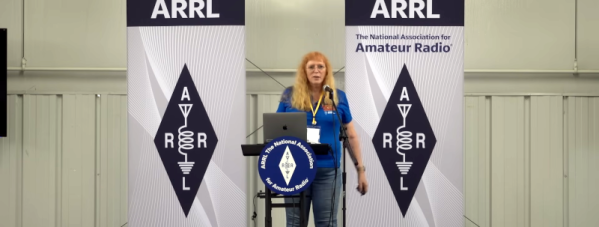
Everyone who deals with electronics knows that grounding is important. Your house has a copper rod in the ground. But [Kristen K6WX] has news: the idea of ground is kind of a myth. She explained at a talk at the recent ARRL National Convention, and if you didn’t make it, you can watch it in the video below.

The problem is analogous to finding something that is standing still. You really can only talk about something standing still relative to something else. Sure, you might be standing still outside a building, but seen from the moon, you and the building are spinning around at about one revolution per day. If you were sitting on the sun and not burning up, you’d see lots of motion of everything, and, of course, the sun itself is moving in the right frame of reference.

Continue reading “Ham Busts The Myth Of Ground”

Tunneling TCP By File Server

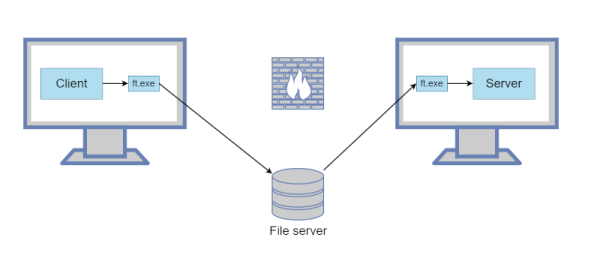
You want to pass TCP traffic from one computer to another, but there’s a doggone firewall in the way. Can they both see a shared file? Turns out, that’s all you need. Well, that and some software from [fiddyschmitt].

If you think about it, it makes sense. Unix treats most things as a file, so it is pretty easy to listen on a local TCP port and dump the data into a shared file. The other side reads the file and dumps the same data to the desired TCP port on its side. Another file handles data in the other direction. Of course, the details are a bit more than that, but that’s the basic idea.

Performance isn’t going to be wonderful, and the files keep growing until the program detects that they are bigger than 10 megabytes. When that happens, the program purges the file.

The code is written in C# and there are binaries for Windows and Linux on the release page. The examples show using shared files via Windows share and RDP, but we imagine any sort of filesystem that both computers can see would work. Having your traffic stuffed into a shared file is probably not great for security but, you know, you are already jumping a firewall, so…

Of course, no firewall can beat an air gap. Unless you can control the fans or an LED.

Tech In Plain Sight: Theodolites

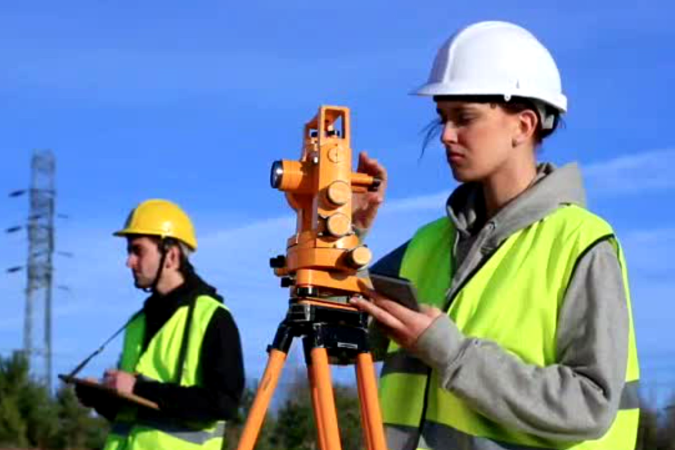
We take it for granted that you can look at your phone and tell exactly where you are. At least, as exact as the GPS satellites will allow. But throughout human history, there has been a tremendous desire to know where here is, exactly. Where does my farm end and yours start? Where is the border of my city or country? Suppose you have a flagpole directly in the center of town and a clock tower at the edge of town. You know where they are precisely on a map. You also know how tall they are. What you need is a theodolite, which is an instrument that measures angles very precisely.

Continue reading “Tech In Plain Sight: Theodolites”