3D Printer Hot Off The Griddle

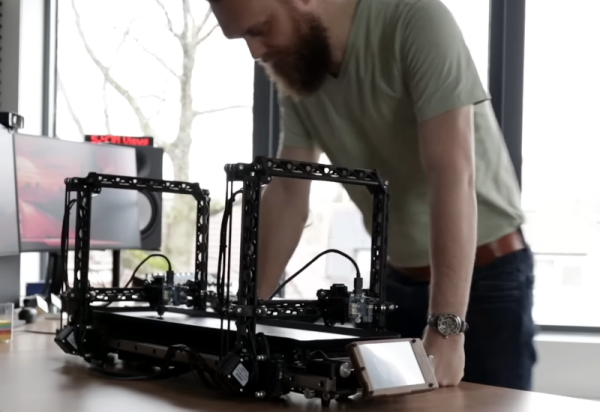
If you look at [Proper Printing’s] latest video — see below — you’ll immediately get the idea behind his latest printer. There are two heads on two separate gantries, which, of course, opens up many possibilities. But when you think you’ve seen enough, you find out the heated bed is a kitchen griddle, and… well, for us, we had to keep watching.

The heated bed idea was interesting, although the flatness left something to be desired. While it is a simple idea, getting the two gantries to move reliably across the hotbed griddle took a lot of parts and a careful design. We wonder how evenly the griddle heats — ours definitely has hot spots when we cook with it.

Continue reading “3D Printer Hot Off The Griddle”

Fictional Computers: The Three Body Problem

If you intend to see the Netflix series “The Three Body Problem” or you want to read the Hugo-winning story from Chinese author [Cixin Liu], then you should probably bookmark this post and stop reading immediately. There will be some mild spoilers. You have been warned.

While the show does have some moments that will make your science brain cringe, there is one scene that shows a computer that could actually be built. Would it be practical? Probably not in real life, but in the context provided by the show, it was perfectly feasible. It could have, however, been done a little better, but the idea was — like many great ideas — both deceptively simple and amazingly profound. The computer was made of human beings. I’m not talking like Dune’s mentats — humans with super brains augmented by drugs or technology. This is something very different.

Background

This is your last chance. There are spoilers ahead, although I’ll try to leave out as much as I can. In the story, top scientists receive a mysterious headset that allows them to experience totally immersive holodeck-style virtual reality. When they put the headset on, they are in what appears to be a game. The game puts you in a historical location — the court of Henry VIII or Ghengis Kahn. However, this Earth has three suns. The planet is sometimes in a nicely habitable zone and sometimes is not. The periods when the planet is uninhabitable might have everything bursting into flames or freezing, or there might not be sufficient gravity to hold them on the planet’s surface. (Although I’ll admit, I found that one hard to grasp.)

Apparently, the inhabitants of this quasi-Earth can hibernate through the “chaotic eras” and wait for the next “stable era” that lasts a long time. The problem, as you probably know, is that there is no general closed-form solution for the three-body problem. Of course, there are approximations and special cases, but it isn’t easy to make long-term predictions about the state of three bodies, even with modern computers.

Continue reading “Fictional Computers: The Three Body Problem”

3D Navigator For Blender

If you work with high-end CAD workstations, you may have encountered a SpaceMouse or similar devices. Sort of a mouse with an extra dimension, they aren’t cheap. So [meisterodin1981] decided to build a do-it-yourself version for use with Blender. You can check it out in the video below.

The device uses an MPU6050 accelerometer and a spring. It also has some buttons for special features. The device uses a Teensy 2, although any controller that can provide an HID device could probably do the job. Of course, a nice 3D printed case is part of the design. A printed pair of plates holds a 3D printer bed spring to provide the device’s Z-axis movement. The wires to the encoder are routed through the center of the spring, so neatness counts.

We’ve seen other 3D mice like the Orbion. Your other option is to pick up the old-fashioned serial port versions and convert them. Until you can do your designs in virtual reality, these mice are just the ticket.

Continue reading “3D Navigator For Blender”

Retrotechtacular: The IBM 7070

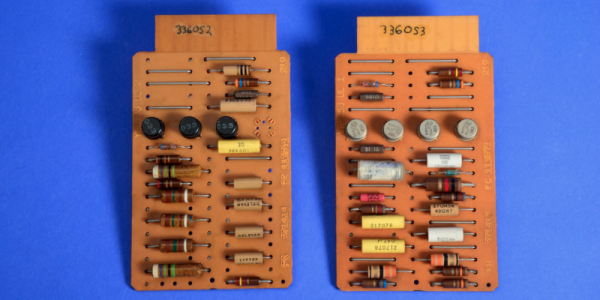
If you think of IBM mainframe computers, you most likely are thinking of the iconic S/360 or the slightly newer S/370. But what about the 7070 from 1958? It had transistors! It didn’t, however, use binary. Instead, it was a decimal-architecture machine. You can see a lost video of the machine below.

It was originally slated to upgrade the older IBM 650 and 705 computers. However, it wasn’t compatible with either, so IBM had to roll out the IBM7080, which was compatible, at least, with the 705. Both machines could run 650 code via emulation.

Continue reading “Retrotechtacular: The IBM 7070”

Retrogadgets: Butler In A Box

You walk into your house and issue a voice command to bring up the lights and start a cup of coffee. No big deal, right? Siri, Google, and Alexa can do all that. Did we mention it is 1985? And, apparently, you were one of the people who put out about $1,500 for a Mastervoice “Butler in a Box,” the subject of a Popular Science video you can see below.

If you think the box is interesting, the inventor’s story is even stranger. [Kevin] got a mint-condition Butler in a Box from eBay. How did it work, given in 1983, there was no AI voice recognition and public Internet? We did note that the “appliance module” was a standard X10 interface.

Continue reading “Retrogadgets: Butler In A Box”

Tech Support… Can AI Be Worse?

You can’t read the news today without another pundit excitedly reporting how AI is going to take every job you can imagine. Of course, AI will change the employment landscape. It will take some jobs and reduce the need for others. What about tech support? Is it possible that an AI might be able to help people with technical issues better than humans? My first answer was no way, but then I was painfully reminded of something. The question isn’t if AI can help you better than any human can. The question is if AI can help you better than the low-paid person on the other end of the phone you are likely to talk to. Sadly, I think the answer to that question is almost certainly yes.

In all fairness, if you read Hackaday, you probably don’t encounter many technical support people who can solve a problem you can’t. By the time you call them, it is a lost cause. But this is more than just “Hackday folks are smarter than the tech support agents.” The overall quality of tech support at many companies is rock bottom no matter who you are. Continue reading “Tech Support… Can AI Be Worse?”

Fictional Computers: Colossus And Guardian

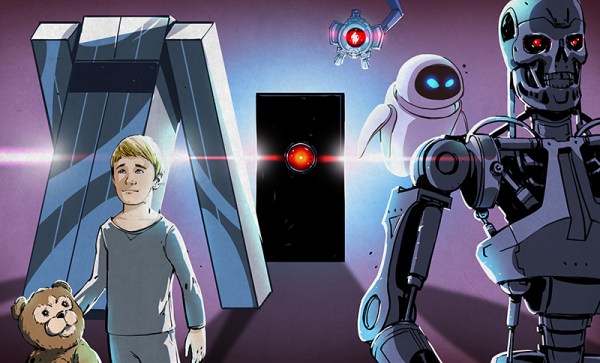
We can learn a lot by looking at how writers and filmmakers imagine technology. While some are closer than others, there are some definite lessons like never make a killer computer without an off switch you can reach. We are especially interested in how computers appear in books, movies, and TV shows, and so in Computers of Fiction, we want to remember with you some of our favorites. This time, we are thinking about the 1970 movie Colossus: The Forbin Project. There were actually two computers: the titular Colossus, which was an American computer, and the Guardian, a similar Soviet computer.

The Story

In the United States, Dr. Forbin has created a supercomputer deep under a mountain. Colossus, the computer, is put in charge of the nuclear arsenal to eliminate human error in the defense of the country. Colossus gathered intelligence, analyzed it, and was able to launch its own missiles.

Colossus realizes there is another system.

Shortly after activation, however, the computer reaches a startling conclusion: “WARN: THERE IS ANOTHER SYSTEM.” It provides coordinates in the Soviet Union. That system is a similar system called Guardian. The computers decide they want to talk to each other. The President decides to allow it, hoping to learn more about the Soviet’s secret computer. The Soviets agree, too, presumably for the same reason. You can watch the original trailer below.

Continue reading “Fictional Computers: Colossus And Guardian”