Home Assistant Display Uses E-Ink

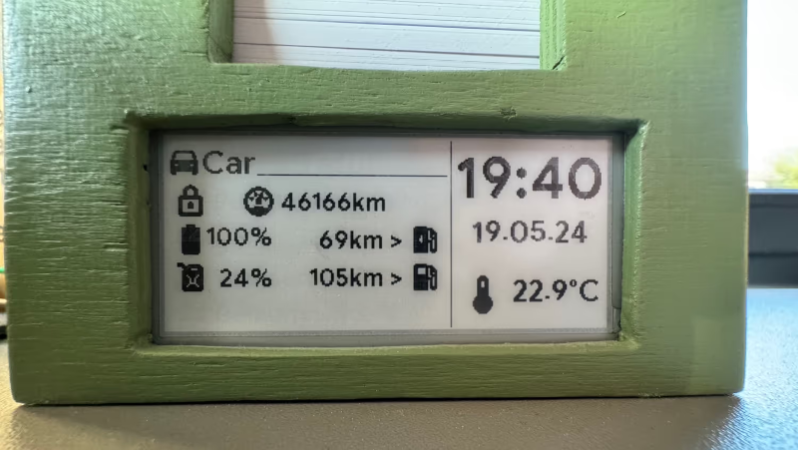
[Markus] grabbed an ESP32 and created a good-looking e-ink dashboard that can act as a status display for Home Automation. However, the hardware is generic enough that it could work as a weather station or even a task scheduler.

The project makes good use of modules, so there isn’t much to build. A Waveshare 2.9-inch e-ink panel and an ESP32, along with a power supply, are all you need. The real work is in the software. Of course, you also need a box to put it in, but with 3D printing, that’s hardly a problem.

Well, it isn’t a problem unless — like [Markus] — you don’t have a 3D printer. Instead, he built a wooden case that also holds notepaper.

The software uses ESPHome to interface with Home Assistant. There is a fair amount of configuration, but nothing too difficult. Of course, you can customize the display to your heart’s content. Overall, this is a great example of how a few modular components and some open-source software can combine to make a very simple yet useful project.

There are many ways to use an ESP32 in your home automation setup. Maybe you can salvage the e-ink displays. Just try not to get carried away.


Radio Caroline At 60

In the 1960s, if you were a teenager in the United States, a big part of your life was probably music. There was a seemingly endless supply of both radio stations and 45s to keep you entertained. In the UK and other countries, though, the government held a monopoly on broadcasting, and they were not always enthralled with the music kids liked. Where there is demand, there is an opportunity, and several enterprising broadcasters set up radio stations at sea, the so-called pirate radio stations. In 1964, Irish businessman [Ronan O’Rahilly] did just this and founded Radio Caroline. Can you imagine that 60 years later, Radio Caroline is still around?

Not that it has been in operation for 60 years in a row. There were a few years the station’s ship had been impounded by creditors. Then, the ship ran aground on the Goodwin Sands and was damaged. You can see a news short from 1965 in the video below (Radio Caroline shows up at about the 1:50 mark).

Continue reading “Radio Caroline At 60”

[Scott Manley] Explains GPS Jamming

We always think of [Scott Manley] as someone who knows a lot about rockets. So, if you think about it, it isn’t surprising he’s talking about GPS — after all, the system uses satellites. GPS is used in everything these days, and other forms of navigation are starting to fall by the wayside. However, the problem is that the system is vulnerable to jamming and spoofing. This is especially important if you fear GPS allowing missiles or drones to strike precise targets. But there are also plenty of opportunities for malicious acts. For example, drone light shows may be subject to GPS attacks from rival companies, and you can easily imagine worse. [Scott] talks about the issues around GPS spoofing in the video, which you can see below.

Since GPS satellites are distant, blocking the signal is almost too easy, sometimes happening inadvertently. GPS has technology to operate in the face of noise and interference, but there’s no way to prevent it entirely. Spoofing — where you produce false GPS coordinates — is much more difficult.

Continue reading “[Scott Manley] Explains GPS Jamming”

Möbius String Robot Goes Round And Round

While it doesn’t look like a traditional robot, the hydrogel robot from [Zi Liang Wu] forms a möbius strip and can be activated by light. They also experimented with shaping the hydrogels as a Seifert ribbon.

The key is that the hydrogels contain gold nanoparticles. Light heats the gold particles and this causes the hydrogels to move. The connections between the strips of hydrogels causes them to move in predictable ways. You can see a video about the experiments below.

These robots aren’t going to be for warehouse or factory work. But they can do tasks like collecting plastic beads, something difficult for conventional robots to do. They also hope to demonstrate that these soft robots could work in the body for taking samples or delivering a drug, although it isn’t apparent how light would get to them inside your body.

The dark side of the material tends to turn towards the light. The continuous loop structure means it never runs to the end of its travel. Watching it move on a string is pretty impressive.

Crawling and slithering robots may be the answer for certain specialized applications. After all, it works well in nature.

Continue reading “Möbius String Robot Goes Round And Round”

Hack Your Own Adventure Story With Yarn Spinner

We are big fans of programmed texts for education. You know, the kind where you answer a question and go to a new page based on your answer. But they can also be entertaining “choose your own adventure” stories. You might say, “You are standing in front of an oak door, two meters high, with an iron handle. Do you a) open it? b) knock on it? c) ignore it?” Then, based on your answer, you go to a different part of the story. These are tough to write, but you can get some help using Yarn Spinner and the Yarn scripting language.

The original purpose of Yarn is to produce conversations for games. There’s a tutorial for that. The difference is to produce a book, you get a choose your own adventure PDF at the end. For the tutorial, you can try to read the text on the left-hand side of the editor or just press Test (at the top) and let it “read” the tutorial to you, which is a little more fluid.

Continue reading “Hack Your Own Adventure Story With Yarn Spinner”

Hackaday Podcast Episode 271: Audio Delay In A Hose, Ribbon Cable Repair, And DIY Hacker Metrology

What did Hackaday Editors Elliot Williams and Al Williams find interesting on Hackaday this week? Well, honestly, all the posts, but they had to pick some to share with you in the podcast below. There’s news about SuperCon 2024, and failing insulin pumps. After a mystery sound, the guys jump into reverbing garden hoses, Z80s, and even ribbon cable repair.

Adaptive tech was big this week, with a braille reader for smartphones and an assistive knife handle. The quick hacks ranged from a typewriter that writes on toast to a professional-looking but homemade ham radio transceiver.

Check out the links below if you want to follow along, and as always, tell us what you think about this episode in the comments!

Download a file chock full of podcast here.

Continue reading “Hackaday Podcast Episode 271: Audio Delay In A Hose, Ribbon Cable Repair, And DIY Hacker Metrology”

A Slice Of Simulation, Google Sheets Style

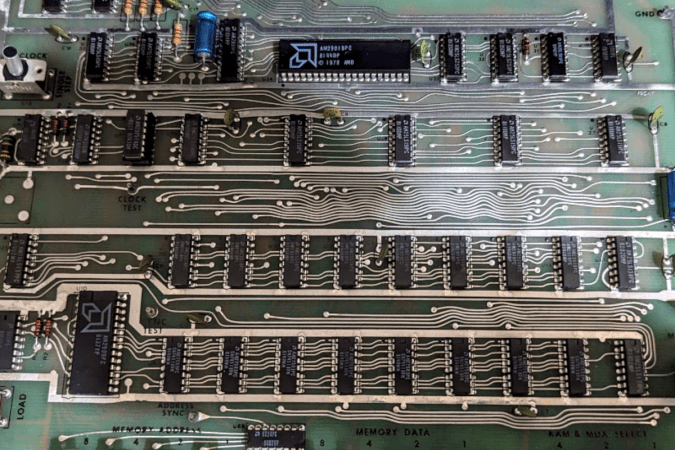
Have you ever tried to eat one jelly bean or one potato chip? It is nearly impossible. Some of us have the same problem with hardware projects. It all started when I wrote about the old bitslice chips people used to build computers before you could easily get a whole CPU on a chip. Bitslice is basically Lego blocks that build CPUs. I have always wanted to play with technology, so when I wrote that piece, I looked on eBay to see if I could find any leftovers from this 1970-era tech. It turns out that the chips are easy to find, but I found something even better. A mint condition AM2900 evaluation board. These aren’t easy to find, so the chances that you can try one out yourself are pretty low. But I’m going to fix that, virtually speaking.

This was just the second potato chip. Programming the board, as you can see in the video below, is tedious, with lots of binary switch-flipping. To simplify things, I took another potato chip — a Google Sheet that generates the binary from a quasi-assembly language. That should have been enough, but I had to take another chip from the bag. I extended the spreadsheet to actually emulate the system. It is a terrible hack, and Google Sheets’ performance for this sort of thing could be better. But it works.

Continue reading “A Slice Of Simulation, Google Sheets Style”