IRC Client On Bare Metal

In the beginning, there was the BIOS, and it was good. A PC’s BIOS knows how to set up the different hardware devices, grab a fixed part of a hard drive, load it, and run it. That’s all you need. While it might be all you need, it isn’t everything people want, so a consortium developed UEFI, which can do all the things a normal BIOS can’t. Among other things, UEFI can load code for the operating system over the network instead of from the hard drive.

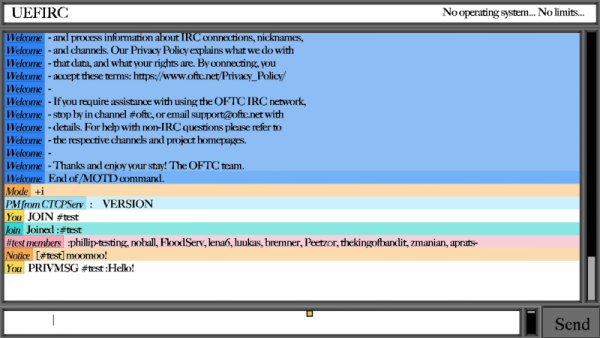
In true hacker fashion, [Phillip Tennen] thought, “Does it have to be an operating system?” The answer, of course, is no. It could be an IRC client. He chose Rust to implement everything. While UEFI does provide a network stack, it isn’t very easy to use, apparently. It also provides support for a mouse. [Phillip] ported his GUI toolkit library over, and then the rest is just building an IRC client.

The client isn’t the easiest to use because, after all, this is a lark. Why would you want to do this? On the other hand, we can think of reasons we might want to take control of a UEFI motherboard and use it for something. If you want to do that, this project is a great template to jump-start your endeavors.

We’ve looked at the UEFI system a few times. Or, you can use it to play DOOM.
Continue reading “IRC Client On Bare Metal”

Linear Feedback Shift Registers For FPGAs

If you want to start an argument at a Hackaday meeting, you have only to ask something like “How much does this weigh?” or “What time is it?” But if you really want to start a street brawl, you can always say, “Are these numbers random?” Making random numbers that are actually random is actually a tough nut to crack. Most of what we do is, technically, pseudo-random (but we’ll say random number and assume you know what we mean). One way to generate seemingly random sequences is to use a linear feedback shift register or LFSR. You can use LFSRs in software, but they are also very useful in hardware design and [Adam Taylor] takes us through his use of them on FPGAs in a recent post. Continue reading “Linear Feedback Shift Registers For FPGAs”

ColecoVision Cart Rises From Ashes

We felt bad for [Mark] of Mark Fixes Stuff. Apparently, his house burned down and took virtually everything, including his retrocomputer collection. He did manage to pull out a few things from the remains including a ColecoVision cartridge that was — honestly — melted. We probably would have written it off, but [Mark] was determined to recover something.

He was fortunate that the PCB was not burned, but it was covered in soot and possibly other things. However, the case looked like a chocolate bar left on a dashboard for a few summer days in the tropics.

Continue reading “ColecoVision Cart Rises From Ashes”

3D Printer Hot Off The Griddle

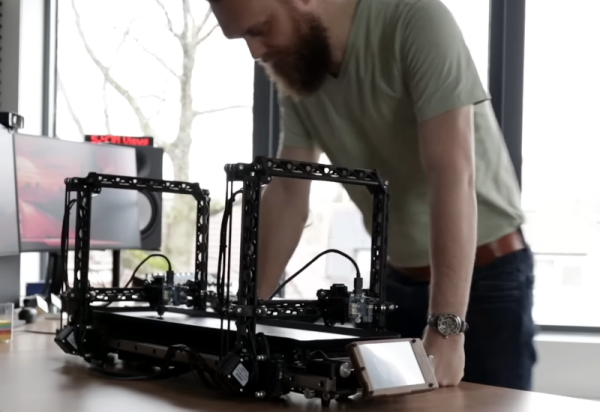
If you look at [Proper Printing’s] latest video — see below — you’ll immediately get the idea behind his latest printer. There are two heads on two separate gantries, which, of course, opens up many possibilities. But when you think you’ve seen enough, you find out the heated bed is a kitchen griddle, and… well, for us, we had to keep watching.

The heated bed idea was interesting, although the flatness left something to be desired. While it is a simple idea, getting the two gantries to move reliably across the hotbed griddle took a lot of parts and a careful design. We wonder how evenly the griddle heats — ours definitely has hot spots when we cook with it.

Continue reading “3D Printer Hot Off The Griddle”

Fictional Computers: The Three Body Problem

If you intend to see the Netflix series “The Three Body Problem” or you want to read the Hugo-winning story from Chinese author [Cixin Liu], then you should probably bookmark this post and stop reading immediately. There will be some mild spoilers. You have been warned.

While the show does have some moments that will make your science brain cringe, there is one scene that shows a computer that could actually be built. Would it be practical? Probably not in real life, but in the context provided by the show, it was perfectly feasible. It could have, however, been done a little better, but the idea was — like many great ideas — both deceptively simple and amazingly profound. The computer was made of human beings. I’m not talking like Dune’s mentats — humans with super brains augmented by drugs or technology. This is something very different.

Background

This is your last chance. There are spoilers ahead, although I’ll try to leave out as much as I can. In the story, top scientists receive a mysterious headset that allows them to experience totally immersive holodeck-style virtual reality. When they put the headset on, they are in what appears to be a game. The game puts you in a historical location — the court of Henry VIII or Ghengis Kahn. However, this Earth has three suns. The planet is sometimes in a nicely habitable zone and sometimes is not. The periods when the planet is uninhabitable might have everything bursting into flames or freezing, or there might not be sufficient gravity to hold them on the planet’s surface. (Although I’ll admit, I found that one hard to grasp.)

Apparently, the inhabitants of this quasi-Earth can hibernate through the “chaotic eras” and wait for the next “stable era” that lasts a long time. The problem, as you probably know, is that there is no general closed-form solution for the three-body problem. Of course, there are approximations and special cases, but it isn’t easy to make long-term predictions about the state of three bodies, even with modern computers.

Continue reading “Fictional Computers: The Three Body Problem”

3D Navigator For Blender

If you work with high-end CAD workstations, you may have encountered a SpaceMouse or similar devices. Sort of a mouse with an extra dimension, they aren’t cheap. So [meisterodin1981] decided to build a do-it-yourself version for use with Blender. You can check it out in the video below.

The device uses an MPU6050 accelerometer and a spring. It also has some buttons for special features. The device uses a Teensy 2, although any controller that can provide an HID device could probably do the job. Of course, a nice 3D printed case is part of the design. A printed pair of plates holds a 3D printer bed spring to provide the device’s Z-axis movement. The wires to the encoder are routed through the center of the spring, so neatness counts.

We’ve seen other 3D mice like the Orbion. Your other option is to pick up the old-fashioned serial port versions and convert them. Until you can do your designs in virtual reality, these mice are just the ticket.

Continue reading “3D Navigator For Blender”

Retrotechtacular: The IBM 7070

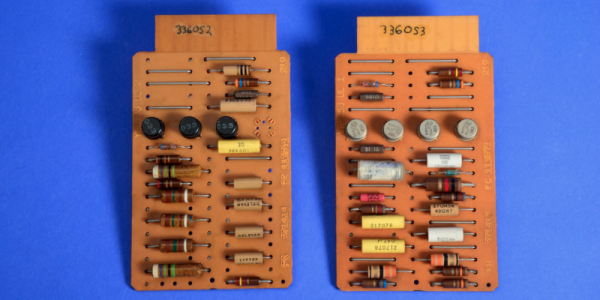
If you think of IBM mainframe computers, you most likely are thinking of the iconic S/360 or the slightly newer S/370. But what about the 7070 from 1958? It had transistors! It didn’t, however, use binary. Instead, it was a decimal-architecture machine. You can see a lost video of the machine below.

It was originally slated to upgrade the older IBM 650 and 705 computers. However, it wasn’t compatible with either, so IBM had to roll out the IBM7080, which was compatible, at least, with the 705. Both machines could run 650 code via emulation.

Continue reading “Retrotechtacular: The IBM 7070”