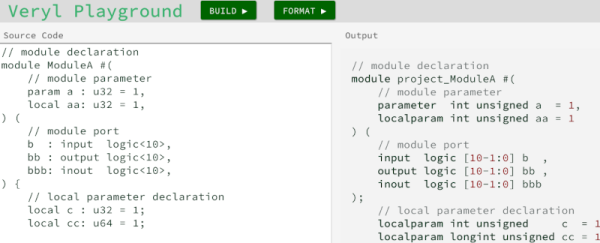
When you think about hardware description languages, you probably think of Verilog or VHDL. There are others, of course, but those are the two elephants in the room. Do we need another one? [Veryl-lang] thinks so. The Veryl language is sort of Verilog meets Rust. What makes Veryl interesting is that it transpiles to normal SystemVerilog, so it will — probably — work with your existing tool chains.
That means you can define your logic Veryl, have it output SystemVerilog, and then use that Verilog in your vendor’s (or an open source) Verilog tool. The output is supposed to be human-readable Verilog, too, so you don’t have to transport opaque blocks of gibberish.
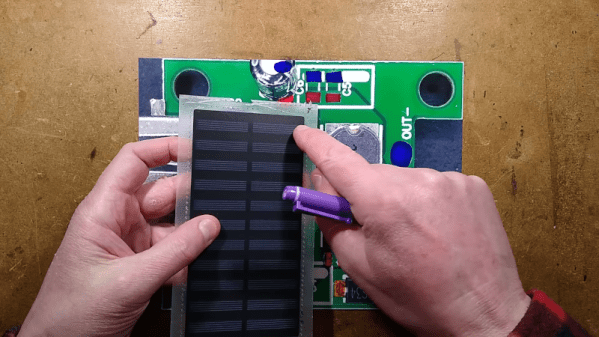
If you hang out on certain kinds of sites, you can find huge-capacity USB drives and high-power yet tiny solar panels, all at shockingly low prices. Of course, the USB drives just think they are huge, and the solar panels don’t deliver the kind of power they claim. That seems to be the case with [Big Clive’s] latest folding solar panel purchase. The nice thing about the Internet is you can satisfy your urge to tear things open to see what’s inside of them vicariously instead of having to buy a lot of junk yourself. Thanks [Clive]!
The picture on the website didn’t match the actual product, which was the first sign, of course. The panel’s output in full sun was around 2.5 watts instead of the claimed 10 watts. He’s also seen sellers claim they are between 20 and 80-watt panels. But the interesting bits are when [Clive] decides to rip the panel into pieces and analyze the controller board.
Today, if you want to send a message to a distant location, you’ll probably send an e-mail or a text message. But it hasn’t always been that easy. Military commanders, in particular, have always needed ways to send messages and were early adopters of radio and, prior to that, schemes like semaphores, drums, horns, Aldis lamps, and even barrels of water to communicate over distances.
One of the most reliable ways to pass messages, even during the last world war, was by carrier pigeon. Since the U.S. Army Signal Corps handled anything that included messages, it makes sense that the War Department issued TM 11-410 about how to use and care for pigeons. Think of it as the network operations guide of 1945. The practice, though, is much older. There is evidence that the Persians used pigeons in the 6th century BC, and Julius Caesar’s army also used the system.
You wouldn’t imagine that drawing an assignment in the Signal Corps might involve learning about breeding pigeons, training them, and providing them with medical attention, but that’s what some Signal Corps personnel did. The Army started experimenting with pigeons in 1878, but the Navy was the main user of the birds until World War I, when the U.S. Pigeon Intelligence Service was formed. In World War II, they saw use in situations where radio silence was important, like the D-Day invasion.
The Navy also disbanded its earlier Pigeon Messenger Service. It then returned to avian communications during the World Wars, using them to allow aviators to send messages back to base without radio traffic. The Navy had its own version of the pigeon manual.
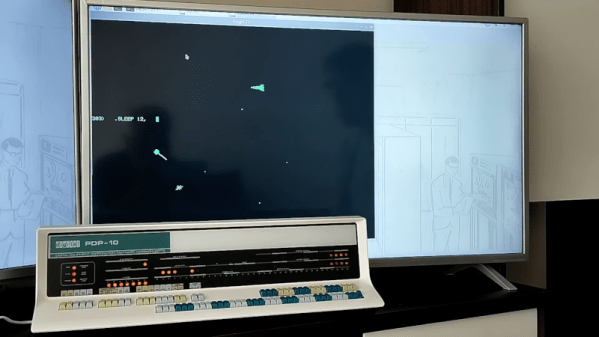
[Oscar] at Obsolescence Guaranteed is well-known for fun replicas of the PDP-8 and PDP-11 using the Raspberry Pi (along with some other simulated vintage computers). His latest attempt is the PDP-10, and you can see how it looks in the demo video below.
Watching the video will remind you of every old movie or TV show you’ve ever seen with a computer, complete with typing noise. The PDP-10, also known as a DECsystem-10, was a mainframe computer that usually ran TOPS-10. These were technically “mainframes” in 1966, although the VAX eclipsed the system. By 1983 (the end of the PDP-10’s run), around 1,500 had been sold, including ones that ran at Harvard, Stanford, Carnegie Mellon, and — of course — MIT. They also found homes at CompuServe and Tymshare.
The original 36-bit machine used transistors and was relatively slow. By the 1970s, newer variants used ICs or ECL and gained some speed. A cheap version using the AM2901 bit-slice CPU and a familiar 8080 controlling the system showed up in 1978 and billed itself as “the world’s lowest cost mainframe.”
The Knight terminals were very unusual for the day. They each used a PDP-11 and had impressive graphics capability compared to similar devices from the early 1970s. You can see some of that in the demo video.
Naturally, anyone who used a PDP-10 would think a Raspberry Pi was a supercomputer, and they wouldn’t be wrong. Still, these machines were the launching pad for Adventure, Zork, and Altair Basic, which spawned Microsoft.
The cheap version of these used bitslice which we’ve been talking about lately. [Oscar] is also known for the KIMUno, which we converted into a COSMAC Elf.
Imagine an electronics lab. If you grew up in the age of tubes, you might envision a room full of heavy large equipment. Even if you grew up in the latter part of the last century, your idea might be a fairly large workbench with giant boxes full of blinking lights. These days, you can do everything in one little box connected to a PC. Somehow, though, it doesn’t quite feel right. Besides, you might be using your computer for something else.
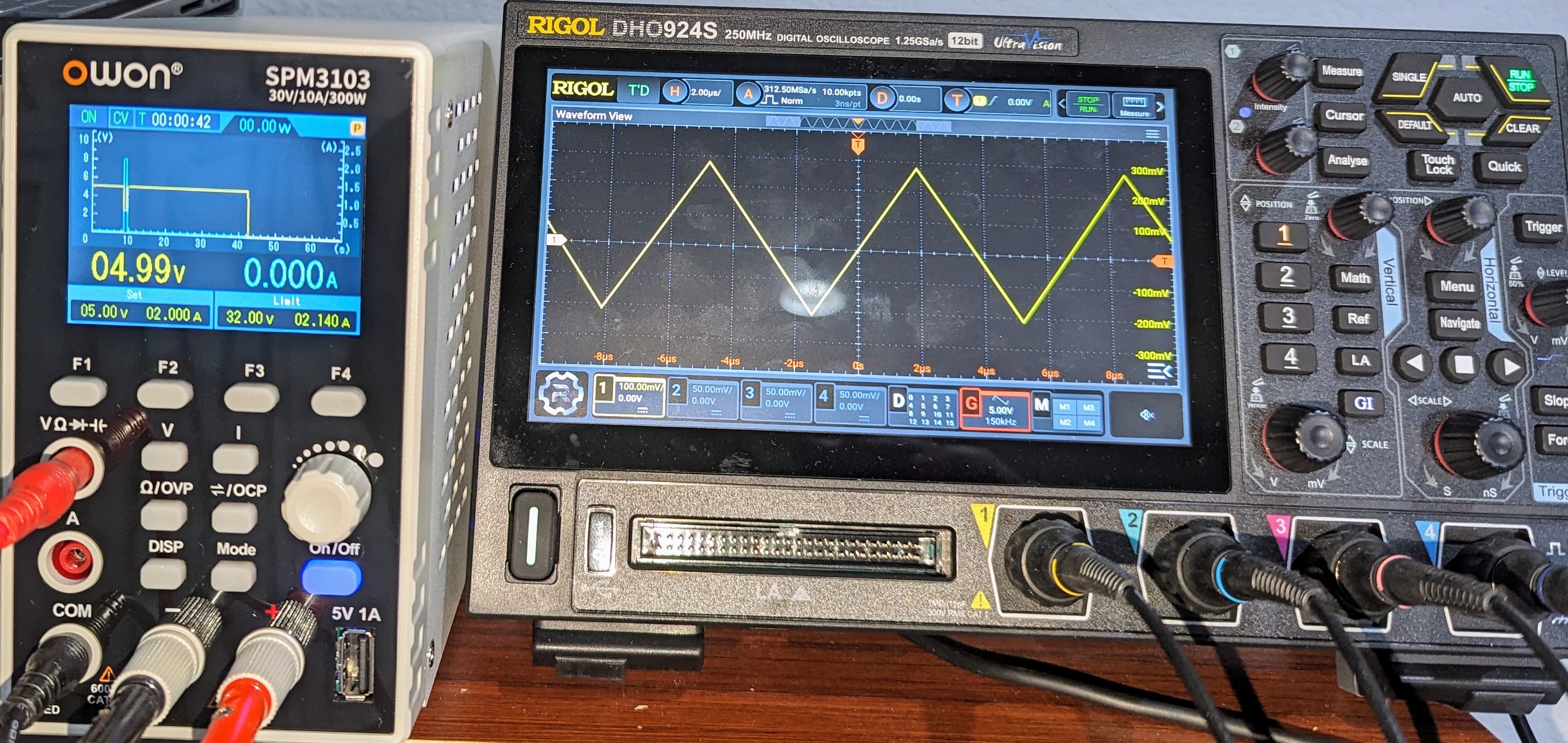
I’m fortunate in that I have a good-sized workspace in a separate building. My main bench has an oscilloscope, several power supplies, a function generator, a bench meter, and at least two counters. But I also have an office in the house, and sometimes I just want to do something there, but I don’t have a lot of space. I finally found a very workable solution that fits on a credenza and takes just around 14 inches of linear space.
How?
How can I pack the whole thing in 14 inches? The trick is to use only two boxes, but they need to be devices that can do a lot. The latest generation of oscilloscopes are quite small. My scope of choice is a Rigol DHO900, although there are other similar-sized scopes out there.
If you’ve only seen these in pictures, it is hard to realize how much smaller they are than the usual scopes. They should put a banana in the pictures for scale. The scope is about 10.5″ wide (265 mm and change). It is also razor thin: 3″ or 77 mm. For comparison, that’s about an inch and a half narrower and nearly half the width of a DS1052E, which has a smaller screen and only two channels.
A lot of test gear in a short run.
If you get the scope tricked out, you’ve just crammed a bunch of features into that small space. Of course, you have a scope and a spectrum analyzer. You can use the thing as a voltmeter, but it isn’t the primary meter on the bench. If you spend a few extra dollars, you can also get a function generator and logic analyzer built-in. Tip: the scope doesn’t come with the logic analyzer probes, and they are pricey. However, you can find clones of them in the usual places that are very inexpensive and work fine.
There are plenty of reviews of this and similar scopes around, so I won’t talk anymore about it. The biggest problem is where to park all the probes. Continue reading “The Short Workbench”→
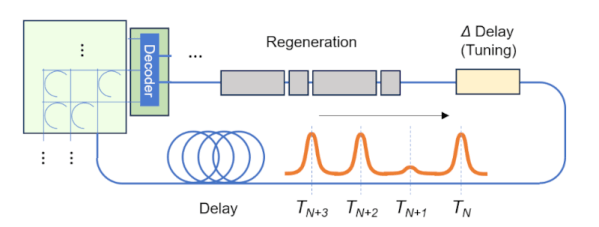
We always hear that future computers will use optical technology. But what will that look like for a general-purpose computer? German researchers explain it in a recent scientific paper. Although the DOC-II used optical processing, it did use some conventional electronics. The question is, how can you construct a general computer that uses only optical technology?
The paper outlines “Miller’s criteria” for practical optical logic gates. In particular, any optical scheme must provide outputs suitable for introduction to another gate’s inputs and also support fan out of one output to multiple inputs. It is also desirable that each stage does not propagate signal degradation and isolate its outputs from its inputs. The final two criteria note that practical systems don’t depend on loss for information representation since this isn’t reliable across paths, and, similarly, the gates should require high-precision adjustment to work correctly.
The paper also identifies many misconceptions about new computing devices. For example, they assert that while general-purpose desktop-class CPUs today contain billions of devices, use a minimum of 32-bits of data path, and contain RAM, this isn’t necessarily true for CPUs that use different technology. If that seems hard to believe, they make their case throughout the paper. We can’t remember the last scientific paper we read that literally posed the question, “Will it run Doom?” But this paper does actually propose this as a canonical question.
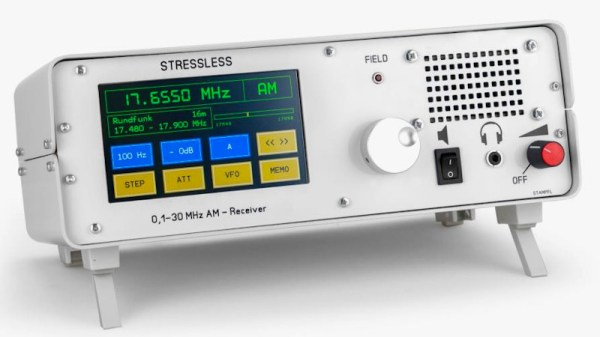
[Dan Robinson] picked up a shortwave receiver known as the “stressless” receiver kit. We aren’t sure if the stress is from building a more complicated kit or operating a more complicated receiver. Either way, it is an attractive kit that looks easy to build.
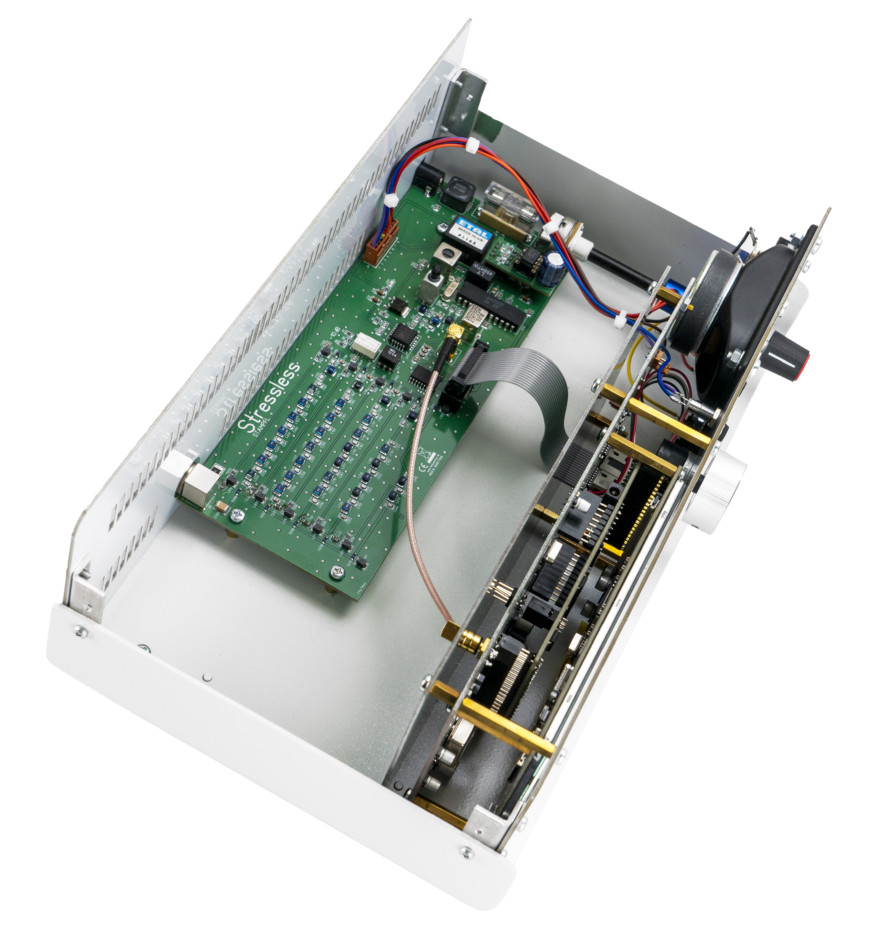
Presumably to reduce stress, the VFO and receiver boards are already built, so assembly is just a few hours connecting large components and boards. As kits go, this is a fairly simple one. We were surprised to read that the supplier says you can’t upgrade the firmware. We, of course, wonder if that’s true.
For technical specs, the receiver is AM only and can operate from 100 kHz to 30 MHz. It uses a double conversion with intermediate frequencies of 21.4 MHz and 455 kHz. There’s a BNC connector on the back, and the radio requires 11 to 15V on the input. Apparently, the frequency generator inside is an SI5351. The sensitivity and selectivity numbers look very good for an AM radio.
We were surprised to see the radio didn’t have provisions for SSB since AM-only makes it not as useful for hams or others interested in non-broadcast transmissions. If we are doing our conversions correctly, the kit is fairly pricey, too, especially considering that it is AM only.
Still, we like that you could easily assemble a nice-looking radio kit. We were interested in hearing it perform, and [Dan’s] video lets us virtually try it out without the effort. We’ve seen the SI5351 on a carrier if you want to roll your own. Come to think of it, we’ve seen several.