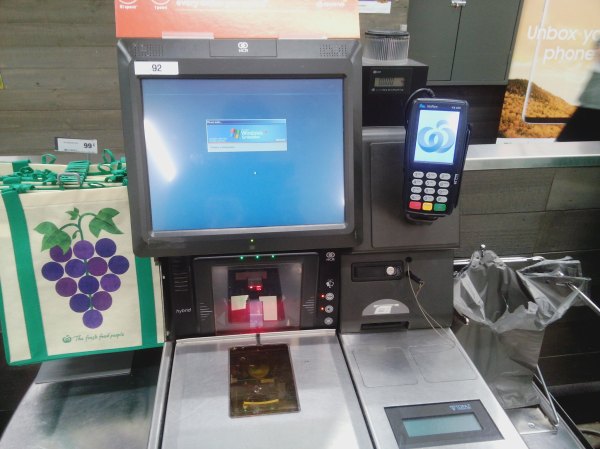
Ask Hackaday: Why Are Self-Checkouts Failing?

Most people who read Hackaday have positive feelings about automation. (Notice we said most.) How many times have you been behind someone in a grocery store line waiting for them to find a coupon, or a cashier who can’t make change without reading the screen and thought: “There has to be a better way.” The last few years have seen that better way, but now, companies are deciding the grass isn’t greener after all. The BBC reports that self-checkouts have been a “spectacular failure.” That led us to wonder why that should be true.

As a concept, everyone loves it. Stores can hire fewer cashiers. Customers, generally, like having every line open and having a speedy exit from the store. The problem is, it hasn’t really panned out that way. Self-checkout stations frequently need maintenance, often because it can’t figure out that you put something in the bag. Even when they work flawlessly, a customer might have an issue or not understand what to do. Maybe you’ve scanned something twice and need one of them backed off. Then, there are the age-restricted products that require verification. So now you have to hire a crew of not-cashiers to work at the automated not-register. Sure, you can have one person cover many registers, but when one machine is out of change, another won’t print a receipt, and two people are waiting for you to verify their beer purchase, you are back to waiting. Next thing you know, there’s a line.

Continue reading “Ask Hackaday: Why Are Self-Checkouts Failing?”
Remembering ISDN

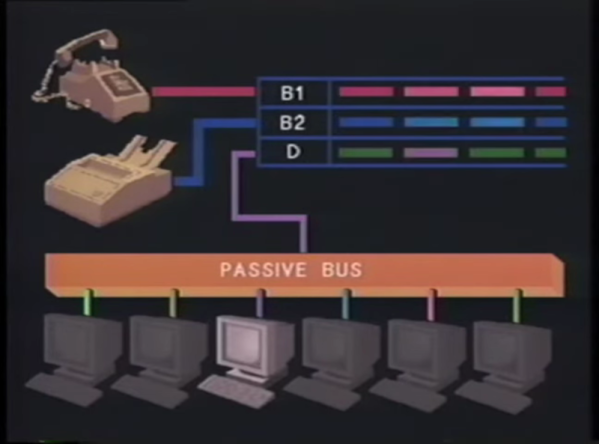
We are definitely spoiled these days in terms of Internet access. In much of the world gigabit speeds are common and even cheap plans are likely to be measured in 100s of megabits. But there was a time not long ago when a fast modem received at 56 kilobits per second. If you couldn’t justify a dedicated T1 line and you had a lot of money, you might have thought about ISDN – the Integrated Services Digital Network. [Tedium] has a great retrospective now that the UK has decided to sunset ISDN in 2025. ISDN started in the UK in the mid-1980s.

ISDN offered two 64-kilobit channels that could be bonded to reach 128 kilobits. There was also a slower third channel for commands and signaling (although you could use it for data, too, using an X.25-like protocol). If you wanted phone service, your voice was on one 64K channel and the data on the other. No need to tie up your phone just to get online. Voice was digitized at 8 kHz with 8 bits of G.711 encoding.

Continue reading “Remembering ISDN”

How To Operate A 500KW Transmitter

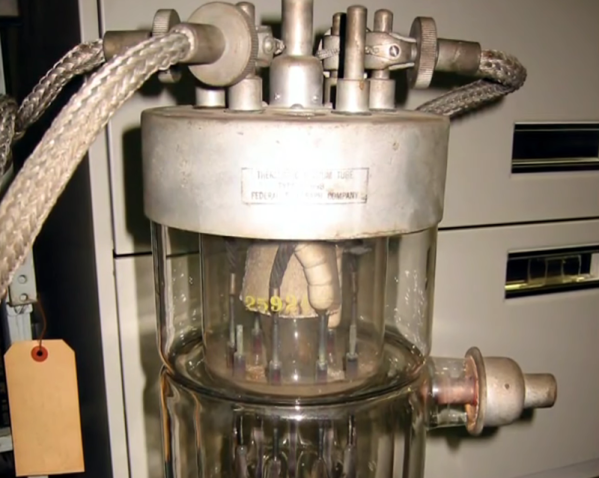
Crosley was a famous name in radio for more than one reason. The National VOA Museum of Broadcasting has a video telling [Powel Crosley Jr.’s] story, and the story behind the 500 kW WLW transmitter. WLW was an AM broadcast station often called the nation’s channel since its signal covered most of the United States. The first Crosley station was identified at 8CR, running 20 watts from [Crosley’s] living room. Quite a modest start!  By 1922, he had moved to his family business location along with 500 watts of output. Over the years, WLW got more powerful until it was finally a 500 kW giant.

Continue reading “How To Operate A 500KW Transmitter”

Wiring Harness? That’s A Wrap!

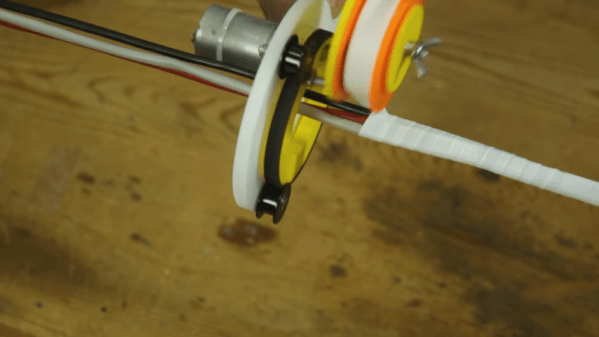
[Mr Innovative] likes to keep his wire harnesses tidy, but it is a pain to neatly wrap cables. So, he automated the process using a combination of milled acrylic and 3D printing. We hope the design files will be up on his website soon, although the mechanism is similar to another wrapping machine he made a few years ago. However, it can still be a source of inspiration if you want to do a unique take on it.

To use the machine, you feed the wires through the center hole and mount tape on the spool. A motor spins the spool and you only need to slowly advance the tool to get a nice close wrap. Naturally, you can wrap tape around wires by hand, so this is a bit of a luxury item. However, we could see modifying it to move the cable through at a constant rate with another motor, which might do a better job than you can do by hand.

We couldn’t help but wonder if you could start with a ping pong paddle instead of cutting the frame out of acrylic.

Continue reading “Wiring Harness? That’s A Wrap!”

In Praise Of Old Meters

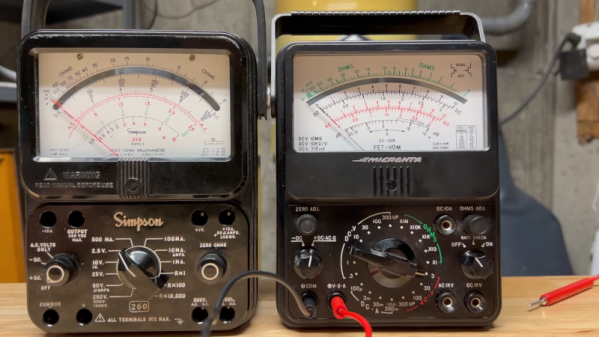
We are spoiled with multimeters today. Even the cheapest meter you will get these days is almost surely digital with a tremendous input impedance. But a few decades ago, meters were almost always analog affairs. To make a precise measurement, you needed a mirror under the meter to ensure you read the needle correctly. Moreover, a common meter wouldn’t have that high of an input impedance. If you spent more, you could get a VTVM and, later, one that used FETs to provide high input impedance. [Peter AA2VG] just picked up a vintage Micronta FET volt-ohm meter to join some of the other new and old meters in his shack. You can check it out in the video below.

[Peter] already has a Simpson and a more modern Fluke meter. The Simpson, however, doesn’t have a tube or FET amplifier. The Fluke is nice, but there is something about the needle on an analog meter. If you aren’t old enough to remember, the Micronta brand was a Radio Shack label.

Continue reading “In Praise Of Old Meters”

Linux Fu: Name That Tune

If you aren’t old enough to remember, the title of this post refers to an old game show where contestants would try to name a tune using the fewest possible notes. What can we say? Entertainment options were sparse before the Internet. However, using audio fingerprinting, computers are very good at pulling this off. The real problem is having a substantial library of fingerprints to compare with. You can probably already do this with your phone, and now you can do it with your Linux computer.

In all fairness, your computer isn’t doing the actual work. In fact, SongRec — the program in question — is just a client for Shazam, a service that can identify many songs. While this is mildly interesting if you use a Linux desktop, we could also see using the same technique with a Raspberry Pi to get some interesting projects. For example, imagine identifying a song playing and adjusting mood lighting to match. A robot that could display song information could be the hit of a nerdy party.

Continue reading “Linux Fu: Name That Tune”

19th Century Copy Machine: The Cyclostyle

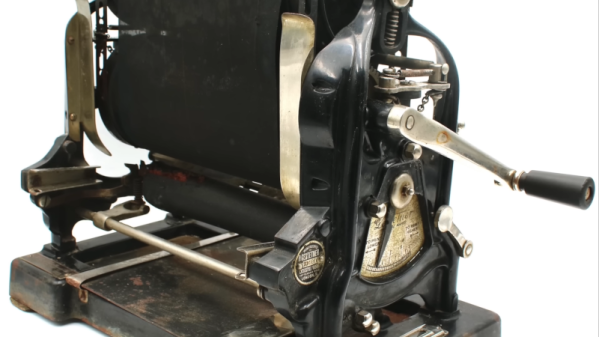
In the 2020s photocopiers are getting a bit exotic, although they are not gone yet. But these days, you are more likely to simply print multiple copies of a document. However, it wasn’t long ago that making a copy of a document was a tall order. Carbon paper was fine if you were typing and only needed a few copies. But in the late 1800s to early 1900s, several solutions were available, including a beautiful early mimeograph known as the Cyclostyle at [Our Own Devices], examined in the video below.

The Cyclostyle was possibly inspired by a hectograph (something we looked at before). The Cyclostyle was originally a special stylus used to remove wax from a paper stencil. Then, a process similar to screen printing would make copies for you.

Continue reading “19th Century Copy Machine: The Cyclostyle”