Calculation Before We Went Digital

We have to like [Nicola Marras]. First, he wrote a great mini-book about analog computers. Then he translated it into English. Finally, he opened with a picture of Mr. Spock using an E6-B flight slide rule. What’s not to like? We suggest you settle in when you want to read it — there are almost 60 pages of text, photos, and old ads for things like slide rules and adding machines.

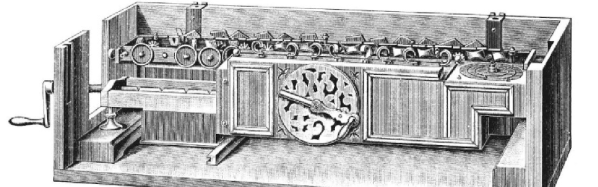
There is a lot of research here. We couldn’t think of anything missed. There’s a Pascalina, Ishango’s bone, a Babylonian spreadsheet, an abacus, and even Quipu. Toward the end, he gets to nomographs, adding machines, and the early calculators.
Continue reading “Calculation Before We Went Digital”

Roll Your Own SDR

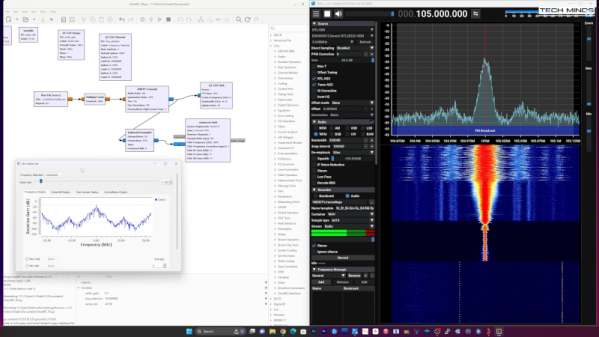
If you have software-defined radio hardware and you are only using someone elses’ software, you are missing out on half of the fun. [Tech Minds] shows you how easy it can be to roll your own software using GNU Radio Companion in a recent video.

GNU Radio usually uses Python, but with the companion software you rarely need to know any actual Python. Instead, you simply drag blocks around to represent filters, DSP processing, and other functions you need to create the processing for your application.

Continue reading “Roll Your Own SDR”

Hubless E-Bike Is Nostalgic

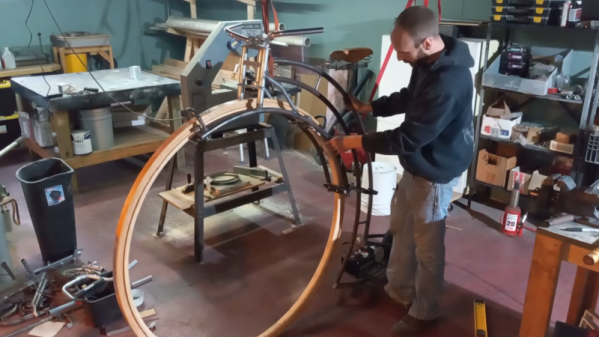
[Chris Makes Stuff] is an aptly named channel. His recent video shows how he took a kid’s electric motorcycle toy and built a “penny farthing” bicycle. You might not know the bike by that name, but when you see it in the video below, you’ll recognize it. These Victorian-era bikes used a single large wheel before chain drives on a bike became a thing.

Of course, the big part of this — literally and figuratively — is the giant front wheel. There’s a second video showing how it was built in layers using wood.

Continue reading “Hubless E-Bike Is Nostalgic”

Forget The Altair! Remember The Mark-8!

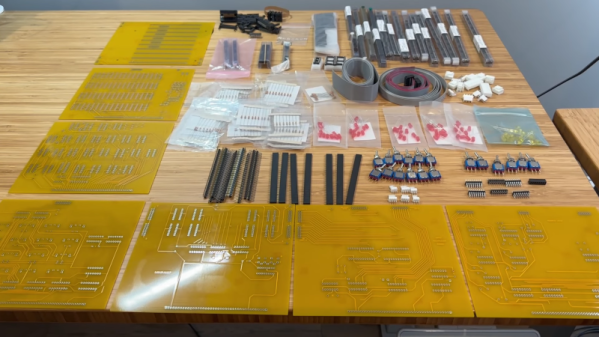
Calling any one computer the first hobby computer is fraught with peril. Most people think the MITS Altair 8800, first featured in Popular Electronics back in January 1975, was the first. Some might argue that others were first, but there is no doubt that the Altair started the hobby computer revolution from a practical standpoint. However, there was another computer that almost took the crown. It, too, appeared in a magazine — Radio and Electronics. But it was in the July 1974 issue. That computer was the Mark 8, and [Artem Kalinchuk] is building a replica that you can see started in the video below. This isn’t some Arduino work-alike. He has a pile of parts and some almost authentic-looking PCBs.

The Mark 8 used the 8008, not the 8080, so it was less powerful. [Artem] has been building a replica Altair, too. Check out his YouTube channel if you are interested in those.

Continue reading “Forget The Altair! Remember The Mark-8!”

Inside Electronic Gain Control

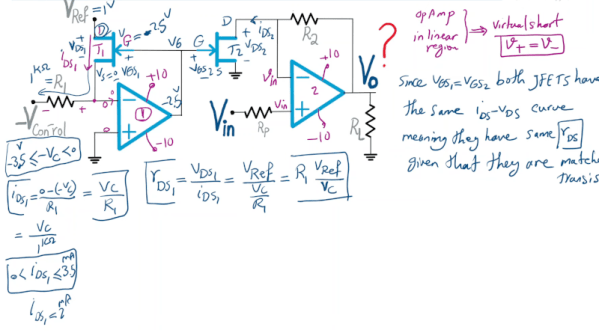
Normally, if you want to control the gain of an amplifier, you’ll use a variable resistor. You know, like a volume control. But what if you want to control the amplifier’s gain with a voltage? [Engineering Prof] explains a circuit that can do this using a pair of op amps and a pair of matched JFETs.

The analysis is simple because you assume the op amps are not in saturation, so you can assume that the op amp will do what it needs to do to make the input terminals equal. The left-hand op amp has one input grounded, so the output will drive the first FET  to ensure the negative terminal is also 0V. It is easy to see that the current through R1 must then be the current through the FET, which is going to be the control voltage (which is negative) divided by R1.

Continue reading “Inside Electronic Gain Control”

Repairing An HP Power Supply

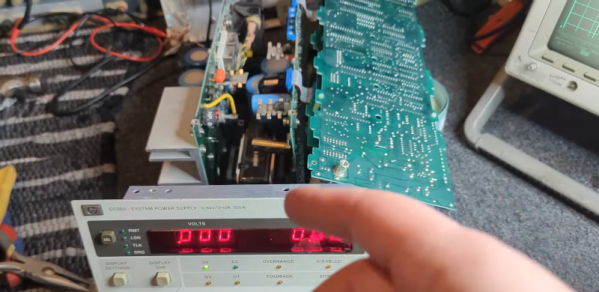
One of the interesting things about living in modern times is that a confluence of the Internet and rapid changes in the electronics industry means that test gear that used to be astronomically priced is now super affordable. Especially if, like [Frankie Mashockie], you can do a little repair work. He picked up an HP6038A power supply for $50. We couldn’t find the original list price, but even refurbs from “professional” sources go for around $800. However, the $50 price came with a “for parts” disclaimer.

The power supply is autoranging. You usually think of that as a feature of meters. In a power supply, autoranging means the device can adjust the voltage based on load as you can see explained in the video below.

Continue reading “Repairing An HP Power Supply”

Quick Negative Voltage For An Op Amp

It is a classic problem when designing with op amps: you need the output to go to zero, but — for most op amps — you can’t quite get down to the supply rail. If your power options are a positive voltage and ground, you can’t get down to zero without a special kind of op amp which might not meet your needs. The best thing to do is provide a negative supply to the chip. Don’t have one? [Peter Demchenko] can help. He uses a simple two-transistor multivibrator along with some diodes and capacitors to generate a minimal negative voltage for this purpose.

The circuit is simple and only produces a small negative voltage. He mentions that into a 910 ohm load, he sees about -0.3V. Not much, but enough to get that op amp down to zero with a reasonable load. Unlike other circuits he’s used in the past, this one is efficient. With a 5-volt input, it draws less than 1.5 mA.

Continue reading “Quick Negative Voltage For An Op Amp”