Farewell American Computer Magazines

I grew up in a small town with a small library. The next town over had what I thought at the time was a big library, but it was actually more like my town had a tiny library, and the next one over had an actual small library. When I left to go to University, I found out what a real library looked like, and I was mesmerized. Books! Lots of books, many of them written in the current decade. My grades probably suffered from the amount of time I spent in the library reading things that didn’t directly relate to my classes. But there was one thing I found that would turn out to be life-changing: A real computer magazine. Last month, Harry McCracken pointed out that the last two widely-distributed American consumer computer magazines ceased paper publication. It is the end of an era, although honestly, it is more like a comatose patient expiring than a shocking and sudden demise.
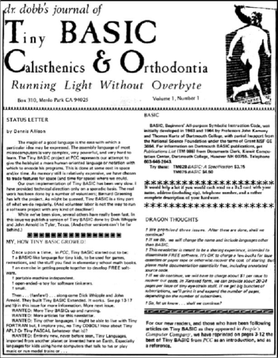
Dr. Dobb’s first issue was far from the slick commercial magazine it would become.

Actually, before I had gone to college, I did have a subscription to Kilobaud, and I still have some copies of those. No offense to Wayne Green, but Kilobaud wasn’t that inspiring. It was more an extension of his magazine “73”, and while I enjoyed it, it didn’t get me dreaming. Dr. Dobb’s Journal — the magazine I found in the stacks of my University’s library — was tangibly different. There was an undertone of changing the world. We weren’t sure why yet, but we knew that soon, everyone would have a computer. Maybe they’d balance their checkbook or store recipes. A few people already saw the potential of digital music reproduction, although, I must admit, it was so poor at the time, I couldn’t imagine who would ever care.

I say it was life-changing to discover the few issues of Dr. Dobb’s that were published back then because I would go on to contribute to Dr. Dobb’s throughout its storied history. I wrote the infamous DOS extender series, produced special issues, and, when it went mostly digital, was the embedded system blogger for them for more years than I care to admit. In fact, I have the dubious distinction of having the final blog posted; although the website has suffered enough bit rot, I’m not sure any of it has survived other than, maybe, on the Wayback machine. While I wasn’t with the magazine for its entire 38-year run, I read it for at least 35 and had some function there for about 24 of those.
Continue reading “Farewell American Computer Magazines”

Your Engineering Pad In Browser

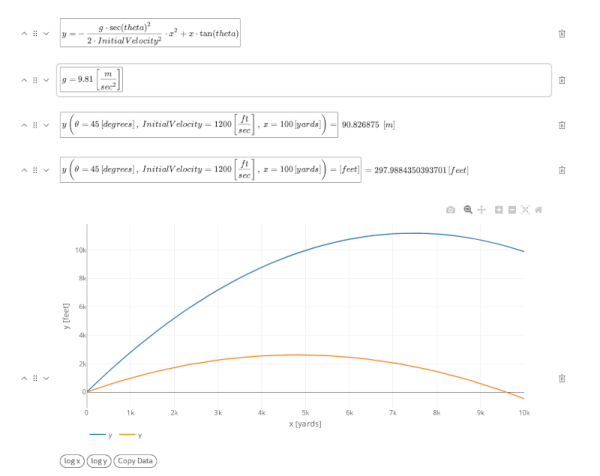
It was always easy to spot engineering students in college. They had slide rules on their belts (later, calculators) and wrote everything on engineering pads. These were usually a light brown or green and had a light grid on one side, ready to let you sketch a diagram or a math function. These days, you tend to sketch math functions on the computer and there are plenty of people willing to take your money for the software. But if you fire up your browser, head over to EngineeringPaper.xyz and you might save a little cash.

Although it looks a lot like a Jupyter notebook, the math cells in EngineeringPaper keeps track of units for you and allows you to query results easily. Want to read more? Luckily, there is an EngineeringPaper worksheet that explains how to use it. If you prefer your explanations in video form, check out their channel, including the video that appears below.

Continue reading “Your Engineering Pad In Browser”

All Your Robots Are Belong To Us: You Just Rent Them

Monthly bills. Everyone has them. Except if you go far enough back, not everyone had them. After all, you might live in a home your family has owned for generations. You might be able to produce all the basic necessities using your homestead: food from a garden, water from a well, textiles, soap, and candles. You might have to buy the occasional animal, but your recurring bills could be modest outside of the ever-present tax burden.

But as people moved to cities, they had to pay rent. Buy gas or coal and, eventually, electricity. Water and trash collection are pretty essential, too. But at some point, everyone realized that being in a position to bill you monthly is a good idea. Now we pay for the internet, movie subscriptions, meal plans, alarm monitoring, shopping clubs, cell phones, spa memberships. Soon we might be paying a monthly fee for our robots, too.

Rent To (Not) Own

In industry, this is a common occurrence. You often don’t buy a robot arm or similar device. That, after all, is a capital expense, and most tax codes require you to count it as an asset that slowly depreciates. Instead, you hire a robot from a service provider. Not only does that make it a pure expense, but the provider worries about software, repairs, and all that.

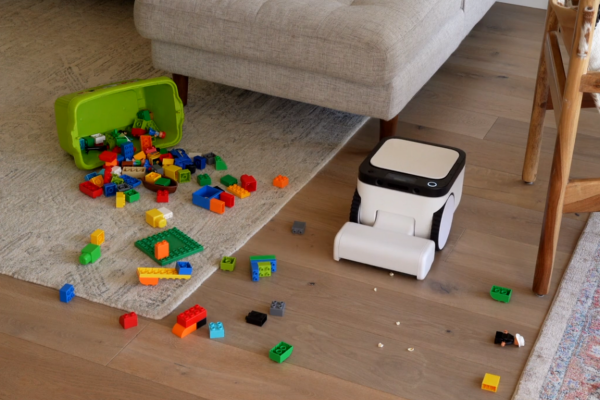
But at home, it is different. There’s no tax advantage in most places between owning a car and leasing it. Yet vendors want to adopt a rent-a-robot strategy. Case in point: a startup named Matician wants you to sign up for a robotic vacuum. For $125 a month, you get a super smart robot vacuum. You could, of course, buy a Roomba, but — according to Matician — the Matic robot uses computer vision to map your house and automatically finds messes. You can also voice command it to clean up areas. It also avoids wire and furniture. They didn’t mention if it can avoid presents left by your pets or not. It will avoid pets and kids, though.

Continue reading “All Your Robots Are Belong To Us: You Just Rent Them”

Electronic Connect 4 Console Doesn’t Use LCD

You might think that making your own electronic games would require some kind of LCD, but lately, [Mirko Pavleski] has been making his using inexpensive 8X8 WS2812B LED panels. This lets even a modest microcontroller easily control a 64-pixel “screen.” In this case, [Mirko] uses an Arduino Nano, 3 switches, and a buzzer along with some 3D printed components to make a good-looking game. You can see it in action in the video below.

The WS2812B panels are easy to use since the devices have a simple protocol where you only talk to the first LED. You send pulses to determine each LED’s color. The first LED changes color and then starts repeating what you send to the next LED, which, of course, does the same thing. When you pause a bit, the array decides you are done, and the next train of pulses will start back at the first LED.

It looks like the project is based on a German project from [Bernd Albrecht], but our German isn’t up to snuff, and machine translation always leaves something to be desired. Another developer added a play against the computer mode. This is a simple program and would be easy to port to the microcontroller of your choice. [Mirko]’s execution of it looks like it could be a commercial product. If you made one as a gift, we bet no one would guess you built it yourself.

Of course, you could play a real robot. You could probably repurpose this hardware for many different games, too.

Continue reading “Electronic Connect 4 Console Doesn’t Use LCD”

BBC Master 128 Revealed

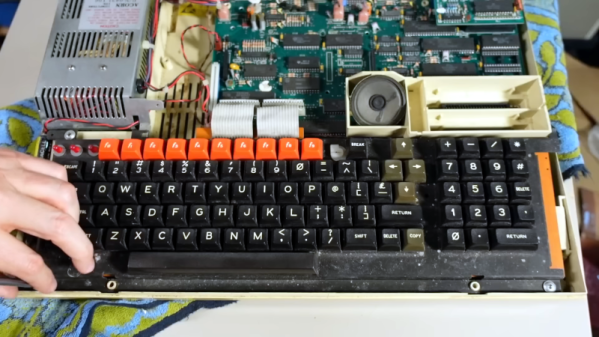
[Adrian] comments that the BBC Master 128 is a rare 8-bit computer, and we agree — we couldn’t remember hearing about that particular machine, although the BBC series is quite familiar. The machine has a whopping 128 K of RAM, quite a bit for those days. It also had a 6502 variant known as the 65C12, which has an extra pin compared to a 6502 and doesn’t use the same clock arrangement. A viewer sent him one of these machines, which apparently was used in the BBC studios. You can see this rare beauty in the video below.

The computer has a very nice-looking keyboard that includes a number pad. There are also expansion ports for printers and floppy disk drives. It has some similarities to a standard BBC computer but has a number of differences externally and internally.

Of course, we were waiting for the teardown about 15 minutes in. There were some corroded batteries but luckily, they didn’t do much damage. The power supply had a burned smell. Cracking it open for inspection was a good time to convert the power supply to run on 120 V, too.

After some power supply repair, it was time to power the machine up. The results were not half bad. It started up with a cryptic error message: “This is not a language.” Better than a dead screen. The keyboard wasn’t totally working, though. A bit of internet searching found that the error happens when the battery dies and the machine loses its configuration.

More walkthroughs will take a bit more work on the keyboard. But we were impressed it came up as far as it did, and we look forward to a future installment where the machine fully starts up.

[Adrian] mentioned the co-processor slot accepting a Raspberry Pi, something we’ve talked about before. Or, add an FPGA and make the plucky computer think it is a PDP/11.

Continue reading “BBC Master 128 Revealed”

AI Creates Killer Drug

Researchers in Canada and the United States have used deep learning to derive an antibiotic that can attack a resistant microbe, acinetobacter baumannii, which can infect wounds and cause pneumonia. According to the BBC, a paper in Nature Chemical Biology describes how the researchers used training data that measured known drugs’ action on the tough bacteria. The learning algorithm then projected the effect of 6,680 compounds with no data on their effectiveness against the germ.

In an hour and a half, the program reduced the list to 240 promising candidates. Testing in the lab found that nine of these were effective and that one, now called abaucin, was extremely potent. While doing lab tests on 240 compounds sounds like a lot of work, it is better than testing nearly 6,700.

Interestingly, the new antibiotic seems only to be effective against the target microbe, which is a plus. It isn’t available for people yet and may not be for some time — drug testing being what it is. However, this is still a great example of how machine learning can augment human brainpower, letting scientists and others focus on what’s really important.

WHO identified acinetobacter baumannii as one of the major superbugs threatening the world, so a weapon against it would be very welcome. You can hope that this technique will drastically cut the time involved in developing new drugs. It also makes you wonder if there are other fields where AI techniques could cull out alternatives quickly, allowing humans to focus on the more promising candidates.

Want to catch up on machine learning algorithms? Google can help. Or dive into an even longer course.

Where Exactly Did That Network Packet Come From?

Have you ever noticed that some websites can figure out, at least roughly, where you are? Sometimes they use it to find you a closer content provider. Or they might block you from seeing certain things while offering you other things specific to your location. This is possible because there are databases that map IPs to locations. [Mark Litwintschik] looks at using those databases from an API or downloading them into your own database. He also shows some very large database queries, which is interesting, too. He uses IPInfo, although there are other providers. Some only provide a limited number of lookups, but there are plenty of free tiers for low-volume usage.

The database changes every day. Of course, each provider has a different way of getting data, and so there are differences. [Mark] compares the IPInfo dataset against MaxMind’s also free database. That involved comparing over 3 billion records! Actually, the 3 billion are the number of IPs that matched up in both databases. There were an additional 118 million that didn’t match and 34 million that were not in the MaxMind database.

Continue reading “Where Exactly Did That Network Packet Come From?”