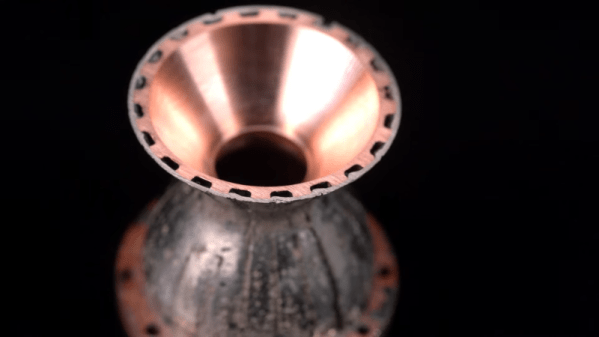
If we asked you to design a circuit to blink a flashing turn signal, you would probably reach for a cheap micro or a 555. But old cars used bimetallic strips in a thermomechanical design. Why? Because, initially, 555s and microcontrollers weren’t available. [Breaking Taps] has the story of NASA engineers who needed some special cooling chambers in a rocket design for the Space Shuttle. Today you’d 3D print them, but in the 70s, that wasn’t an option. So they used wax. You can see a video about the process, including a build of a model rocket engine, in the video below.
The issue is the creation of tiny cooling channels in the combustion chamber. You can use additional thin pipes brazed onto the engine. However, there are several disadvantages to doing this way, but early rocket engines did it anyway. Having the cooling path integrated into the system would be ideal, but without 3D printing, it seems difficult to do. But not impossible.
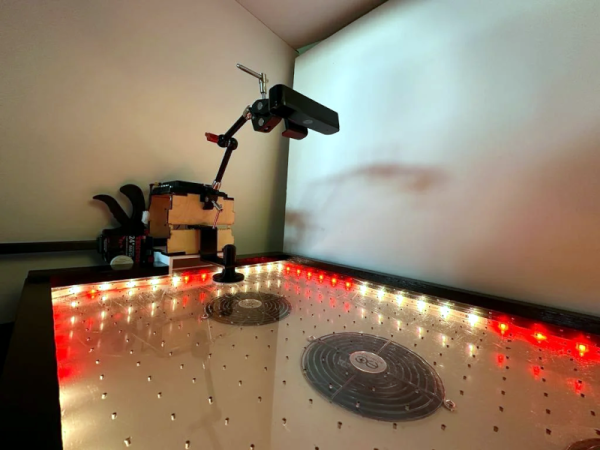
While air hockey is a fine amusement, it isn’t much fun if you can’t find someone to play against. Unless that is, you build a mini table with a robotic defender. [Vaib], [Nathan], and [Navish] can show you how. There is a video you can see below that shows two players using the table without the robot.
The project takes a bit of woodworking, as you might expect. You also have to drill 576 holes for the air to lift the puck. Some of the components are 3D printed in PETG, too. The automated defense uses a camera and relies on the fact that the puck is the only red thing on the table. A servo moves to intercept the incoming puck and return the shot. We were disappointed the video didn’t show the automated play.
We wondered if they had considered making a pair of the detachable robots and letting them play with each other. If you prefer football, the robot could probably adapt. We’ve seen other robot air hockey contenders, so maybe a better idea would be to build different robots and let them compete for a gold medal.
Society and governments are struggling to adapt to a world full of cybersecurity threats. Case in point: the EU CRA — Cyber Resilience Act — is a proposal by the European Commission to enact legislation with a noble goal: protect consumers from cybercrime by having security baked in during design. Even if you don’t live in the EU, today’s global market ensures that if the European Parliament adopts this legislation, it will affect the products you buy and, possibly, the products you create. In a recent podcast, our own [Jonathan Bennett] and [Doc Searles] interview [Mike Milinkovich] from the Eclipse Foundation about the proposal and what they fear would be almost a death blow to open source software development. You can watch the podcast below.
If you want some background, you can read the EU’s now closed request for comments and the blog post outlining the problems from opensource.org. At the heart of the issue is the need for organizations to self-certify their compliance with the act. Since open source is often maintained by a small loose-knit group of contributors, it is difficult to see how this will work.
The Baader-Meinhof effect is the common name for what scientists call frequency illusion. Suppose you are watching Star Trek’s Christopher Pike explain how he makes pasta mama, and you’ve never heard of it before. Immediately after that, you’ll hear about pasta mama repeatedly. You’ll see it on menus. Someone at work will talk about having it at Hugo’s. Here’s the thing. Pasta mama was there all along (and, by the way, delicious). You just started noticing it. We sometimes wonder if that’s the deal with Morse code. Once you know it, it seems to show up everywhere.
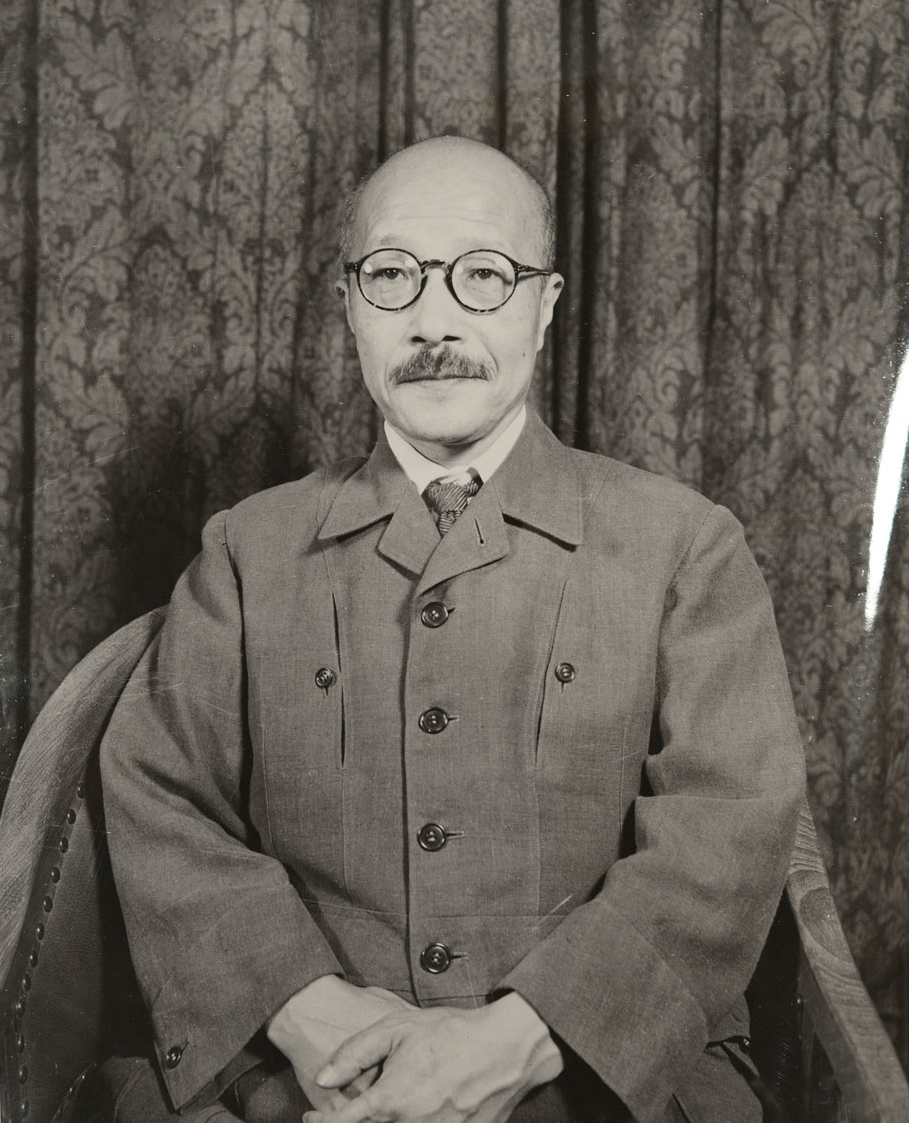
Gen. Hideki Tojo in custody in 1947
One of the strangest places we’ve ever heard of Morse code appearing is the infamous case of Tojo’s teeth. If you don’t remember, General Hideki Tojo was one of the main “bad guys” in the Pacific part of World War II. In particular, he is thought to have approved the attack on Pearl Harbor, which started the American involvement in the war globally. Turns out, Tojo would be inextricably tied to Morse code, but he probably didn’t realize it.
The Honorable Attempt
At the end of the war, the US military had a list of people they wanted to try, and Tojo was near the top of their list of 40 top-level officials. As prime minister of Japan, he had ordered the attack that brought the US into the war. He remained prime minister until 1944, when he resigned, but the US had painted him as the face of the Japanese enemy. Often shown in caricature along with Hitler and Mussolini, Tojo was the face of the Japanese war machine to most Americans.
In Allied propaganda, Tojo was one of the “big three”
When Americans tried to arrest him, though, he shot himself. However, his suicide attempt failed. Reportedly, he apologized to the American medics who resuscitated him for failing to kill himself. Held in Sugamo Prison awaiting a trial, he requested a dentist to make him a new set of dentures so he could speak clearly during the trial.
We all know we should save energy and not leave computers on all the time. It is probably better for the computer, too. But when you operate a home server, it isn’t feasible to just turn it on when you want to use it and then turn it off again. Or is it? [Daniel] decided that was exactly what he wanted to do, and it was quite an adventure to get there.
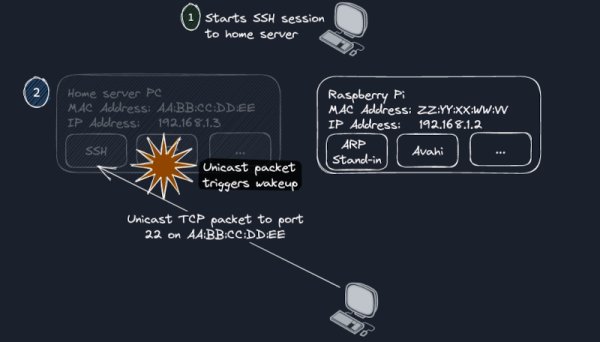
The trick is to use a Raspberry Pi — they don’t draw nearly the power a big computer does — to stay awake to facilitate the process. The Pi watches for ARP requests for the sleeping machine and replies on its behalf so that other network nodes can find the machine even when it isn’t on.
The server itself detects if it is idle in a cron job. When it finds that there are no SSH or other service connections for a set period of time, it suspends the machine to RAM, putting it in a low-power mode. Waking a sleeping computer up over the network is a solved problem, and [Daniel] investigated several wake-on-lan solutions.
There were several oddities to work out, including a Mac pinging an unused network share, and a router that was making NetBIOS queries. However, [Daniel] found a $30 router that could do port mirroring and that helped a lot with troubleshooting.
This is one of those things where his recipe won’t exactly fit your situation. But the post has a lot of good information and some nice tricks for troubleshooting any kind of network bizarreness.
Wireshark is a great tool for this kind of work, too. Another useful technique is recording network traffic and playing it back.
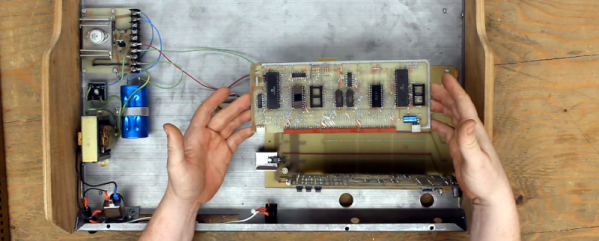
[CelGenStudios] has an impressive collection of vintage hardware. One that really struck us came from a thrift store in Canada, so the original provenance of it is unknown. It looks like someone’s handmade interpretation of a SOL-20. There’s a wooden and sheet metal box containing a keyboard looted from an old dedicated word processor (back when a word processor was a machine, not a piece of software). Inside? Some vintage-looking hand-drawn PC boards, including a backplane with two boards. One contains an RCA 1802 and a little bit of memory. There’s also a video card with more memory on it than the CPU.
We loved the 1802, and we disagree with [CelGenStudios] that it “wasn’t that popular.” It was super popular in some areas. The CMOS processor was popular in spacecraft and among homebrew builders. There were a few reasons for that. Unlike some early CPUs, you didn’t need much to bootstrap a system. It would run on 5V and had a “DMA” mode to key data in with just a few simple switches and buttons. You didn’t need a ROM-based monitor to get the system to work. In addition, the design could be low power, and the static design meant you could slow or stop the clock for very low power compared to many other systems of the day.
Water cooler talk at the office usually centers around movies, sports, or life events. Not at Hackaday. We have the oddest conversations and, this week, we are asking for your help. It is no secret that we have a special badge each year for Supercon. Have you ever wondered where those badges come from? Sometimes we do too. We can’t tell you what the badge is going to be for Supercon 2023, but here’s a chance for you to contribute to its design.
What I can tell you is that at least part of the badge is analog. Part, too, is digital. So we were discussing a seemingly simple question: How do we best generate a bipolar power source for the op amps on a badge? Like all design requests, this one is unreasonable. We want:
Ideally, we’d like a circuit to give us +/- 9 V to +/- 12 V at moderately low current, say in the tens of milliamps. Actual values TBD.
Low noise: analog circuitry, remember?
Lightweight: it is going on a badge
Battery operated: the badge thing again
Cheap: we only have a couple bucks in the budget for power