The Gallium Nitride Revolution

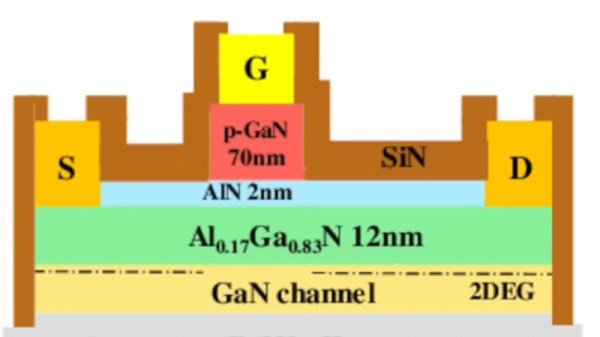
[Asianometry] has been learning about gallium nitride semiconductors and shares what he knows in an informative video you can see below. This semiconductor material has a much higher bandgap voltage than the more common silicon. This makes it useful for applications that need higher efficiency and less heating.

The original use of the material was for LEDs, but we are seeing increasing use of the material in high-power applications like chargers. Phone chargers are especially common using this technology. This isn’t surprising when your think about how many phone chargers are needed worldwide every day.

Other places that need power-efficient devices are data centers, electric vehicles, and battery-operated equipment. It isn’t clear, though, that we can make enough of the material to meet global demand if it becomes extremely popular. This is especially true because the machinery and processes used to create silicon devices don’t work with gallium nitride. Silicon carbide is a competitor, and it could be easier to create, even though it isn’t as efficient as gallium nitride.

We’ve looked at gallium nitride before, and we are sure we are going to be seeing it again. Silicon carbide may one day operate on the surface of Venus. You can even use it to make homemade LEDs.
Continue reading “The Gallium Nitride Revolution”

Single Photon Detection With Photomultipliers

Unless you are an audiophile, you likely think of tubes as mostly relegated to people who work on old technology. However, photomultiplier tubes are still useful compared to more modern sensors, and [Jaynes Network] has a look into how they work, especially with scintillating detectors.

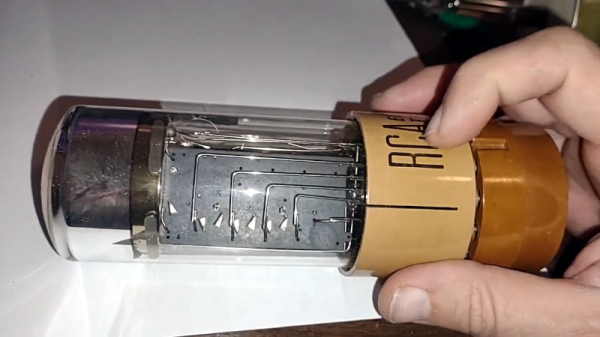
The RCA photomultiplier he examines has ten stages and can detect even a single photon. Combined with a scintillating detector, they make good radiation detectors.

We can’t help but smile when we hear someone obviously in love with the engineering behind a tube like this. We get it. The inside of the tube is crowded, so it is hard to identify the dynodes and other portions, but some diagrams make it readily apparent how the tube does its job.

We were impressed with how good the documentation that came with the tube looked, considering its age. We mean the condition it was in. The document itself was obviously a reproduction of a typewritten document with hand-drawn figures and graphs.

We were hoping for some footage of the tube in action, but we’ll have to wait for a future video. We are betting that is coming, though. Although there are some solid-state detectors, they are not suitable for all applications. There was a time, though, when the tubes were in many applications, including X-ray scanners and photography equipment.

Continue reading “Single Photon Detection With Photomultipliers”

Z8000 Trump Card Needs Your Help

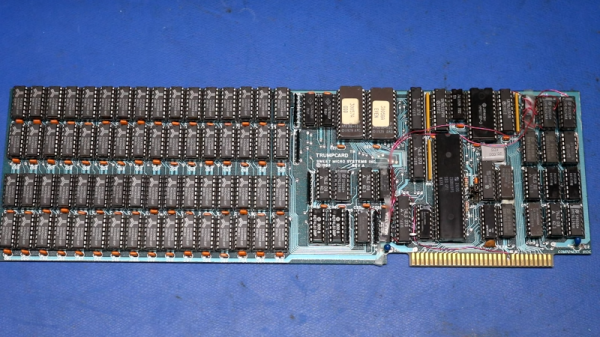
[Smbakeryt] needs your help. He bought a 1984-vintage Z8000 coprocessor card for the PC, but the software is missing in action. Apparently, the co-processor — called a Trump Card — appeared in Byte magazine courtesy of the famous [Steve Ciarcia]. The schematics were published, and if you sent [Steve] proof that you built it, he’d send you the software. The product was later commercialized, but no one seems to have the software, so [Smbakeryt] is on the lookout for it.

The board itself was pretty amazing for its day. It added a 16-bit Zilog Z8000 CPU with 512 K of RAM. Big iron for 1984 and a good bit more performance than a stock IBM PC of the era.

We miss the days when computer gear came with big binders of documentation. These days, you are more likely to get a sticker with a URL. The Z8000 was a nice processor and could emulate the Z80, but it never became hugely popular. In addition to Zilog’s System 8000, the CPU found its way into some Unix computers including the Onyx C8002 and several Olivetti computers. Commodore planned to use the CPU in a canceled project. The Z8000 was famous for not using microcode and, thus, it fit on a relatively small die with 17,500 transistors (compared to the 8086’s 29,000 transistors).

We hope someone can help out with the software. If you want your own Z8000 system, you might be better off with Clover. Or, stick with a Z80 on the cheap.

Continue reading “Z8000 Trump Card Needs Your Help”

Solar Cell Fabric Makes Anything Solar

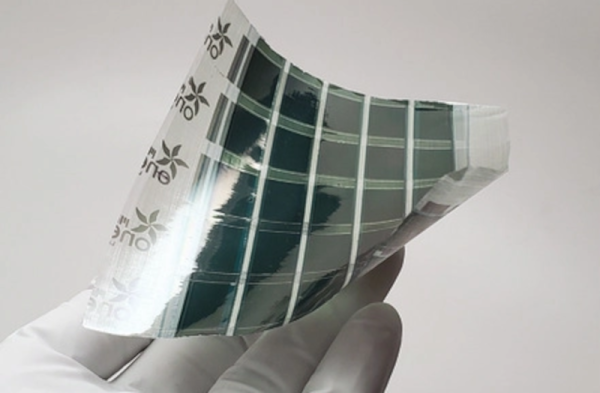
MIT has been working on very thin solar cells made of a film just a few microns thick. The problem? The cells are so thin that they’re hard to work with. You could make a small solar cell on top of, say, a glass slide, but that’s not all that interesting since you can make perfectly good solar cells that are as fragile as glass using conventional techniques. But in a new paper, MIT researchers describe creating 50-micron-thin fabrics that can generate electricity from solar.

The process still involves using chemical vapor deposition to produce the solar cell on glass. However, the cells are removed from the glass, prepared with electrodes, and then transferred to a piece of fabric which acts as a new substrate.

The fabric used in the paper is a composite fabric known as Dyneema composite fabric. It uses ultra-high molecular weight polyethylene fibers and sheets of Mylar. This material has low weight but a very high strength. A UV cure adhesive bonds the fabric and solar cells.

Honestly, we doubt anyone will be making these in their garages anytime soon. But we would love to see what you could do with a roll of this fabric. Wearables, self-charging laptop bags, or solar-powered instruments in an airborne drone could all take advantage of the material’s flexibility and low weight.

A Transistor? Memory? Wait, It’s Both!

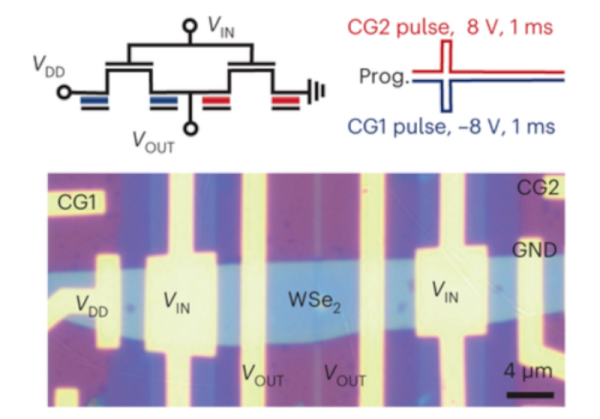
What do you get if you cross graphene, hexagonal boron nitride, and tungsten diselenide? Well, according to researchers at Hunan University, you get a field effect transistor that can act as both a switching element or a memory cell. The partial floating-gate field-effect transistor or PFGFET uses 2D van der Waals heterostructures to deal with isolated atomic layers. The paper in Nature is unfortunately behind a pay wall, but you can read a summary over on [TechExplore].

The graphene acts as the gate, and the transistor can be switched between n-type behavior and p-type behavior. It can also be configured as a switching element or as a memory element similar to an EEPROM cell.

One advantage of having configurable transistor types is that a single transistor structure can produce CMOS or complementary circuits. Traditionally, a CMOS IC has two different transistor structures and often producing one of them requires extra effort.

The configuration takes place by applying a control voltage pulse. A negative control voltage produces a p-type FET and a positive voltage configures the same transistor as an n-type. If you don’t have access to the paper, the figures available online offer a good bit of insight into the device’s design.

If you want to learn more about ordinary MOSFETs, we talk about them often. You can also get the skinny on CMOS from [Bil Herd].

Robot Dog Has Animal Magnetism

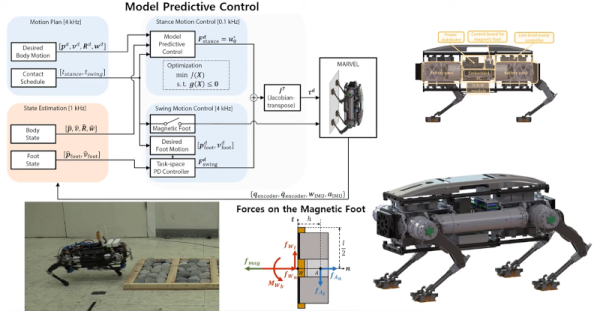
Robot “dogs” are all the rage lately, but you probably haven’t seen one that can climb up a wall. Researchers in Korea have made one that can, assuming the wall is made out of a metal that a magnet can stick to at least. The robot, MARVEL or magnetically adhesive robot for versatile and expeditious locomotion, might be pressing its luck on acronyms, but it is pretty agile as you can see in the video below. Tests showed the robot walking on walls and ceilings. It can cross gaps and obstacles and can even handle a curved storage tank with paint and rust.

The robot weighs 8 kilograms (17.6 pounds), can carry 2 – 3 kg of payload, and operates without a tether. Each foot contains both an electropermanent magnet and magnetorheological elastomers. If you haven’t seen them before, an electropermanent magnet, or EPM, is a magnet that can be turned on or off electronically. The elastomer is a polymer containing ferromagnetic particles that can alter the material’s properties in response to a magnetic field.

EPMs have two parts. One part is a simple permanent magnet. The other is a soft core easily magnetized by a surrounding coil. If you magnetize the soft core to oppose the permanent magnet, the fields cancel out, effectively turning off the magnet. If you magnetize it the other way, it reinforces the field.

This is better than an electromagnet in this application because turning the magnet on or off only requires a brief pulse. If you want your robot to hang out on the ceiling with Spider Man indefinitely, you don’t have to worry about draining your batteries while keeping an electromagnet engaged.

Overall, an interesting robot. Most wall-climbing robots we’ve seen are pretty lightweight. We don’t see nearly as many that can have the feeling of clinging to the ceiling.

Continue reading “Robot Dog Has Animal Magnetism”

Say The Magic Word, And The TinySA Goes Ultra

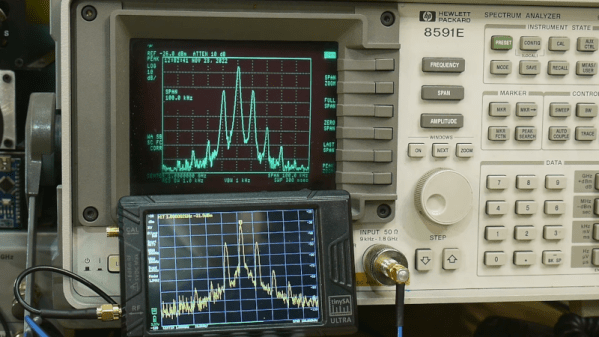
We’ve looked at the TinySA spectrum analyzer in the past. However, the recent Ultra edition offers an increase in range from 800 MHz to 6 GHz. How does it work? [IMSAI Guy] tells us in a recent video that you can watch below. In addition to an increased frequency range, the new device offers a larger display and enhancements to the signal generator and bandpass filtering. It also has an optional LNA. All this, of course, is at a price since the Ultra sells at a little more than twice the original unit’s price. Still, $120 or so for a 6 GHz spectrum analyzer isn’t bad.

For some reason, you have to put a passcode in to enable the Ultra mode, although the passcode appears to be common knowledge and available on the device’s wiki. You can presume they could, at some point, make this feature or others require a paid passcode, but for now, it is just a minor inconvenience. Reminds us of a certain oscilloscope that’s become quite popular in our community.

One thing you should be aware of, however, is that the Ultra mode uses a mixer to downconvert the incoming signal to the ordinary 800 MHz range. That means, as you can see in the video, that the local oscillator puts out some signal at the input. The level is relatively low, but still something to be aware of if you are trying to make a precision measurement.

The video compares the device to an HP 8591E spectrum analyzer. It tops out at 1.8 GHz and runs about $2,500 new. Even on eBay, you can expect to pay between $500 and $1000 for one of these. The results seem to be comparable, for the most part.

We looked at the device’s predecessor back in 2020. We also did a full-blown review a little bit later.

Continue reading “Say The Magic Word, And The TinySA Goes Ultra”