We are often struck by how often we spend time trying to optimize something when we would be better off just picking a better algorithm. There is the old story about the mathematician Gauss who, when in school, was given busy work to add the integers from 1 to 100. While the other students laboriously added each number, Gauss realized that 100+1 is 101 and 99 + 2 is also 101. Guess what 98 + 3 is? Of course, 101. So you can easily find that there are 50 pairs that add up to 101 and know the answer is 5,050. No matter how fast you can add, you aren’t likely to beat someone who knows that algorithm. So here’s a question: You have a large body of text and you want to search for it. What’s the best way?
Author: Al Williams4508 Articles
Plastic CPUs Will Bend To Your Will
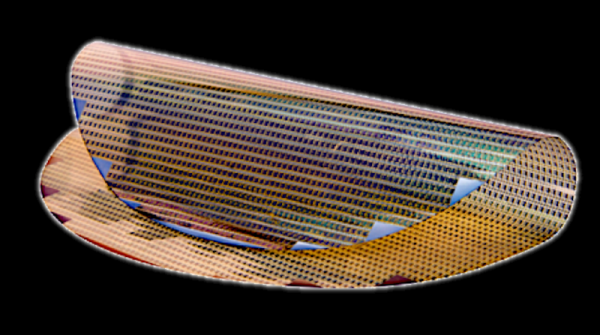
As microcontroller prices drop, they appear in more things. Today you will find microcontrollers in your car, your household appliances, and even kid’s toys. But you don’t see them often embedded in things that are either super cheap or have to flex, such as for example a bandage. Part of the reason is the cost of silicon chips and part of the reason is that silicon chips don’t appreciate bending. What if you could make CPUs for less than a penny out of flexible plastic? What applications would that open up? PragmatIC — a company working to make this possible — thinks it would open up a whole new world of smart items that would be unthinkable today. They worked with a team at the University of Illinois Urbana-Champaign to create prototype plastic CPUs with interesting results.
This is still the stuff of research and dreams, but a team of researchers did work to produce 4-bit and 8-bit processors using IGZO –indium gallium zinc oxide — semiconductor technology. This tech can be put on plastic and will work even if you bend it around a radius as small as a few millimeters.
Inside 3D Printing Shoes
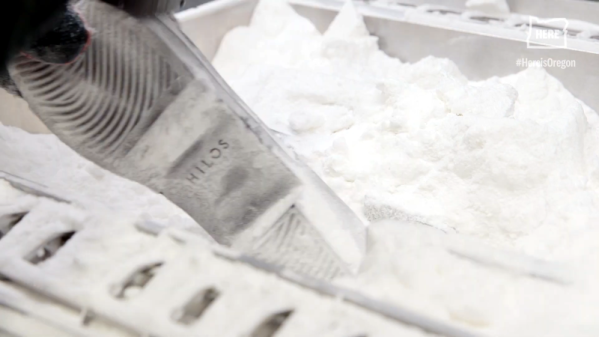
If you’ve ever thought about 3D printing shoes, you’ll enjoy watching the video below about a Portland-based company that creates shoes on demand using an HP MJF 5200 3D printer. Granted, this isn’t a printer you likely have in your basement. The one-ton printer costs up to a half-million dollars but watching it do its thing is pretty interesting.
The printer doesn’t create the entire shoe, but just a spongy foam-like TPU footbed and heel. They run the printer overnight and get about a dozen pairs out at once. There’s quite a bit of clean-up to get the piece ready. Of course, there’s also the assembly of the rest of the shoe to take into account.
Linux Fu: Docking Made Easy
Most computer operating systems suffer from some version of “DLL hell” — a decidedly Windows term, but the concept applies across the board. Consider doing embedded development which usually takes a few specialized tools. You write your embedded system code, ship it off, and forget about it for a few years. Then, the end-user wants a change. Too bad the compiler you used requires some library that has changed so it no longer works. Oh, and the device programmer needs an older version of the USB library. The Python build tools use Python 2 but your system has moved on. If the tools you need aren’t on the computer anymore, you may have trouble finding the install media and getting it to work. Worse still if you don’t even have the right kind of computer for it anymore.
One way to address this is to encapsulate all of your development projects in a virtual machine. Then you can save the virtual machine and it includes an operating system, all the right libraries, and basically is a snapshot of how the project was that you can reconstitute at any time and on nearly any computer.
In theory, that’s great, but it is a lot of work and a lot of storage. You need to install an operating system and all the tools. Sure, you can get an appliance image, but if you work on many projects, you will have a bunch of copies of the very same thing cluttering things up. You’ll also need to keep all those copies up-to-date if you need to update things which — granted — is sort of what you are probably trying to avoid, but sometimes you must.
Docker is a bit lighter weight than a virtual machine. You still run your system’s normal kernel, but essentially you can have a virtual environment running in an instant on top of that kernel. What’s more, Docker only stores the differences between things. So if you have ten copies of an operating system, you’ll only store it once plus small differences for each instance.
The downside is that it is a bit tough to configure. You need to map storage and set up networking, among other things. I recently ran into a project called Dock that tries to make the common cases easier so you can quickly just spin up a docker instance to do some work without any real configuration. I made a few minor changes to it and forked the project, but, for now, the origin has synced up with my fork so you can stick with the original link.
Up In The Sky… It’s A Bird… It’s A Drone… Oh Yeah, It’s A Drone
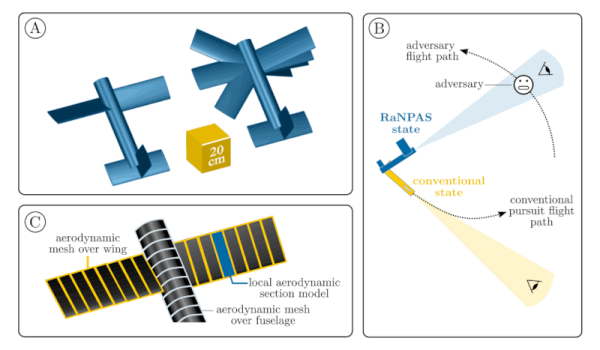
One staple of science fiction is the ornithopter, which is a plane with moving wings. While these haven’t proved very practical in the general sense, a recent paper talks about mimicking natural wings changing shape to improve maneuverability in drones and other aircraft. In particular, the paper talks about how the flight performance of many birds and bats far exceeds that of conventional aircraft.
The technical term for being more maneuverable than a conventional aircraft is, unsurprisingly, called supermaneuverability. Aircraft performing things like the Pugachev Cobra maneuver (watch the video below, or the latest Top Gun movie) require this type of operation, and with modern aircraft, this means using thrust-vector technology along with unstable airframes and sophisticated computer control. That’s not how birds or bats operate, though, and the paper uses modern flight simulation techniques to show that biomimicry and thrust vector technology don’t have to be mutually exclusive.
Continue reading “Up In The Sky… It’s A Bird… It’s A Drone… Oh Yeah, It’s A Drone”
3D Printed Concrete Beam Improves Sustainability
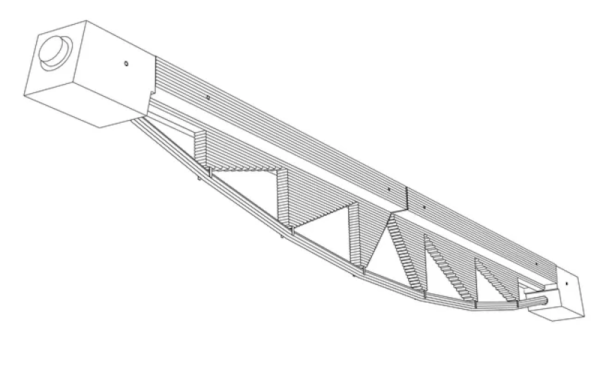
Many of the 3D printed houses and structures we’ve seen use concrete and are — frankly — a little underwhelming. Making big squares out of concrete isn’t that hard and while we are sure there is some benefit, it isn’t overwhelming. [Andy Coward] apparently felt the same way and set out to find ways that 3D printing could offer unique benefits in building structures. The result: a beam that would be difficult to create with conventional techniques but is easy to make with a printer. The advantage is that it uses 78% less concrete than a conventional beam with the same properties.
The key is that in a normal beam, not much of the concrete is bearing a significant load. It is simply there because you need some concrete on one side of the beam and then some more on the other side. In the center, surprisingly little of the concrete actually supports anything. The new beam takes advantage of this along with a steel reinforcement at a strategic point. Still, it uses 70% less steel than a typical reinforced beam.
Continue reading “3D Printed Concrete Beam Improves Sustainability”
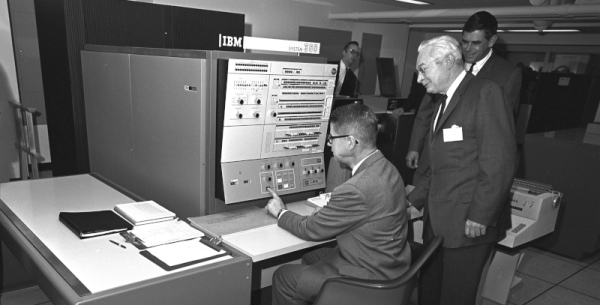
Your Own IBM Mainframe (or Vax, Or Cray…) The Easy Way
If you want the classic experience of working with an IBM mainframe or another classic computer like a DEC VAX, you have a few choices. You could spend a lot of money trying to find one, transport it, and refurbish it. But, of course, most of us will settle for an emulator. While there are great emulators out there, most of the time you aren’t interested in running just the bare machine — you want the operating systems, the compilers, and the other software that made these machines so interesting. Running your three lines of machine code isn’t as much fun as playing hunt the wumpus or compiling some Fortran IV code. Unfortunately, finding copies of all this old software can be daunting. But thanks to the efforts of [Rattydave], you can do it with no problems at all. The secret? Pre-built docker images that have everything you need in one place.
Continue reading “Your Own IBM Mainframe (or Vax, Or Cray…) The Easy Way”