Book Teaches Gaming Math

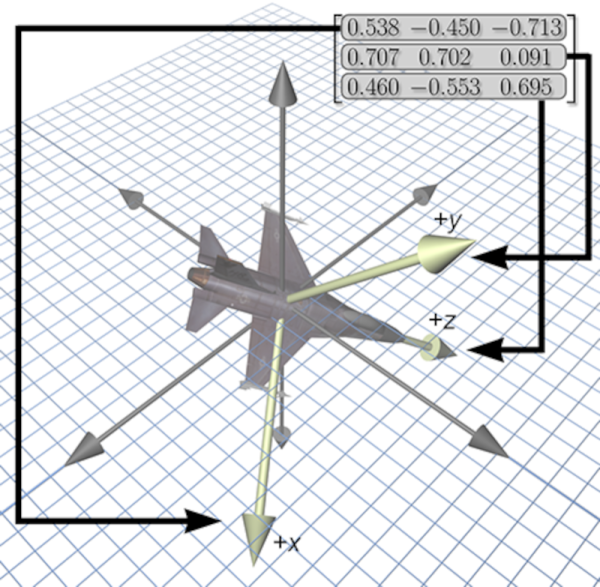
If we knew how much math goes into writing a video game, we might have paid more attention in math class. If you need a refresher, [Fletcher Dunn] and [Ian Parbery] have their book “3D Math Primer for Graphics and Game Development” available free online. The book was originally a paper book from 2011 with a 2002 first edition but those are out of print now. However, math is math, so regardless of the age of the book, it is worth a look. For now, the online version is a bunch of web pages, but we hear a PDF or E-reader version is forthcoming.

There’s quite a bit of discussion about vectors, matrices, linear transformations, and 3D graphics. The last part of the book covers calculus, kinematics, and parametric curves. Some of these topics will be of interest even if you don’t care about graphics but do want to learn some math with practical examples.

Continue reading “Book Teaches Gaming Math”

When Hams Helped Polar Researchers Come In From The Cold

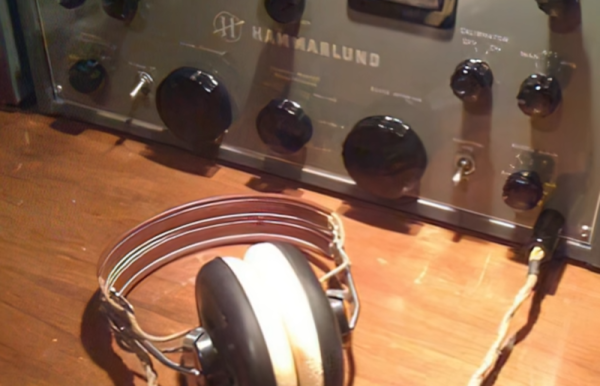
We always enjoy [The History Guy] videos, although many of them aren’t much about technology. However, when he does cover tech topics, he does it well and his recent video on how ham radio operators assisted in operation Deep Freeze is a great example. You can watch the video, below.

The backdrop is the International Geophysical Year (IGY) where many nations cooperated to learn more about the Earth. In particular, from 1957 to 1958 there was a push to learn more about the last unexplored corner of our planet: Antarctica. Several of the permanent bases on the icy continent today were started during the IGY.

It’s hard for modern audiences to appreciate what the state of personal communication was in 1957. There were no cell phones and if you are thinking about satellites, don’t forget that Sputnik didn’t launch until late 1957, so that wasn’t going to happen, either.

Operation Deep Freeze had ten U. S. Navy vessels that brought scientists, planes, and Seabees (slang for members of the Naval Construction Batallion) — about 1,800 people in all over several years culminating in the IGY. Of course, the Navy had radio capabilities, but it wasn’t like the Navy to let you just call home to chat. Not to mention, a little more than 100 people were left for each winter and the Navy ships went home. That’s where ham radio operators came in.

Hams would do what is called a phone patch for the people stationed in Antarctica. Some hams also send radiograms to and from the crew’s families. One teen named Jules was especially dedicated to making connections to Antarctica. We can’t verify it, but one commenter says that Jules was so instrumental in connecting his father in Antarctica to his fiancee that when his parents married, Jules was their best man.

Jules and his brother dedicated themselves to keeping a morale pipeline from New Jersey to the frozen stations. He figures prominently in recollections of many of the written accounts from people who wintered at the nascent bases. Apparently, many of the men even traveled to New Jersey later to visit Jules. What happened to him? Watch the end of the video and you’ll find out.

While being a ham today doesn’t offer this kind of excitement, hams still contribute to science. Want to get in on the action? [Dan Maloney] can tell you how to get started on the cheap.

Continue reading “When Hams Helped Polar Researchers Come In From The Cold”

Building Petahertz Logic With Lasers And Graphene

There was a time when we thought a 50 MHz 486 was something to get excited about. In comparison, the computer this post was written on clocks in at about 3.8 GHz, which these days, isn’t an especially fast machine. But researchers at the University of Rochester and the  Friedrich-Alexander-Universität Erlangen-Nürnberg want to blow the doors off even the fastest modern CPUs. By using precise lasers and graphene, they are developing logic that can operate at nearly 1 petahertz (that’s 1,000,000 GHz).

These logic gates use a pair of very short-burst lasers to excite electrical current in graphene and gold junctions. Illuminating the junctions very briefly creates charge carriers formed by electrons excited by the laser. These carriers continue to move after the laser pulse is gone. However, there are also virtual charge carriers that appear during the pulse and then disappear after. Together, these carriers induce a current in the graphene. More importantly, altering the laser allows you to control the direction and relative composition of the carriers. That is, they can create a current of one type or the other or a combination of both.

This is the key to creating logic gates. By controlling the real and virtual currents they can be made to add together or cancel each other out. You can imagine that two inputs that cancel each other out would be a sort of NAND gate. Signals that add could be an OR or AND gate depending on the output threshold.

[Ignacio Franco], the lead researcher, started working on this problem in 2007 when he started thinking about generating electrical currents with lasers. It would be 2013 before experiments bore out his plan and now it appears that the technique can be used to make super fast logic gates.

We often pretend our logic circuits don’t have any propagation delays even though they do. If you could measure it in femtoseconds, maybe that’s finally practical. Then again, sometimes delays are useful. You have to wonder how much the scope will cost that can work on this stuff.

Repairing An HDMI Adapter Doesn’t Go So Well

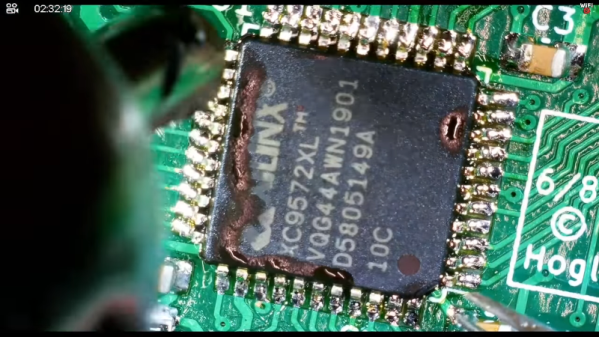
[Adrian] has a lot of retrocomputers, so he uses an RGB to HDMI converter to drive modern monitors. In particular, he has a box that uses a programmable logic chip to read various RGB signals and ships them to a Raspberry Pi Zero to drive the HDMI output. Sounds great until, of course, something goes wrong.

A converter that had worked stopped working due to a bad board with the programmable logic chip on it. Unlike the retrocomputers, this board has little tiny surface mount components. A little analysis suggested that some of the chip pins were not accepting inputs.

Continue reading “Repairing An HDMI Adapter Doesn’t Go So Well”

Can You Hear Me Now? Lunar Edition

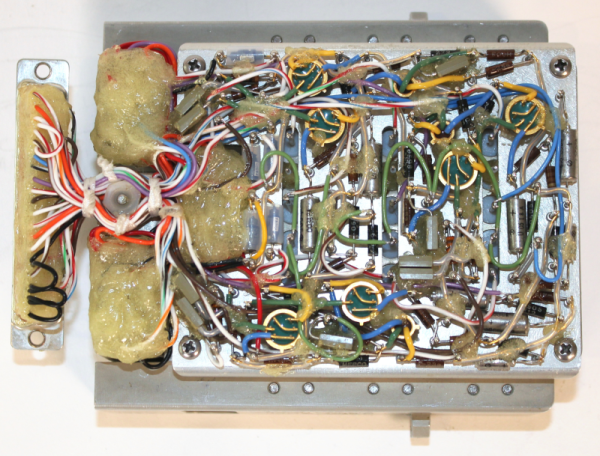
Despite what it looks like in the movies, it is hard to communicate with astronauts from Earth. There are delays, and space vehicles don’t usually have a lot of excess power. Plus everything is moving and Doppler shifting and Faraday rotating. Even today, it is tricky. But how did Apollo manage to send back TV, telemetry, and voice back in 1969? [Ken Shirriff] and friends tell us part of the story in a recent post where he looks at the Apollo premodulation processor.

Things like weight and volume are always at a premium in a spacecraft, as is power. When you look at pictures of this solid box that weighs over 14 pounds, you’ll be amazed at how much is crammed into a relatively tiny spot. Remember, if this box was flying in 1969 it had to be built much earlier so there’s no way to expect dense ICs and modern packaging. There’s not even a printed circuit board. The components are attached to metal pegs in a point-to-point fashion. The whole thing lived near the bottom of the Command Module’s lower equipment bay.

Continue reading “Can You Hear Me Now? Lunar Edition”

Striping A Disk Drive The 1970 Way

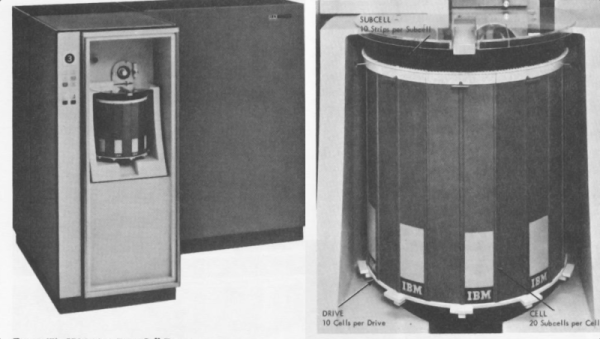
These days, mass storage for computers is pretty simple. It either uses a rotating disk or else it is solid state. There are a few holdouts using tape, too, but compared to how much there used to be, tape is all but dead. But it wasn’t that long ago that there were many kinds of mass storage. Tapes, disks, drums, punched cards, paper tape, and even stranger things. Perhaps none were quite so strange though as the IBM 2321 Data Cell drive — something IBM internally called MARS.

What is a data cell you might ask? A data cell was a mass storage device from IBM in 1964 that could store about 400 megabytes using magnetic strips that looked something like about a foot of photographic film. The strips resided inside a drum that could rotate. When you needed a record, the drum would rotate the strip you needed to the working part and an automated process would remove the strip in question, wrap it around a read/write head and then put it back when it was done.

Continue reading “Striping A Disk Drive The 1970 Way”

The Hair Dryer Monitor Fix

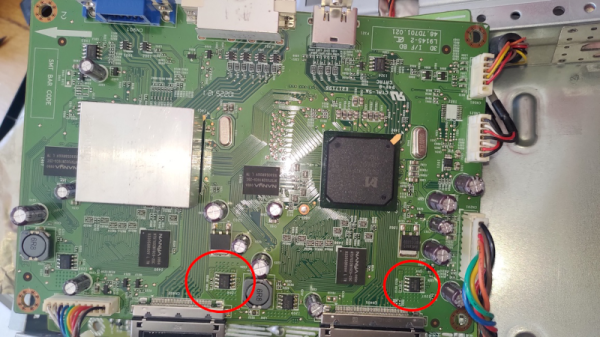
[Johnny] had a monitor that he was particularly fond of. The whole monitor appeared dead, and he decided to open it up and find out what could be wrong. He wound up fixing it — sort of — using a hairdryer. While we think his explanation of the problem is unlikely, we hate to armchair quarterback, and we applaud that he opened it up and got it working.

When something is dead, it is always a good idea to check the power and power supply, but that didn’t pan out in this case. In fact, the power supply board inside had what looked like reasonable voltage values throughout. The problem had to be something more subtle.

Continue reading “The Hair Dryer Monitor Fix”