3D Printing Tiny Metal Parts

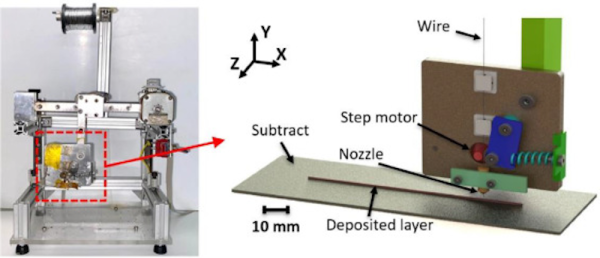
It may sound like a pop band, but μ-WAAM is actually a 3D printing technique for making small metal parts from the NOVA University Lisbon. Of course, WAAM stands for wire arc additive manufacturing, a well-known technique for 3D printing in metal. The difference? The new technique uses 250 μm wire stock instead of the 1mm or thicker wires used in conventional WAAM.

The thinner feed wire allows μ-WAAM to create fine details like thin walls that would be difficult to replicate with traditional methods. Typically, for fine structures, printers use fused metal powder. This is good for fine details, but typically slower and has higher waste than wire-based systems.

Continue reading “3D Printing Tiny Metal Parts” →

Predicting The Future: How’s That Working Out?

With 2022 off to a good start, it is about time to let go of all those New Year’s resolutions that didn’t quite work out. The scale’s needle didn’t reverse, our nails are still bitten, and we are still binge-watching Breaking Bad instead of reading the classics. But, of course, there’s always the future where we just know we’re going to stick to our resolutions. Besides, the future will be replete with fat-eating nanobots, 3D printed nails every morning, and a pill you can take that will make you remember reading Ulysses.

Predicting the future is fraught with peril, which is why launching a new company or product is so risky. However, there have been a few prognosticators that have made some impressive forecasts. For example, in 1922 popular (if not critically acclaimed) author W. L. George wrote a piece for The New York Herald titled “What the World Will be Like In a Hundred Years.” Since May will see that piece’s 100th anniversary, let’s see how he did.

Continue reading “Predicting The Future: How’s That Working Out?” →

Pump Up The Resin

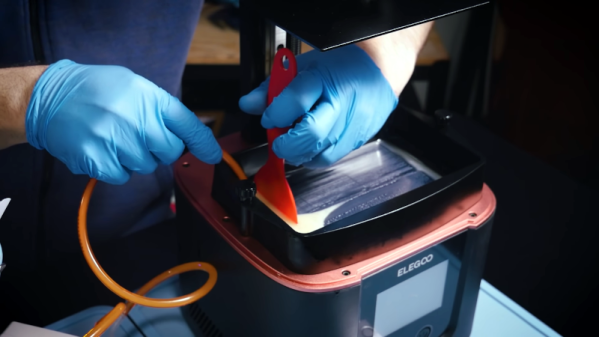
Sometimes the best ideas are simple and seem obvious after you’ve heard them. [Danny] showed us a great idea that fits that description. He uses a peristaltic pump to move resin in and out of his print bed. (Video, embedded below.) Normally, you remove the tank and pour the resin out into a container. With the pump, you can leave the tank where it is and simply pull the resin through a tube. The process is slower than pouring, but not as messy and doesn’t risk damage to your FEP film.

You can also use the pump like a vacuum to clean up resin. According to [Danny], the biggest value is when working with very large printers. He shows a Peopoly Phenom which has a huge tank compared to the other printers he shows in the video.

Continue reading “Pump Up The Resin” →

3D Printing Rainbows

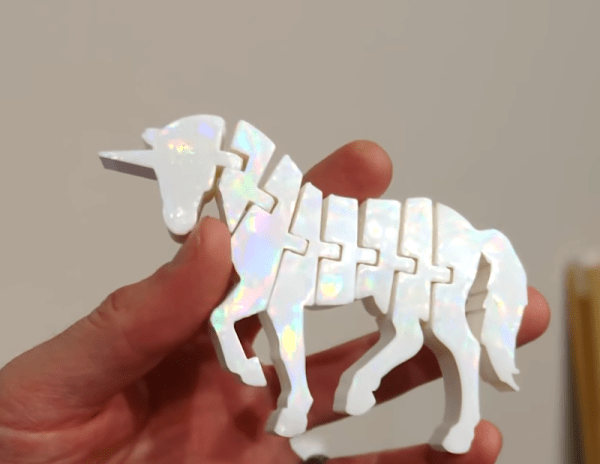
[The Action Lab] had a very serious technical problem. His daughter wanted to 3D print sparkly unicorns. But how do you make a 3D print sparkly? Turns out, he had used a diffraction grating before to make rainbow-enhanced chocolate.

The method turns out to be surprisingly simple. Using a diffraction grating as a print bed, puts the pattern on the bottom of the 3D print and — thanks to how a diffraction grating works — the 3D print now works like a grating, too.

Continue reading “3D Printing Rainbows” →

Sticker Brings The Heat

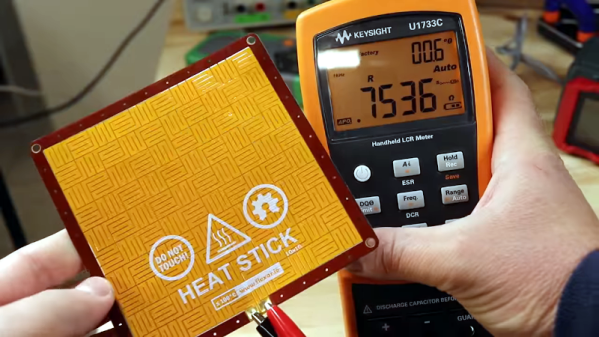
[Carl] is always looking at making heater plates for PCB reflow and other applications. In his latest video, he shows how he is using thin flexible PCBs with adhesive backs as stickers that get hot. You can find gerber files and design files on GitHub.

You might think that this is a pretty simple thing to do with a flex PCB, but it turns out while the PCB might be flexible, the traces aren’t and so the typical long traces you see in a heater won’t allow the sticker to bend, which is a problem if you want to wrap it around, say, a coffee mug.

Continue reading “Sticker Brings The Heat” →

Homemade Probe For 3D Printer: $3

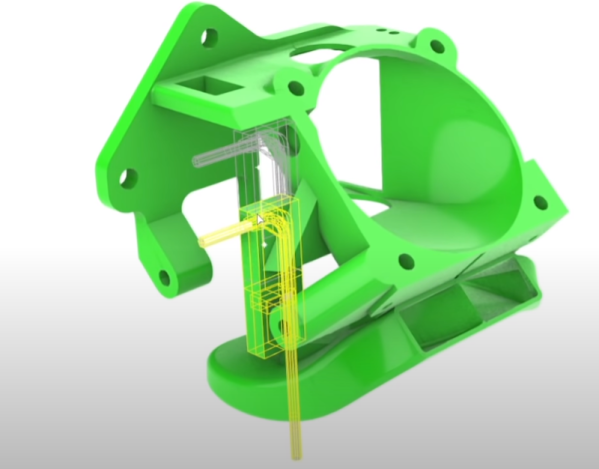
You have a few choices if you want to use a probe to level your 3D printer bed. Rarely, you’ll see optical or capacitive probes. More commonly, though, your probe will sense a metal print or uses a physical probe to touch the print bed. [Design Prototype Test] has long used a BLTouch which uses the latter method. However, putting it in a heated build chamber prevented it from working so he set out to make his own simple design using an Allen key.

We’ve seen Allen key sensors before, but usually, they use a microswitch. We’ve also seen microswitches used to directly probe the bed. But, in this case, a 3D printed fan shroud uses an optical sensor to note when the Allen key hits the bed.

Continue reading “Homemade Probe For 3D Printer: $3” →

Maybe The Simplest Cloud Chamber

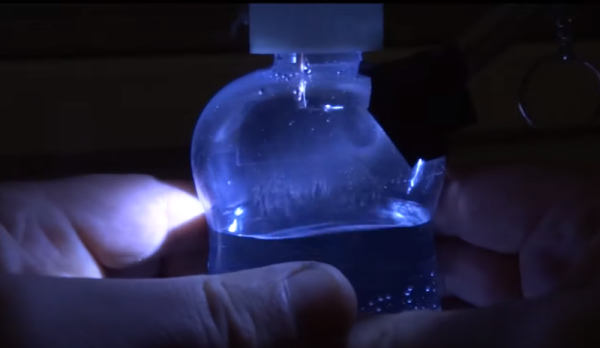
Have you ever seen a Wilson cloud chamber — a science experiment that lets you visualize ionizing radiation? How hard would it be to build one? If you follow [stoppi’s] example, not hard at all (German, Google Translate link). A plastic bottle. some tape, a flashlight, some water, hot glue, and — the only exotic part — a bit of americium 241. You can see the design in the video below and the page also has some more sophisticated designs including one that uses a CPU cooler. Even if you don’t speak German, the video will be very helpful.

You need to temper your expectations if you build the simple version, but it appears to work. The plastic bottle is a must because you have to squeeze it to get a pressure change in the vessel.

Continue reading “Maybe The Simplest Cloud Chamber” →