Where The Rubber Meets The Computer

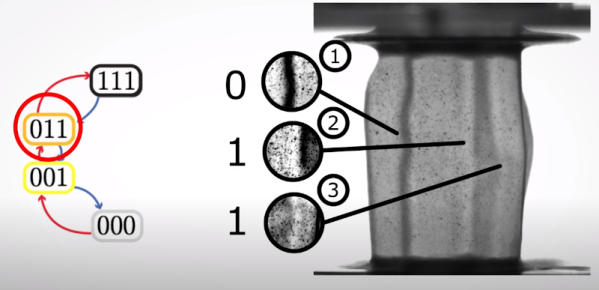
If you ever get a chance to go to Leiden, take it. It is a beautiful little city that hides some high-power university research. It also boasts the world’s first rubber computer. You won’t be running Crysis on it anytime soon, though. The fledgling computer has memory and can count to two — really more of a state machine. It is easier to watch the video below than try to fully explain it. Or you can read through the actual paper.

If you watch the video, you’ll see that deformation in the corrugated rubber structure is apparently repeatable and represent bits in the machine. Pressing and releasing pressure on the structure forms both input and clock and it is possible for the material to go from state A to B on compression, but when you release pressure, it reaches state C. The compression and the angle of the pressure allow for different input conditions. One example rubber state machine counts how many times you compress the piece of rubber.

What do you do with a piece of smart rubber? We don’t know. Maybe if you wanted shoes to count steps so you could transmit the count once a minute to save on battery? The researchers have admitted they don’t have any specific applications in mind either, but presume someone will want to use their work.

Of course, the video’s title: “The Rubber Computer” is a bit of hyperbole, but we can forgive it. Most people wouldn’t get “The Rubber Finite State Machine.” While mechanical computing might seem a bit passe, turns out at the molecular level it may become very important. Besides, you can make a computer out of cardboard (or simulate that computer in an FPGA or spreadsheet, if you prefer).
Continue reading “Where The Rubber Meets The Computer”

Hydrogen Generation Made Easy

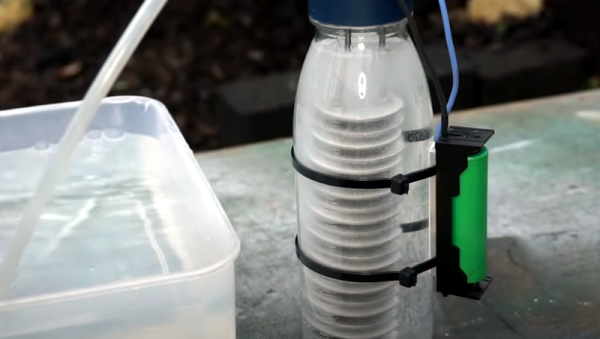
Even if you never want to generate hydrogen, [Maciej Nowak’s] video (embedded below) is interesting to watch because of the clever way the electrode is formed from stainless steel washers. You’ll need heat shrink tubing, but you ought to have that hanging around anyway. Building the electrode using the techniques in the video results in a lot of surface area which is important for an electrochemical reaction.

A standard rechargeable cell provides power for the generator which resides in a modified plastic bottle. The overall build looks good even though it is all repurposed material.

Continue reading “Hydrogen Generation Made Easy”

Concrete With 3D Printed Foam Forms

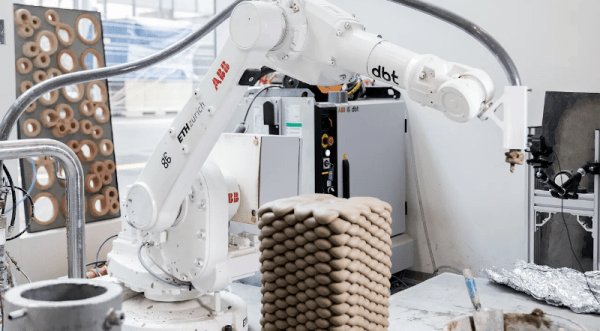
The latest 3D printing application?  Forming concrete. That’s according to a team at ETH Zurich who claims that construction with foam forms cuts concrete usage up to 70%. It also offers improved insulation properties. You can see a video about the process, below.

Typical concrete work relies on a form often made with wood, steel, or plastic. That’s easy to do, but hard to make complex shapes. However, if you can create complex shapes you can easily put material where it adds strength and omit material where it doesn’t carry load. Using a robotic-arm 3D print technique, the researchers can lay out prefabricated blocks of foam that create forms with highly complex shapes. Continue reading “Concrete With 3D Printed Foam Forms”

Game Boy Camera Gets Ridiculously Good Lens

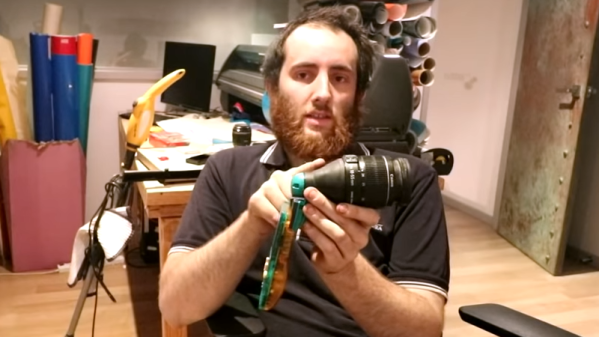
How do you get better pictures from a 20+ year old Game Boy Camera? How about marrying a DSLR lens to it? That’s what [ConorSev] did and, honestly, the results are better than you might expect as [John Aldred] mentioned in his post about the topic. You can check the camera out in the video below.

A 3D printed adapter lets you mount a Canon EF lens to the Game Boy Camera, a trick that we’ve seen in the past. [ConorSev] looked at the existing adapters floating around, and came up with the revised version you see here. There was still the problem of actually getting the images off the Camera cartridge, but luckily, this isn’t exactly unexplored territory either.

While there might not be anything new with this project, using a high-quality lens on the toy makes for some interesting photographs, and you wonder how far you can push this whole idea. Of course, no matter how much of a lens you put on the front, you still have to contend with the original image sensor which has hardly well. Still, we were impressed at how much better things looked with a high-quality zoom lens.

We bet the original designer of the Game Boy Camera never imagined it would have the kind of zoom capability you can see in the video. We love seeing these little handhelds pushed beyond their limits. Cryptomining? No problem. Morse code? Piece of cake.

Continue reading “Game Boy Camera Gets Ridiculously Good Lens”

Your Next Oscilloscope Might Be Optical

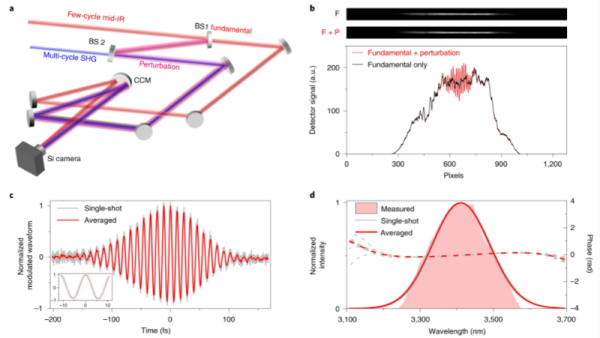
What’s better than a 100MHz scope? How about an optical one? Researchers at the University of Central Florida think that’s just the ticket, and they’ve built an oscilloscope that can measure the electric field of light. You can find the full paper online.

Reading the electrical field of light is difficult with traditional tools because of the very high frequency involved. According to [Michael Chini], who worked on the new instrument, the oscilloscope can be as much as 10,000 times faster as a conventional one.

The measurement of a few cycles of light requires some special techniques as you might expect. According to the paper:

[A]n intense fundamental pulse with a central wavelength of 3.4 µm creates charge packets in the pixels of a silicon-based image sensor via multiphoton excitation, leading to detectable photocurrents. The probability of excitation is perturbed by the field of a weak perturbation pulse, leading to a modulation in the excitation probability and therefore in the magnitude of the detected photocurrent. We have previously shown that, for collinear fundamental and perturbation pulses, the dependence of the modulation in the excitation probability on the time delay between the two pulses encodes the time-varying electric-field waveform of the laser pulse. Here, by using a crossed-beam geometry with cylindrical focusing, we map the time delay onto a transverse spatial coordinate of the image sensor chip to achieve single-shot detection.

Did you get that? In other words, instead of measuring the light pulse directly, they measure the change it makes on another known signal. We think…

Unless you’re moving high-speed data across fiber optic, we aren’t sure you really need this. However, the concept is intriguing and not previously unheard of. For example, we’ve seen capacitance meters that measure the change in frequency caused by adding an unknown capacitor into an existing oscillator.

If you want something more conventional, maybe look at some popular scopemeters. Of course, something this high speed might be able to apply time-domain reflectometry to fiber optics. Maybe.

Error Codes And The Law Of Least Astonishment

Do you know the law of least astonishment? I am not sure of its origin, but I first learned it from the excellent “Tao of Programming.” Simply put, it is the principle that software should always respond to the users in a way that least astonishes them. In other words, printing a document shouldn’t erase it from your file system.

Following the law of least astonishment, what should a program do when it hits a hard error? You might say that it should let the user know. Unfortunately, many systems just brush it under the rug these days.

I think it started with Windows. Or maybe the Mac. The thinking goes that end users are too stupid or too afraid of error codes or detailed messages so we are just leaving them out. Case in point: My wife’s iPhone wouldn’t upload pictures. I’m no expert since I carry an Android device, but I agreed to look at it. No matter what I tried, I got the same useless message: “Can’t upload photos right now. Please try again later.” Not only is this not very informative, but it also implies the problem is in something that might fix itself later like the network.

The real culprit? The iCloud terms of service had changed and she had not accepted the new contract. I have a feeling it might have popped up asking her to do that at some point, but for whatever reason she missed it. Until you dug into the settings and checked the box to agree to those terms, “later” was never going to happen.

Continue reading “Error Codes And The Law Of Least Astonishment”

[Kerry Wong] Is Really Into Scope Meters

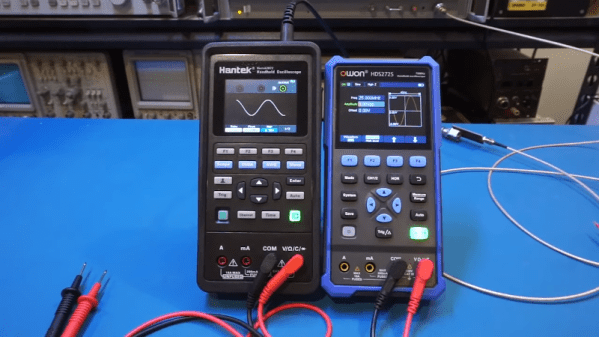
If a combination multimeter and oscilloscope is on your holiday shopping list this year, you might want to have a look at some of [Kerry Wong’s] recent videos on the subject. Over several videos he looks at — inside and out — an OWON HDS272S and a Hantek 2D72, both reasonably inexpensive entries in the field. Both instruments are similar and have a few variants depending on the frequency capability and the addition of a waveform generator.

There are several videos on the Hantek device that are a few months old, then some recent videos — like the one below — on the OWON device along with some comparison videos.

Continue reading “[Kerry Wong] Is Really Into Scope Meters”